All species › Passerines › Antbirds › Klages's Antbird
Klages's Antbird | Drymophila klagesi
Klages' miervogel | Tiluchí de Klages | Trovoada-de-klages
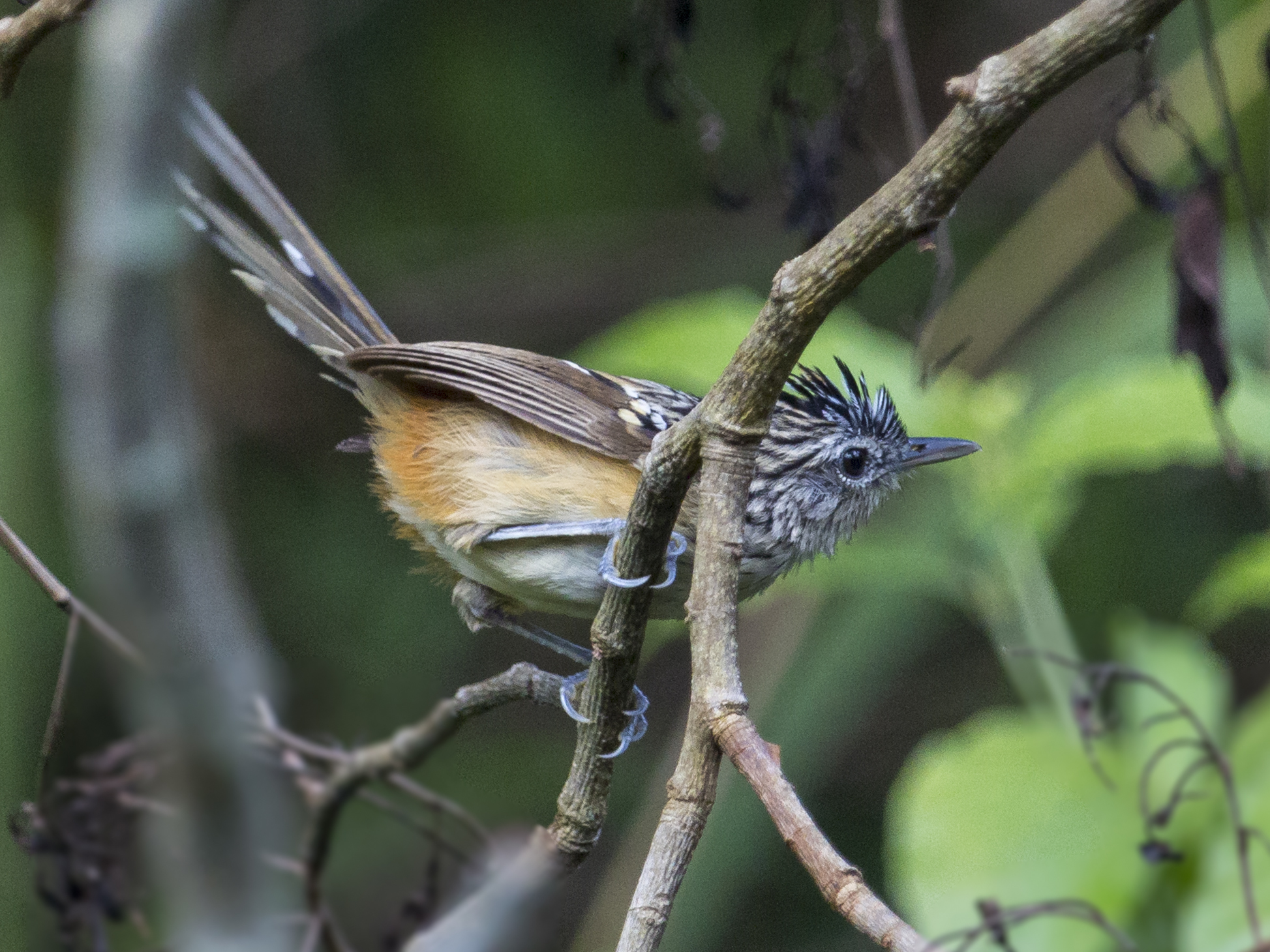
Klages's Antbird is a small, long-tailed antbird with black-and-white streaked plumage and orange-brown flanks that lives almost always in bamboo. It belongs to a group of closely related species that were formerly treated together as one species, Long-tailed Antbird, and were separated mainly on the basis of their songs. In the guide area it lives only in the mountains of Venezuela.
Voice
The male's song begins with two clear, rhythmic notes, followed by two wheezy, breathy phrases. The female often adds a soft, descending series of notes halfway through.
Recording: Bram Vogels — CC BY-NC-SA 4.0 · xeno-canto
Identification
15 cm, with a long, graduated tail with broad white tips. The male has a black crown and back with thin white streaks (the centre of the crown unstreaked), a rufous rump and black wing coverts with two white wing bars. Face, throat and breast are white with thin black streaks; flanks and undertail coverts are bright tawny-orange. The female has the same pattern in duller colours and with fainter, sparser streaking: olive upperparts with black streaks, a buff-tinged breast and a dull cinnamon belly.
Confusion species
No other species of the genus Drymophila occurs in the Venezuelan part of the guide area. Long-tailed Antbird Drymophila caudata of the Eastern Andes of Colombia, outside the guide area, has almost the same plumage and differs mainly in song. Streaked antwrens of the genus Myrmotherula are smaller, with a short tail, and do not live in montane bamboo.
Habitat
Understorey and midstorey of montane evergreen and secondary forest, especially in bamboo thickets, less often in vine tangles and shrubby forest edges, in Venezuela between about 500 and 1500 m. It lives in pairs and searches for insects and other small arthropods among bamboo leaves and twigs. Little is known about the nest.
Where the bird is most at home, classified by the vegetation units of Amazonia and the Guianas.


Range and movements
Venezuela: in the Serranía de Perijá in Zulia, in the Andes of Táchira and Mérida north-east to Lara, and locally in the Coastal Range, where it is common on the Paria Peninsula in Sucre. Not in Brazil, Guyana, Suriname or French Guiana. Resident. Outside the guide area in north-eastern Colombia, in the Perijá and the Andes of Norte de Santander.
- Resident
- dark = core range, pale = thinly spread
How and when to look
Search bamboo thickets at forest edges in the Andes of Mérida or Táchira or on the Paria Peninsula, and listen in the morning for the song with its breathy phrases; pairs often sing in duet.
Conservation status
Least Concern. The population is thought to be stable; the species occurs in several protected areas and also uses secondary forest. Clearance of montane forest with bamboo in the Andes and the Coastal Range reduces its habitat locally.
Scientific name
Drymophila klagesi | Hellmayr & Seilern-Aspang, 1912
Hellmayr & Seilern-Aspang described the species in 1912 and placed it straight away in the genus where it still stands. The genus Drymophila was introduced in 1824 by Swainson. Drymophila is Greek, from drumos 'wood, copse' and philos 'lover': 'woodland-lover'. klagesi honours the American collector Samuel Milton Klages (1875–1957), who collected for many years in Venezuela and Amazonia. The specimen the first description was based on came from Los Palmales, Sucre, Venezuela.