All species › Tubenoses › Northern storm petrels › Leach's Storm-Petrel
Leach's Storm-Petrel | Hydrobates leucorhous
Vaal stormvogeltje | Paíño boreal | Painho-de-cauda-furcada
Leach's Storm-Petrel breeds in the northern Atlantic and Pacific Oceans and is one of the most widespread storm-petrels in the world. Outside the breeding season birds from the Atlantic colonies move to the tropical Atlantic, among other places to the waters off the Guianas and northern and north-eastern Brazil. There they mostly stay far out to sea, over the edge of the continental shelf and beyond, and rarely come within sight of land.
Voice
Silent at sea. At the colonies a rattling, cackling call is given at night, and a long purring sound comes from the burrows.
Recording: Doug Hynes — CC BY-SA 4.0 · converted to mono · xeno-canto
Identification
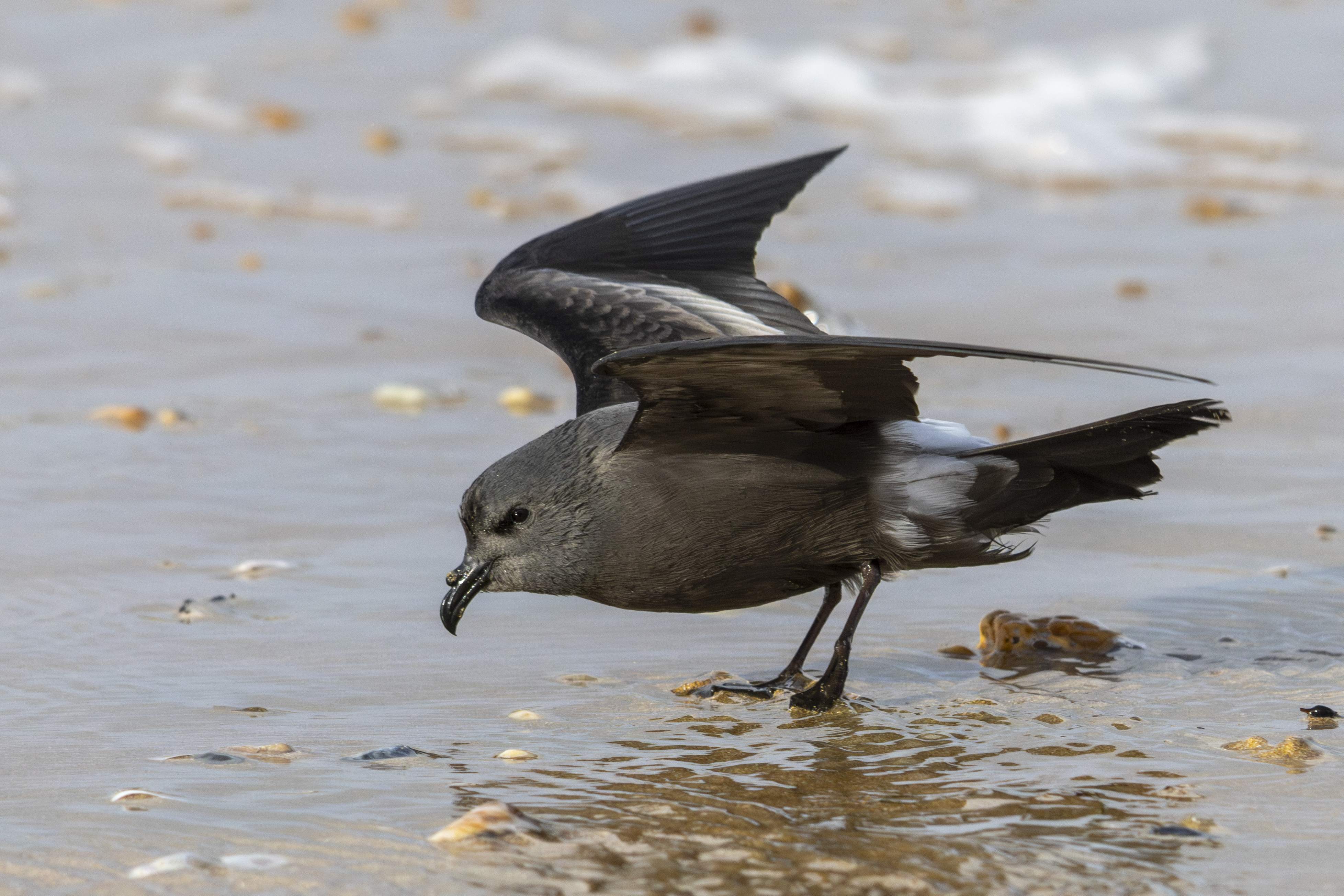
19–22 cm, a medium-sized storm-petrel with long, angled wings and a clearly forked tail. The plumage is dark brownish black, with a broad pale bar across the upperwing that reaches almost to the leading edge. In the Atlantic almost all birds have a white rump, often divided in two by a grey central line; dark-rumped birds occur mainly in the Pacific. Flight is bounding and erratic, with sudden changes of direction, recalling a nightjar. The sexes are alike and juveniles resemble adults.
Confusion species
Band-rumped Storm Petrel Hydrobates castro has a narrower, straight, undivided rump band, a less forked tail, a shorter wing bar and a calmer, shearing flight. Wilson's Storm-Petrel Oceanites oceanicus, the most numerous storm-petrel in the guide area, is smaller, with rounder wings, a square tail, feet that project beyond the tail and a fluttering flight low over the water. European Storm-Petrel Hydrobates pelagicus is much smaller, with a white stripe across the underwing.
Habitat
Open ocean far offshore, especially over deep water, along the edge of the continental shelf and along boundaries between water masses; scarce over shallow inshore water. It picks small fish, crustaceans and other plankton from the surface in flight, mainly at night. It breeds in self-dug burrows in the ground on islands outside the guide area.
Where the bird is most at home, classified by the vegetation units of Amazonia and the Guianas.


Range and movements
French Guiana and Suriname: most records in the guide area, mainly at sea over and beyond the edge of the continental shelf. Guyana and Venezuela: in smaller numbers at sea, in Venezuela also in the Caribbean Sea. Brazil: at sea off the north and north-east, scarcer further south; stranded or weakened birds are sometimes found, including on Fernando de Noronha. Outside the guide area the species breeds in the northern Atlantic, mainly in eastern Canada, and in the northern Pacific; Atlantic birds winter in the tropical Atlantic, on both sides of the ocean.
- Summer visitor (c. Apr–Sep)
- dark = core range, pale = thinly spread
How and when to look
The species is rarely seen from shore. Pelagic trips are scarce in the guide area; most records come from seabird surveys, research vessels and fishing boats far off French Guiana, Suriname and northern Brazil, between November and April. After storms weakened birds are sometimes found on the coast. Look for the forked tail, the long wing bar and the bounding flight.
Conservation status
Vulnerable (VU). The largest colonies, in eastern Canada, have declined sharply in recent decades through predation by gulls and mammals, artificial light on oil platforms and in towns, and changes in food supply at sea. Oil and gas fields are also being developed off the Guianas, where lighting at sea may pose a similar risk.
Scientific name
Hydrobates leucorhous | (Vieillot, 1818) (GBIF: Oceanodroma leucorhoa)
Vieillot described the species in 1818 as Procellaria leucorhoa; because it was later moved to another genus, the author and year stand in brackets. The genus Hydrobates was introduced in 1822 by Boie. Hydrobates is Greek, from hudro- 'water' and batēs 'walker': 'water walker'. leucorhous is Greek, from leukos 'white' and orrhos 'rump', after the white rump band. The specimen the first description was based on came from the coast of Picardy.