All species › Gamebirds › New World quail › Marbled Wood Quail
Marbled Wood Quail | Odontophorus gujanensis
Gemarmerde tandkwartel | Corcovado común | Uru-corcovado
The Marbled Wood Quail is the most widespread wood quail of Amazonia and the Guiana Shield. Groups of five to ten birds walk close together over the forest floor. At dawn and dusk pairs sing a fast, rhythmic duet that carries far through the forest.
Voice
A fast, rhythmic and loud duet in which two birds interlock their calls so that it sounds like a single continuous, rolling series, something like corcorovado-corcorovado, often repeated for minutes. Also soft, squeaky contact calls within the group.
Recording: Jose Martin — CC BY-NC-SA 4.0 · xeno-canto
Identification
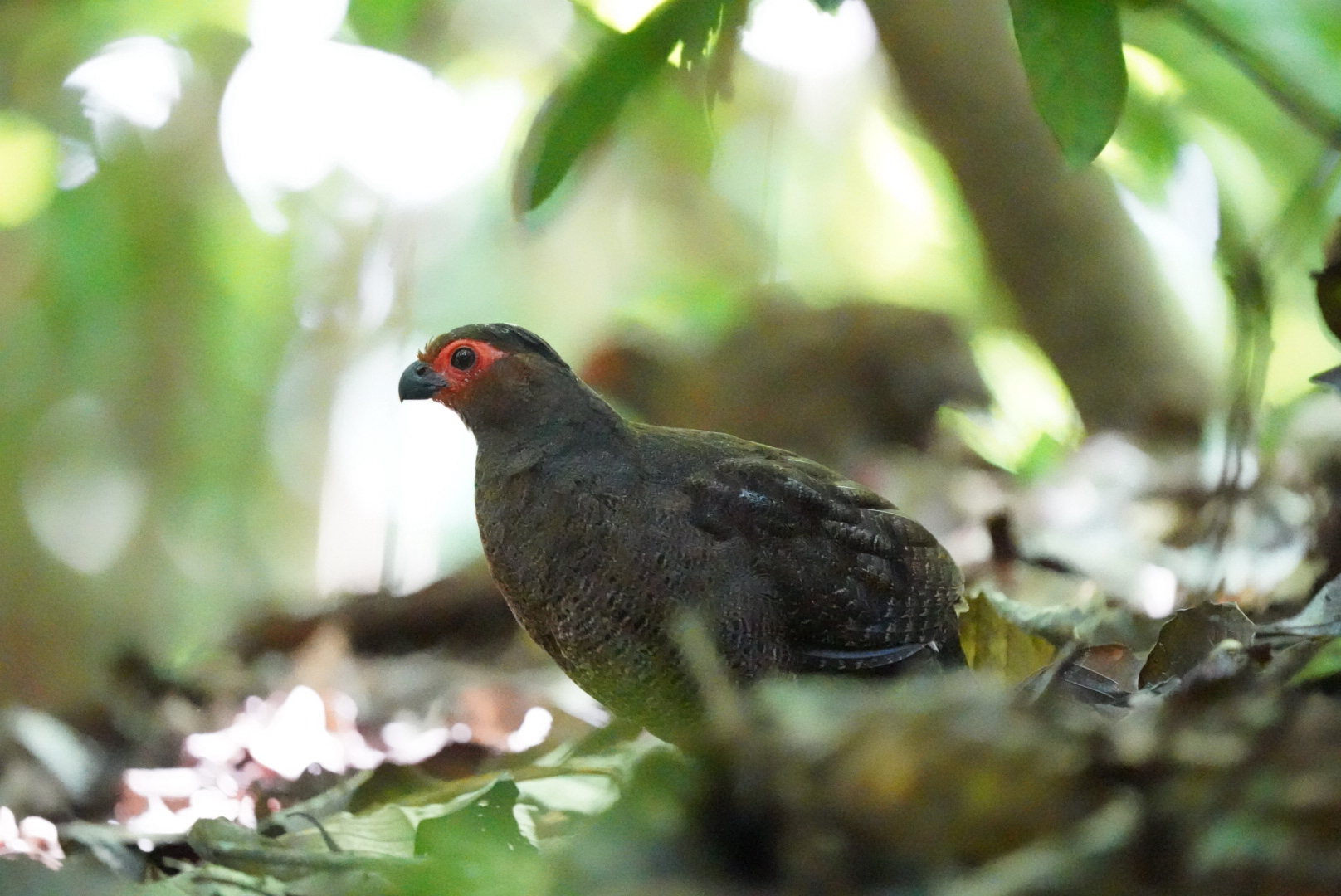
25–28 cm, plump, with a short tail, a short, stout bill and a short, rounded crest. The plumage is almost uniformly dark brown, finely vermiculated and barred black and ochre, with pale shaft streaks on the back and wings. Around the eye is a patch of orange-red bare skin. The underparts are greyish brown, finely barred dark. The sexes are alike; juveniles are duller, with less bare skin around the eye.
Confusion species
Starred Wood Quail Odontophorus stellatus, which partly shares the same forest in western Brazilian Amazonia south of the Amazon, has a rufous (male) or blackish (female) crest, a grey nape and a rufous breast with small white spots. Tinamous such as Variegated Tinamou Crypturellus variegatus have a thin bill, no crest and almost no tail, and usually walk alone.
Habitat
The floor of humid terra firme lowland forest, also mature secondary forest and forest on the lower slopes of the Guiana Highlands, up to about 1200 m. Groups walk slowly over the forest floor, scratch in the leaf litter and eat seeds, fallen fruit, insects and other invertebrates. It roosts on a branch above the ground. The nest is on the ground, sometimes partly roofed.
Where the bird is most at home, classified by the vegetation units of Amazonia and the Guianas.



Range and movements
In Brazil throughout almost all of Amazonia, north and south of the Amazon, south to Rondônia and northern Mato Grosso and east to eastern Pará and western Maranhão. In Venezuela south of the Orinoco, in Bolívar, Amazonas and Delta Amacuro, and with a separate subspecies locally in the north-west. In Guyana, Suriname and French Guiana in the forest of the interior. Outside the guide area from Costa Rica and Panama to Colombia, Ecuador, Peru and Bolivia.
- Resident
- dark = core range, pale = thinly spread
How and when to look
Listen at dawn or dusk for the rolling duet in lowland forest, for example in the forests around Manaus, in the interior of the Guianas or in southern Bolívar. Groups walk away as soon as they hear something; waiting quietly on a forest trail is more productive than following them.
Conservation status
Least Concern. The population is declining because of deforestation and hunting, but the species still occupies a very large area.
Scientific name
Odontophorus gujanensis | (Gmelin, 1789)
Gmelin described the species in 1789 as Tetrao gujanensis; because it was later moved to another genus, the author and year stand in brackets. The genus Odontophorus was introduced in 1816 by Vieillot. Odontophorus is Greek, from odous, odontos 'tooth' and -phoros 'bearing': 'tooth-bearer', after the serrated edge of the lower mandible. gujanensis means 'of Guiana', after the origin of the type specimen. The specimen the first description was based on came from Cayenne, French Guiana.