All species › Passerines › Wrens › Merida Wren
Merida Wren | Cistothorus meridae
Páramowinterkoning | Cucarachero de Mérida | Corruíra-de-mérida
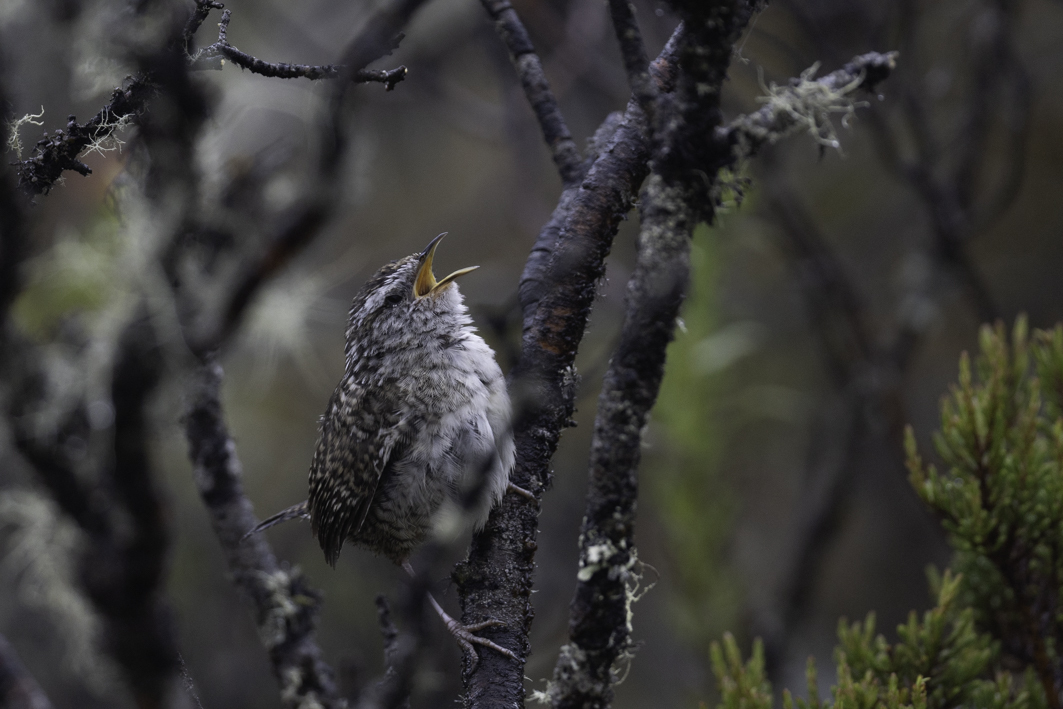
The Merida Wren is a small, streaked wren of the páramo, the treeless high mountain land above the treeline. It occurs only in the Andes of Venezuela and is therefore an endemic species of the guide area. It lives among frailejones, small shrubs and tall grass.
Voice
The song is a varied series of buzzy, rattling notes and short trills, mixed with clear notes, often from the top of a shrub or a frailejón. The call is a dry, rasping chrr.
Recording: Joe Klaiber — CC BY-NC-SA 4.0 · xeno-canto
Identification
10 cm. Small, with a short, often cocked tail and a thin bill. Crown brown, clear whitish supercilium. Back brown with bold black and white streaks, wings and tail barred dark. Underparts whitish, flanks and undertail coverts buff, the flanks faintly barred dark. Male and female alike. Young birds are duller and less sharply streaked.
Confusion species
Grass Wren Cistothorus platensis is warmer buff, has a less obvious supercilium and usually lives lower, in montane and wet grassland below the páramo. Mountain Wren Troglodytes solstitialis has an unstreaked rufous-brown back and a buff supercilium and lives in montane forest, not in open páramo.
Habitat
Páramo with frailejones (Espeletia), low shrubs, tall grass and boggy places, and the transition to scrub at the treeline, roughly from 3000 to 4100 m. It forages low in the vegetation and on the ground for insects and spiders. The nest is a ball of grass with a side entrance, low in a tussock or small shrub.
Where the bird is most at home, classified by the vegetation units of Amazonia and the Guianas.

Range and movements
Venezuela: only in the páramos of the Andes in Trujillo, Mérida and northern Táchira. Not in Brazil or the Guianas. It does not occur outside the guide area.
- Resident
- dark = core range, pale = thinly spread
How and when to look
Found in the páramo of Sierra Nevada National Park and the Sierra de La Culata, for example around Pico El Águila and Laguna de Mucubají. In the morning the bird often sings from a frailejón or small shrub; afterwards it drops into the grass.
Conservation status
Least Concern (IUCN). The range is small and limited to the Venezuelan Andes. Much of it lies in national parks, but fires, grazing, the expansion of potato farming and climate change threaten the páramo.
Scientific name
Cistothorus meridae | Hellmayr, 1907
Hellmayr described the species in 1907 and placed it straight away in the genus where it still stands. The genus Cistothorus was introduced in 1851 by Cabanis. Cistothorus is Greek, from kistos 'shrub, rock-rose' and thoos 'nimble, quick': 'nimble shrub-bird'. meridae refers to Mérida in Venezuela, where the species was discovered in the páramo. The specimen the first description was based on came from El Loro (3,000 m), Mérida, Venezuela.