All species › Passerines › Antbirds › Natterer's Slaty Antshrike
Natterer's Slaty Antshrike | Thamnophilus stictocephalus
Natterers mierklauwier | Batará pizarroso de Natterer | Choca-de-natterer
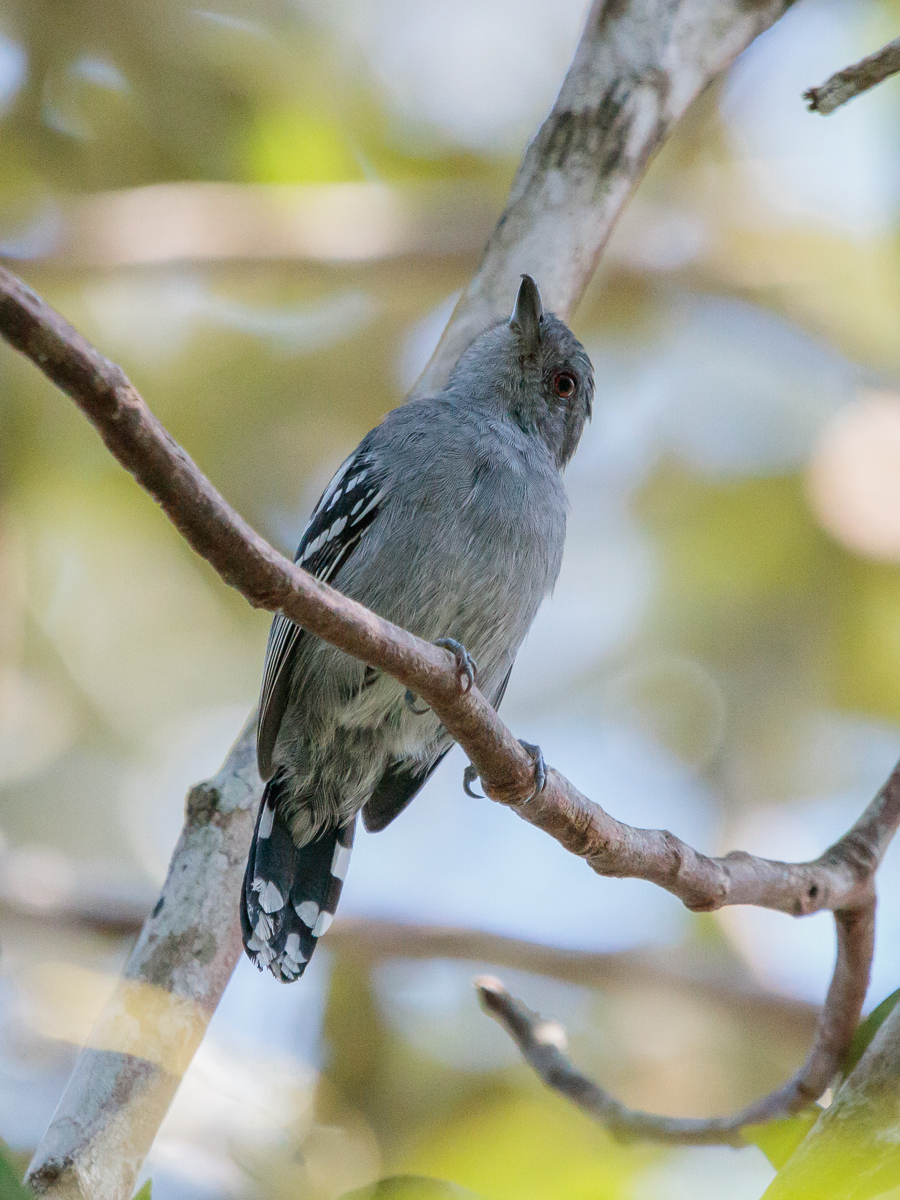
Natterer's Slaty Antshrike is a small grey antshrike with a black crown and white-spotted wings from southern Amazonia. It replaces Northern Slaty Antshrike south of the Amazon and reaches into the transition zone towards the Cerrado. The female is reddish brown with a rufous crown.
Voice
The song is a series of level, nasal notes that starts slowly and speeds up into a bouncing rattle lasting about 3–4 seconds. Calls are short and long caw notes and an abrupt growl.
Recording: JAYRSON ARAUJO DE OLIVEIRA — CC BY-NC-SA 4.0 · converted to mono · xeno-canto
Identification
14–15 cm. Male: forehead black with grey spots, crown black, face grey; back mixed black and grey; wings black with white spots and edges; tail black with white tips; underparts grey with a whitish belly. Female: crown rufous, upperparts reddish yellow-brown, scapulars dark brown, wings dark brown with white spots on the coverts; underparts a mix of clay-brown and grey, paler on throat and belly.
Confusion species
Northern Slaty Antshrike Thamnophilus punctatus north of the Amazon is almost identical; the Amazon separates the two. Bolivian Slaty Antshrike Thamnophilus sticturus in western Mato Grosso is also very similar; the male has a grey forehead and a greyer back with little black. Planalto Slaty Antshrike Thamnophilus pelzelni lives farther east, east of the Tocantins, in the Cerrado and Caatinga. Plain-winged Antshrike Thamnophilus schistaceus lacks the white wing spots and has a red iris.
Habitat
Along the Amazon in patches of forest on white sand, edges of humid evergreen forest and openings in the forest, such as treefall gaps. Farther south in semi-deciduous forest and gallery forest in the transition zone towards the Cerrado. From sea level to 700 m. Pairs forage low to mid-height for insects. The nest is an open cup in a fork.
Where the bird is most at home, classified by the vegetation units of Amazonia and the Guianas.




Range and movements
Brazil: south of the Amazon between the Madeira and the Tocantins, in southern Amazonas and Pará, and south-west into Rondônia and northern and western Mato Grosso. Not in Venezuela, Guyana, Suriname or French Guiana. Outside the guide area only in north-eastern Bolivia (Beni and the Serranía de Huanchaca in Santa Cruz).
- Resident
- dark = core range, pale = thinly spread
How and when to look
Look in patches of white-sand forest and at forest edges along the south bank of the Amazon, for example around Santarém and Alter do Chão, and in gallery forest and forest edges in northern Mato Grosso. The bouncing rattle often comes from dense growth at the edge.
Conservation status
Least Concern. Fairly common over a large range. In the south the range largely coincides with the arc of deforestation, where much forest is being turned into pasture and soybean fields; as a species of forest edges it partly persists there.
Scientific name
Thamnophilus stictocephalus | Pelzeln, 1868
Pelzeln described the species in 1868 and placed it straight away in the genus where it still stands. The genus Thamnophilus was introduced in 1816 by Vieillot. Thamnophilus is Greek, from thamnos 'bush' and philos 'loving': 'bush-lover'. stictocephalus is Greek, from stiktos 'spotted' and kephalē 'head', after the small white spots on the head. The specimen the first description was based on came from São Vicente, Mato Grosso, Brazil.