All species › Gamebirds › Guans, curassows and chachalacas › Nocturnal Curassow
Nocturnal Curassow | Nothocrax urumutum
Nachthokko | Paujil nocturno | Urumutum
The Nocturnal Curassow is the smallest curassow and the only one that is mainly active at night. By day it hides in dense Amazonian lowland forest; at night it sings from a branch with deep, hollow notes that carry far through the forest. In the guide area it lives in north-western Brazilian Amazonia and southern Venezuela.
Voice
A series of deep, hollow, humming notes, somewhat owl-like, for example oom, oom-oom… oom-hoo, given from a branch in the middle storey of the forest. Sings mainly at night, most often by moonlight and early in the rainy season.
Recording: Marco Andrés Urvina Alejandro — CC BY-NC-SA 4.0 · shortened to the first 60 s, mono · xeno-canto
Identification
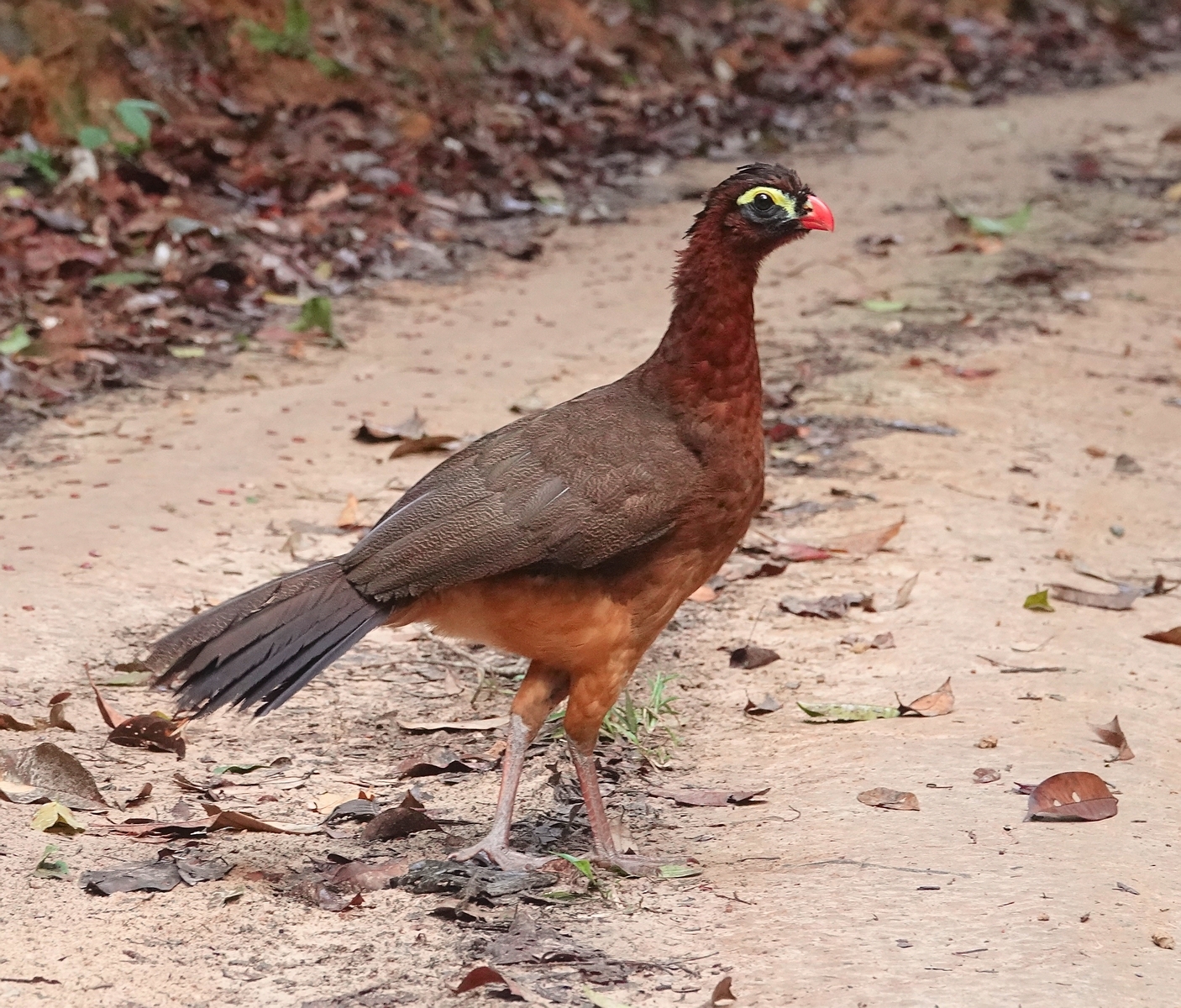
58–66 cm. A rather slim curassow with a crest of black, forward-curled feathers. Head, neck and underparts are rufous-chestnut, the upperparts darker brown with fine black vermiculation. The tail is blackish with a pale buff terminal band. There is bare skin around the eye, yellow above the eye and bluish below. The bill is orange-red, the legs greyish to pinkish. The sexes are alike.
Confusion species
Razor-billed Curassow Mitu tuberosum and Crestless Curassow Mitu tomentosum are much larger, mainly black, with a red bill and red legs. Spix's Guan Penelope jacquacu is dark olive-brown with white streaks on the breast and neck and a red throat wattle, and is active by day. In the dark the song is the best feature.
Habitat
Tall humid lowland forest on terra firme and in seasonally flooded forest, often near streams, also palm swamp forest; mostly below about 600 m. By day it rests on the ground in dense cover or in cavities under fallen trees. It eats fallen fruit, seeds and leaves. The nest is a platform of sticks in a tree, usually with two eggs.
Where the bird is most at home, classified by the vegetation units of Amazonia and the Guianas.




Range and movements
In Brazil in the west of the state of Amazonas, mainly in the Rio Negro basin and along the Solimões and the Japurá; records south of the Solimões are scarce. In Venezuela in the south of Amazonas state, along the upper Orinoco and the Casiquiare. Absent from Guyana, Suriname and French Guiana. Outside the guide area in the Amazonian lowlands of Colombia, Ecuador and Peru.
- Resident
- dark = core range, pale = thinly spread
How and when to look
At night, listen from forest trails in large, undisturbed forest, for example in the Rio Negro basin, for the deep, hollow notes; the species sings mainly by moonlight. With a torch a singing bird can sometimes be found on a branch; by day it is mostly met by chance when it flushes from the forest floor.
Conservation status
Least Concern. The population declines locally through hunting, but the range is large, largely forested and thinly inhabited.
Scientific name
Nothocrax urumutum | (Spix, 1825)
Spix described the species in 1825 as Crax urumutum; because it was later moved to another genus, the author and year stand in brackets. The genus Nothocrax was introduced in 1856 by Burmeister. Nothocrax is Greek, from nōthēs 'sluggish' and Crax 'curassow', after its nocturnal, sluggish habits; possibly also nothos 'false'. urumutum is the Tupí name urú mutúm, 'night or black curassow', for this species. The specimen the first description was based on came from Rio Negro, Brazil.