All species › Oilbirds › Oilbird › Oilbird
Oilbird | Steatornis caripensis
Vetvogel | Guácharo | Guácharo
The Oilbird is the only member of its family: a large, rufous nocturnal bird that breeds in colonies in caves and feeds exclusively on fruit. In the darkness of the cave it navigates by audible clicks, a form of echolocation that is rare among birds. At night it flies tens of kilometres to pluck the fruit of palms and laurels.

Voice
In and near the cave a deafening chorus of hoarse screams, shrieks and snarling sounds. In addition, short, dry clicks that the bird uses for echolocation when flying in the dark and that are clearly audible to people.
Recording: JAYRSON ARAUJO DE OLIVEIRA — CC BY-NC-SA 4.0 · xeno-canto
Identification
43–48 cm, with long, broad wings, a long, graduated tail and a short, strongly hooked bill surrounded by long bristles. The plumage is warm rufous-brown, with small white, black-edged spots on the head, wings and underparts; the spots on the wings and tail are the largest. The eyes are large and dark and shine red in torchlight. The legs are short and weak. The sexes are alike; juveniles are duller.
Confusion species
Potoos, such as Great Potoo Nyctibius grandis and Long-tailed Potoo Nyctibius aethereus, are grey or brown and mottled without white spots, have a broad, unhooked bill and hunt insects from a fixed perch. Nightjars are much smaller. Inside the cave the Oilbird cannot be confused with any other bird.
Habitat
Breeds and roosts in caves, gorges and deep ravines, from the lowlands to roughly 3000 m. In the guide area the largest colonies are in limestone caves in the mountains of northern Venezuela and in the Andes; smaller groups live in caves and rock crevices of the Guiana Shield. It forages at night in humid lowland, foothill and montane forest, plucking fruit of palms, laurels and incense trees in flight; the seeds are later regurgitated in the cave. The nest is a mound of regurgitated fruit pulp on a ledge in the cave; the young become very fat.
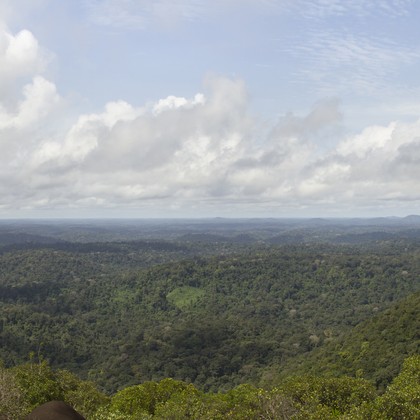
Where the bird is most at home, classified by the vegetation units of Amazonia and the Guianas.




Range and movements
In Venezuela scattered in the mountains north of the Orinoco: in the Cordillera de la Costa, with the large colony of the Cueva del Guácharo near Caripe in Monagas, and in the Andes and the Serranía de Perijá; south of the Orinoco locally in the tepui region of Bolívar and Amazonas. In Guyana in the interior, mainly in the highlands along the border with Venezuela. In Brazil few records, only from the far north, in Roraima and northern Amazonas. In Suriname and French Guiana very few records, probably of wandering birds. Outside the guide area on Trinidad, in eastern Panama and in the Andes from Colombia to Bolivia.
- Resident
- dark = core range, pale = thinly spread
How and when to look
Visit the Cueva del Guácharo near Caripe in north-eastern Venezuela, where the cave can be entered with a guide, and watch the entrance just after sunset, when the birds fly out. Inside the cave use only dimmed light and stay on the paths.
Conservation status
Least Concern. The colonies depend on undisturbed caves and on forest within the foraging range; disturbance of caves, the harvesting of fat nestlings and deforestation around the caves locally threaten colonies. The Cueva del Guácharo was Venezuela's first natural monument and lies within a national park.
Scientific name
Steatornis caripensis | Humboldt, 1817
Humboldt described the species in 1817 and placed it straight away in the genus where it still stands. The genus Steatornis was introduced in 1814 by Humboldt. Steatornis is Greek, from stear, steatos 'fat' and ornis 'bird', after the fat nestlings once rendered down for oil. caripensis means 'from Caripe', after the Cueva del Guácharo near Caripe in Venezuela, where Humboldt found the bird. The specimen the first description was based on came from caves of Caripe, Venezuela.