All species › Passerines › Manakins › Olive Manakin
Olive Manakin | Xenopipo uniformis
Roraimamanakin | Saltarín oliváceo | Dançarino-oliváceo
The Olive Manakin is a fairly large, plain olive-green manakin of the slopes of the tepuis. Male and female look alike, which is unusual within the family. The species occurs only in the highlands of the Guiana Shield, on the borders of Venezuela, Guyana and Brazil.

Voice
A high, thin, rising whistle, roughly tooo-ee, and short series of rapid notes. The species is often silent for long periods.
Recording: Joe Klaiber — CC BY-NC-SA 4.0 · xeno-canto
Identification
14 cm, with a fairly long tail for a manakin. Both sexes are uniform dark olive-green, the belly slightly greyer and paler olive. There are no wing bars or head markings. The eye is dark, the bill dark and fairly short, the legs dark. Young birds resemble adults.
Confusion species
The female Scarlet-horned Manakin Ceratopipra cornuta is smaller and shorter-tailed, with a slightly raised crown. The female Orange-bellied Manakin Lepidothrix suavissima is much smaller and brighter green with a yellowish belly. Black Manakin Xenopipo atronitens lives in the lowlands on white sand; the female is smaller and greyer olive. Small flycatchers such as elaenias have wing bars and perch upright.
Habitat
Humid montane forest, mossy cloud forest and lower, stunted forest on the slopes of the tepuis, mainly at forest edges and in clearings, from about 800 to 2200 m. It forages in the lower and middle levels on small fruit, including that of melastomes, and on insects. The nest is barely described.
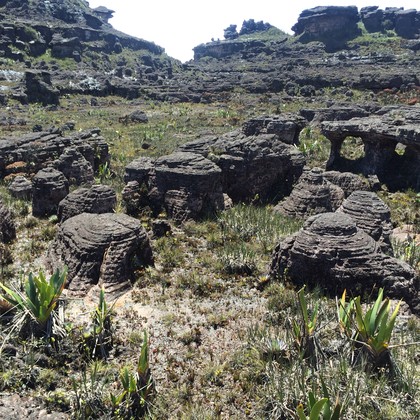
Where the bird is most at home, classified by the vegetation units of Amazonia and the Guianas.

Range and movements
Endemic to the Guiana highlands. In Venezuela in south-eastern Bolívar (Gran Sabana, Sierra de Lema and the surrounding tepuis) and on the high tepuis of Amazonas. In Guyana in the west, around Roraima and the Pakaraima Mountains. In Brazil only in the far north of Roraima and locally along the border with Venezuela. Not in Suriname and French Guiana.
- Resident
- dark = core range, pale = thinly spread
How and when to look
Search along the road through the Sierra de Lema to the Gran Sabana in Venezuela, in the upper part of the climb, where the birds forage at forest edges beside the road. Look for a dark, plain olive-green manakin without markings in fruiting shrubs.
Conservation status
Least Concern. The range is small, but the forest on the tepuis is largely intact and mostly far from roads; locally gold mining may damage forest.
Scientific name
Xenopipo uniformis | (Salvin & Godman, 1884)
Salvin & Godman described the species in 1884 as Chloropipo uniformis; because it was later moved to another genus, the author and year stand in brackets. The genus Xenopipo was introduced in 1847 by Cabanis. Xenopipo is Greek/New Latin, from xenos 'stranger' and pipo 'manakin': a strange, aberrant manakin. uniformis is Latin for 'uniform, plain', after the plain olive plumage. The specimen the first description was based on came from Mount Roraima, Venezuela.