All species › Passerines › Manakins › Orange-bellied Manakin
Orange-bellied Manakin | Lepidothrix suavissima
Oranjebuikmanakin | Saltarín ventrinaranja | Dançador-do-tepui
The Orange-bellied Manakin is a very small manakin of the foot and lower slopes of the tepuis. The male is black with a white forecrown, a pale blue rump and an orange belly. The species was long treated as a subspecies of White-fronted Manakin.
Voice
A short, high, slightly buzzy call, often repeated, and a rapid, dry trill.
Recording: Joe Klaiber — CC BY-NC-SA 4.0 · xeno-canto
Identification
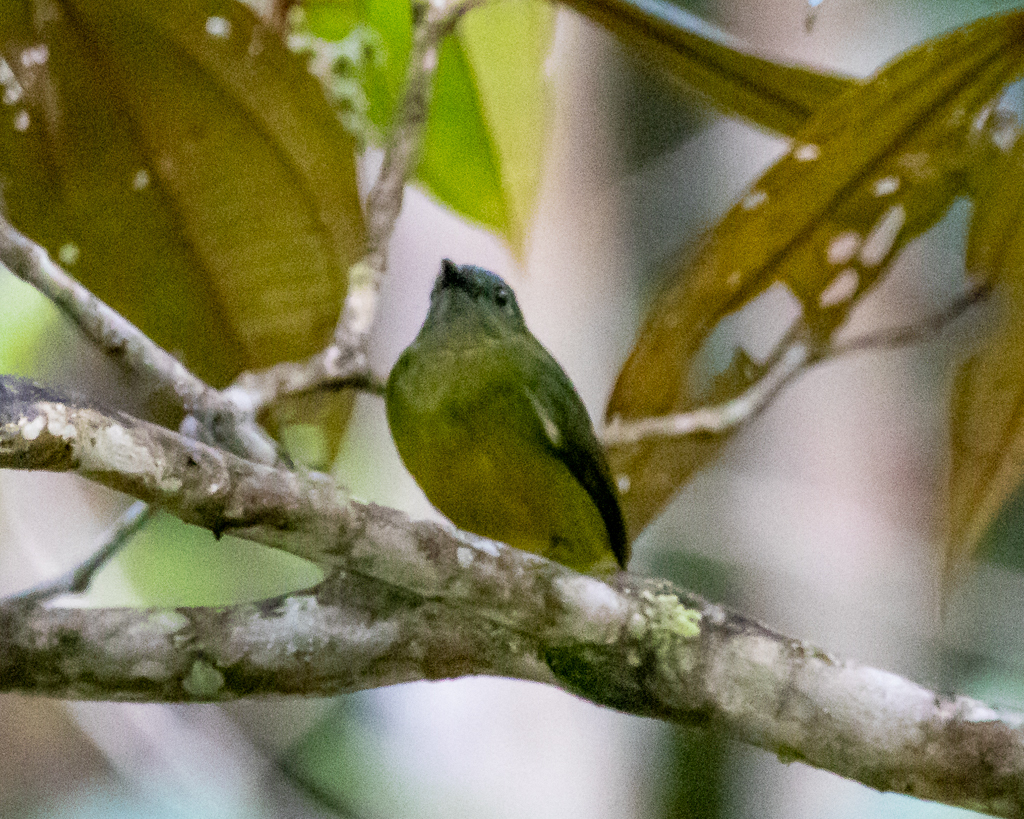
9 cm, with a short tail. The male is velvety black, with a white forecrown, a pale sky-blue rump and an orange belly that becomes yellower towards the rear. The female is green, paler and yellowish below. The legs are dark. Young males at first resemble the female.
Confusion species
White-fronted Manakin Lepidothrix serena lives further east in the lowlands of the Guianas; the male has a yellow belly with only an orange patch on the breast. The male White-crowned Manakin Pseudopipra pipra has the whole crown white and no blue rump. The female Olive Manakin Xenopipo uniformis is larger, darker olive and longer-tailed.
Habitat
The understorey of humid foothill and montane forest of the Guiana highlands, from about 400 to 1800 m, locally lower. It eats mainly small fruit, plucked in flight, and insects. Males display in loose groups on fixed branches in the understorey.
Where the bird is most at home, classified by the vegetation units of Amazonia and the Guianas.


Range and movements
In Venezuela in southern Bolívar and in Amazonas, on the slopes of the tepuis. In Guyana in the west, in the Pakaraima Mountains and adjacent hills. In Brazil in northern Roraima and locally along the border with Venezuela. Not in Suriname and French Guiana.
- Resident
- dark = core range, pale = thinly spread
How and when to look
Search along the road through the Sierra de Lema in Venezuela, in the middle part of the climb, in the understorey of forest beside the road. Males often sit on a low branch and give the high call repeatedly.
Conservation status
Least Concern. The forest of the Guiana highlands is largely intact; locally forest is lost to gold mining.
Scientific name
Lepidothrix suavissima | (Salvin & Godman, 1882)
Salvin & Godman described the species in 1882 as Pipra suavissima; because it was later moved to another genus, the author and year stand in brackets. The genus Lepidothrix was introduced in 1854 by Bonaparte. Lepidothrix is Greek, from lepis, lepidos 'scale' and thrix 'hair', after the scale-like, glossy crown feathers. suavissima is Latin for 'most delightful', superlative of suavis 'sweet, pleasant'. The specimen the first description was based on came from Merume Mountains and Bartica, Guyana.