All species › Passerines › Antbirds › Ornate Stipplethroat
Ornate Stipplethroat | Epinecrophylla ornata
Zwartkeelmiersluiper | Hormiguerito adornado | Choquinha-ornada
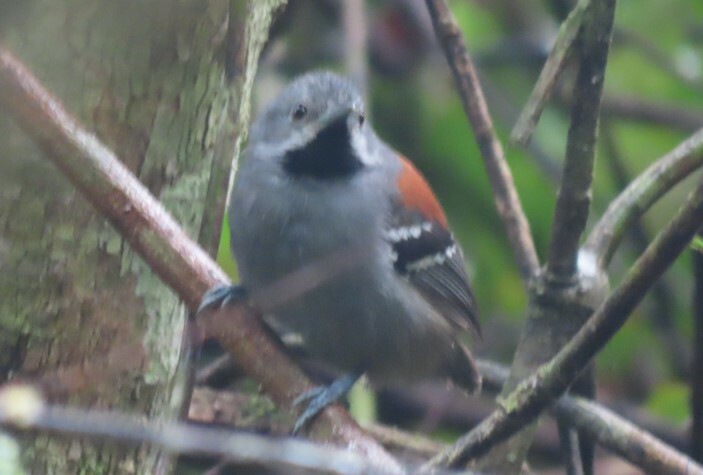
The Ornate Stipplethroat is an antwren of southern and western Amazonia, the male with a grey head and underparts and a black throat. It forages in dead leaves and in vine tangles, often with mixed flocks. The forms in the guide area differ mainly in female plumage.
Voice
The song is an extremely high, thin, rattling trill that drops in pitch at the end; in the west the drop is less marked. Calls are a short, emphatic pseet and a grating zee-zee-zee.
Recording: Juan Freile — CC BY-NC-SA 4.0 · converted to mono · xeno-canto
Identification
10–11 cm. The male has a grey head and underparts, a black throat with white stippling and blackish wing coverts with pale spots; the lower back and rump are rufous, less marked in the south of the guide area. The female has an olive-tinged cinnamon head and underparts and greyish olive-brown upperparts; in the west she has a blackish, white-stippled throat, in Rondônia and Mato Grosso a throat matching the underparts and buff rather than white wing spots.
Confusion species
White-eyed Stipplethroat Epinecrophylla leucophthalma has a grey-brown head and upperparts and a pale iris. Rufous-backed Stipplethroat Epinecrophylla haematonota has an olive-brown crown and a deep rufous back; the female has a pale throat. White-flanked Antwren Myrmotherula axillaris is blackish with white flank feathers and has no rufous back.
Habitat
Lower and middle levels of evergreen forest: terra firme, transitional forest and várzea, in Brazil up to about 900 m. Locally mainly in Guadua bamboo, elsewhere in dense vine tangles, along forest edges and in clearings. It forages in pairs with mixed flocks for arthropods in dead leaves. The nest is probably, as in related species, a ball of dead leaves placed low in the vegetation.
Where the bird is most at home, classified by the vegetation units of Amazonia and the Guianas.




Range and movements
Brazil: south of the Amazon, from Acre and western Amazonas east through Rondônia and northern Mato Grosso to about Tocantins. Absent from Venezuela, Guyana, Suriname and French Guiana. Outside the guide area at the foot of the Andes and in the lowlands of Colombia, Ecuador, Peru and Bolivia.
- Resident
- dark = core range, pale = thinly spread
How and when to look
Search vine tangles and bamboo along forest edges and trails in Acre, Rondônia or northern Mato Grosso, and watch mixed flocks for an antwren with grey underparts, a black throat and a rufous lower back.
Conservation status
Least Concern. The species is widespread and locally fairly common and tolerates forest edge and secondary forest; along the southern edge of Amazonia habitat is lost to deforestation.
Scientific name
Epinecrophylla ornata | (Sclater, 1853)
Sclater described the species in 1853 as Formicivora ornata; because it was later moved to another genus, the author and year stand in brackets. The genus Epinecrophylla was introduced in 2006 by Isler & Brumfield. Epinecrophylla is Greek, from epi 'on', nekros 'dead' and phullon 'leaf', after its habit of foraging in hanging dead leaves. ornata is Latin for 'adorned', after the finely patterned plumage. The specimen the first description was based on came from ‘Bogotá’, Colombia (trade skin).