All species › Passerines › Tapaculos › Pale-bellied Tapaculo
Pale-bellied Tapaculo | Scytalopus griseicollis
Matorraltapaculo | Churrín de matorral | Macuquinho-de-barriga-clara
The Pale-bellied Tapaculo is a small, grey tapaculo with a pale belly from the high-mountain scrub of the Eastern Andes of Colombia. In the guide area it occurs only just across the border, in south-western Táchira in Venezuela. It lives mainly in low shrubbery of páramo and elfin forest and tolerates disturbed habitat better than many relatives.
Voice
The song is a trill, sometimes preceded by a single note; it varies somewhat between subspecies. The alarm call is also a short trill.
Recording: Andres Angulo Rubiano — CC BY-NC-SA 4.0 · converted to mono · xeno-canto
Identification
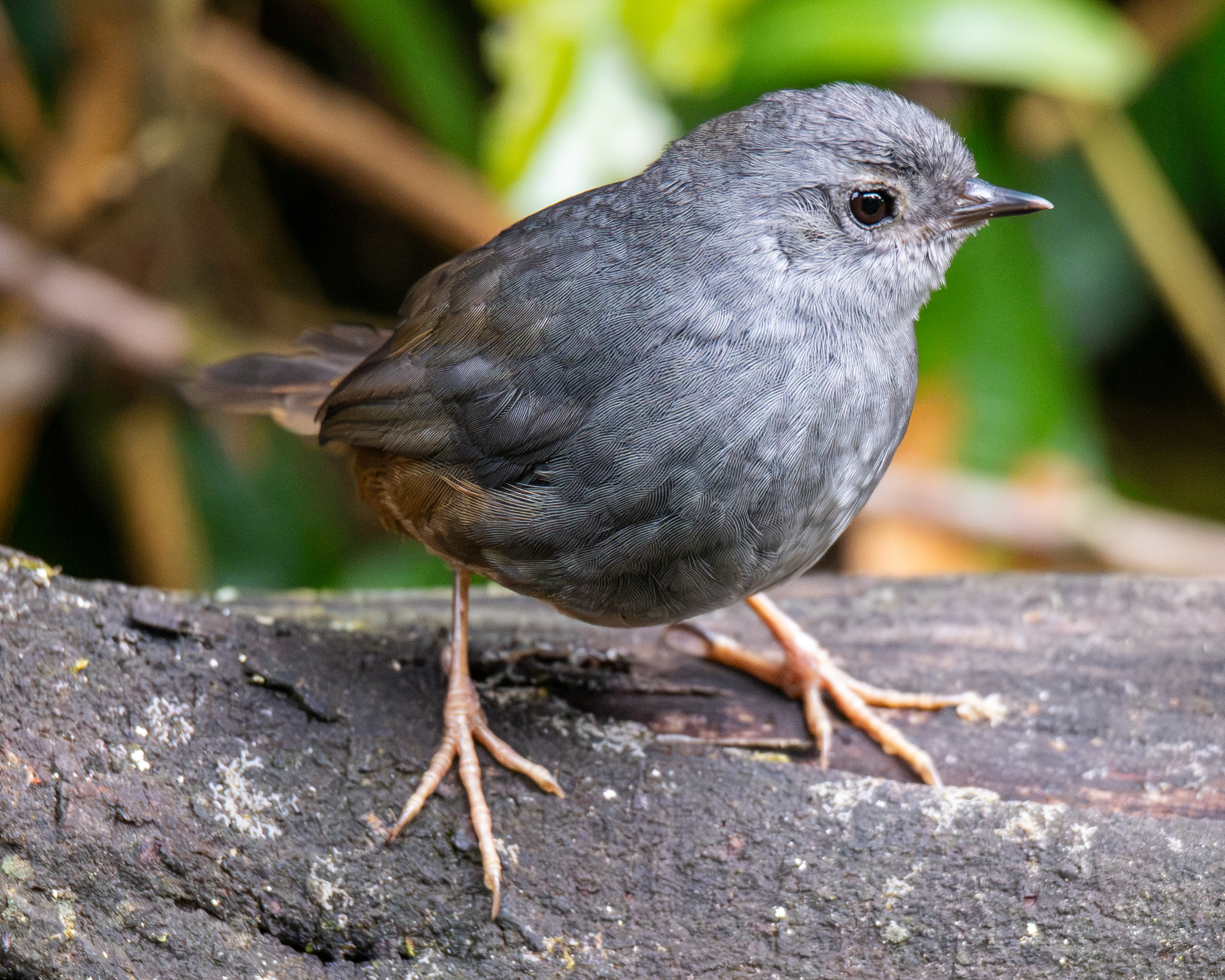
10–11.5 cm, round, with a short tail and a thin bill. Largely grey and clearly paler below, with grey-brown back and wings and an orange-brown, usually dark-barred rump, flanks and undertail. Females are usually somewhat browner than males. Juveniles are brown and barred.
Confusion species
Merida Tapaculo Scytalopus meridanus, which lives in the same kind of scrub in Táchira, is very similar and is mainly told apart by song. Blackish Tapaculo Scytalopus latrans is almost entirely blackish and usually lives lower. White-crowned Tapaculo Scytalopus atratus lives lower and has a white crown patch. In tapaculos, song is the main feature.
Habitat
Low shrubbery in páramo and elfin forest, scrub at forest edges and locally Chusquea bamboo; rarely inside closed montane forest. Mostly at 2000–3900 m. It searches on and just above the ground for small arthropods. Little is known about its breeding.
Where the bird is most at home, classified by the vegetation units of Amazonia and the Guianas.

Range and movements
In the guide area only in the far west of Venezuela, in the Tamá massif in south-western Táchira, on the border with Colombia. Not in Brazil or the Guianas. Outside the guide area in the Eastern Andes of Colombia, from Cundinamarca and Boyacá to Norte de Santander.
- Resident
- dark = core range, pale = thinly spread
How and when to look
Listen early in the morning in the higher parts of El Tamá National Park in Táchira for the trill from low shrubbery at the edge of the páramo. The bird sometimes appears briefly at the edge of a shrub; wait quietly at a gap.
Conservation status
Least Concern. The species tolerates disturbed habitat. In Venezuela the range is very small, but it lies largely within a national park.
Scientific name
Scytalopus griseicollis | (de Lafresnaye, 1840)
De Lafresnaye described the species in 1840 as Merulaxis grisei-collis; because it was later moved to another genus, the author and year stand in brackets. The genus Scytalopus was introduced in 1837 by Gould. Scytalopus is Greek, from skutalē 'stick, cudgel' and pous 'foot', after the stout legs. griseicollis is Latin, from griseus 'grey' and collum 'neck', after the grey neck and throat. The specimen the first description was based on came from Bogotá, Colombia.