All species › Parrots › African and New World parrots › Pearly Parakeet
Pearly Parakeet | Pyrrhura lepida
Parelparkiet | Cotorra pulcra | Tiriba-pérola
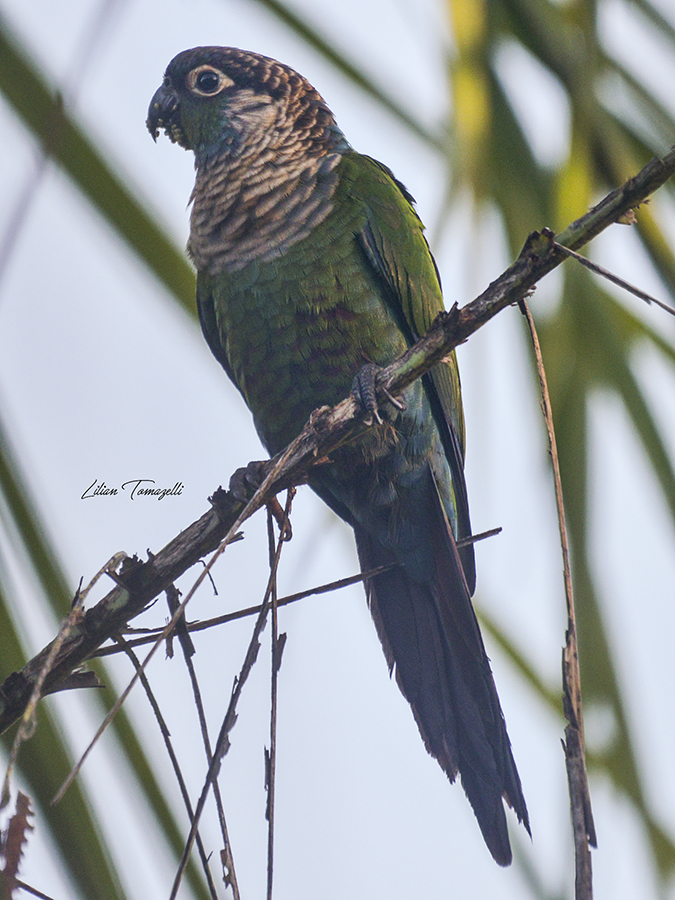
The Pearly Parakeet is a Pyrrhura parakeet of the far east of Amazonia, east of the Tocantins. Its whole range lies in Brazil, in a part of Amazonia where most of the forest has already been cleared. The name refers to the pale, pearly scaling on the breast. Flocks fly fast and call as they move through the canopy.
Voice
Shrill, grating calls such as kreek-kreek, repeated mainly in flight by the whole flock, and soft chattering from groups in the canopy.
Recording: JAYRSON ARAUJO DE OLIVEIRA — CC BY-NC-SA 4.0 · xeno-canto
Identification
24 cm, slim, with a long, graduated tail. The plumage is mostly green. The crown is dark brown, the lower cheeks and sides of the neck blue. The throat and breast are greyish brown with broad, pale edges, giving a scaly, pearly pattern. The belly is green, without a large red patch. The bend of the wing and the underwing coverts are red, the primaries blue. The tail is reddish brown above. There is a bare, pale ring around the eye. In the eastern form the red on the wing is largely absent. The sexes are alike; juveniles are duller, with less red on the wing.
Confusion species
Crimson-bellied Parakeet Pyrrhura perlata also has blue cheeks and red underwings, but a bright red belly; it lives west of the Tocantins. Santarem Parakeet Pyrrhura amazonum has a pale ear patch, no blue cheeks and a dark red belly; it also lives further west. White-eyed Parakeet Psittacara leucophthalmus is larger and plain green, without scaling on the breast.
Habitat
Humid lowland rainforest on terra firme, also flooded forest, forest edges and older secondary forest, in the lowlands up to about 300 m. It feeds on fruit, seeds and blossoms in the canopy. It lives in flocks of four to fifteen birds. The nest is in a tree cavity.
Where the bird is most at home, classified by the vegetation units of Amazonia and the Guianas.



Range and movements
Only in Brazil: in eastern Pará east of the Tocantins, around Belém and further south and east, and in western Maranhão. Absent from Venezuela, Guyana, Suriname and French Guiana. Does not occur outside the guide area.
- Resident
- dark = core range, pale = thinly spread
How and when to look
Search in the larger forest reserves of western Maranhão, such as the Reserva Biológica do Gurupi, or in forest remnants around Paragominas and Tailândia in eastern Pará; flocks give themselves away by their calls in flight.
Conservation status
Vulnerable. Eastern Pará and western Maranhão are among the most heavily deforested parts of Amazonia; forest is lost to cattle ranching, agriculture and logging, and the remaining forest is fragmented. Birds are also trapped for the cage-bird trade.
Scientific name
Pyrrhura lepida | (Wagler, 1832)
Wagler described the species in 1832 as Sittace lepida; because it was later moved to another genus, the author and year stand in brackets. The genus Pyrrhura was introduced in 1856 by Bonaparte. Pyrrhura is Greek, from purrhos 'red' and oura 'tail', after the maroon tail of many species. lepida is probably Latin lepidus 'elegant, charming'; a reference to the scaly breast pattern (Greek lepis 'scale') is also possible. The specimen the first description was based on came from not stated.