All species › Passerines › Antbirds › Pectoral Antwren
Pectoral Antwren | Herpsilochmus pectoralis
Borstbandmiersluiper | Tiluchí pectoral | Chorozinho-de-papo-preto
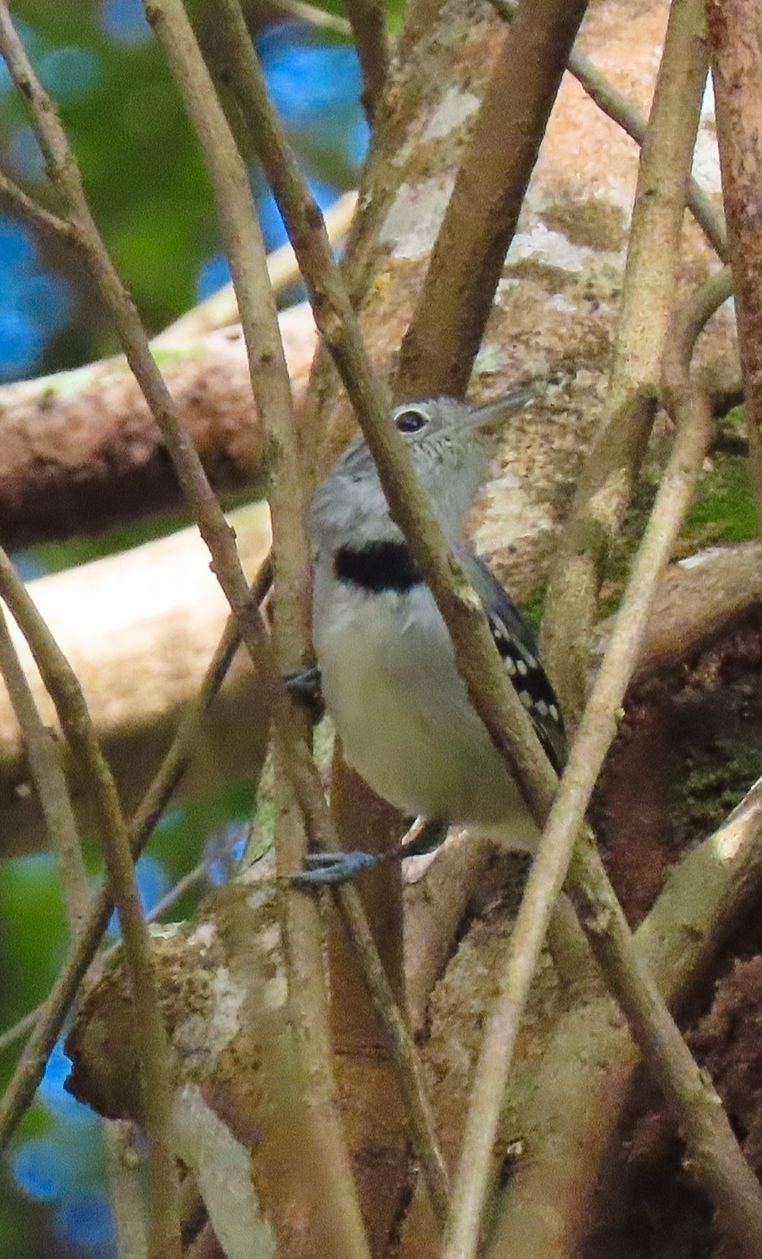
The Pectoral Antwren is a small antwren found only in north-eastern Brazil. The male is the only Herpsilochmus in the guide area with a black band across the white breast. It lives in dry forest, restinga and taller caatinga, a habitat that has been greatly reduced.
Voice
The song is a fast, accelerating roll that starts with a few separate notes; male and female often sing shortly after each other. Calls are short, nasal notes.
Recording: JAYRSON ARAUJO DE OLIVEIRA — CC BY-NC-SA 4.0 · xeno-canto
Identification
11–12 cm, with a thin bill and a fairly long tail. Male: crown black, white supercilium and black eye-stripe; back grey with black; wings black with white wing bars and white edges; tail black with white tips. Throat and underparts white, with a black band or patch across the breast. Female: crown rufous-brown, no breast band, breast and flanks light ochre.
Confusion species
Black-capped Antwren Herpsilochmus atricapillus lacks the black breast band; the female has a black, white-streaked crown instead of a rufous-brown one. Large-billed Antwren Herpsilochmus longirostris is larger and heavier-billed; the female is strongly ochre below. Black-bellied Antwren Formicivora melanogaster of the caatinga is black from throat to belly, not just on the breast, and lives lower in the scrub.
Habitat
Mid-storey and canopy of dry and semi-deciduous forest, restinga forest on sandy soil along the coast and taller, well-wooded caatinga, also at forest edges; from the lowlands into the hills of the interior. It searches for insects among leaves and twigs, usually in pairs, often in mixed flocks. The nest is a small cup in the fork of a branch.
Where the bird is most at home, classified by the vegetation units of Amazonia and the Guianas.




Range and movements
Brazil: endemic, scattered in the north-east, from Maranhão and Rio Grande do Norte south through Paraíba, Pernambuco and Sergipe into Bahia, mainly in the coastal zone and the transition to the caatinga. Not in Venezuela, Guyana, Suriname or French Guiana. Does not occur outside the guide area.
- Resident
- dark = core range, pale = thinly spread
How and when to look
Look for it in restinga and dry forest on the coast of Rio Grande do Norte, Sergipe and northern Bahia. Listen for the roll from the mid-storey and follow mixed flocks; it is present all year.
Conservation status
Vulnerable. The habitat is fragmented and shrinking through clearance for agriculture and cattle and through building along the coast. The population is small and scattered over separate forest remnants.
Scientific name
Herpsilochmus pectoralis | Sclater, 1857
Sclater described the species in 1857 and placed it straight away in the genus where it still stands. The genus Herpsilochmus was introduced in 1847 by Cabanis. Herpsilochmus is Greek, from herpō 'to creep' and lokhmē 'thicket': 'thicket-creeper'. pectoralis is Latin for 'of the breast', from pectus 'breast', after the male's black breast band. The specimen the first description was based on came from Bahia, eastern Brazil (designated later).