All species › Passerines › Tapaculos › Planalto Tapaculo
Planalto Tapaculo | Scytalopus pachecoi
Planaltotapaculo | Churrín de Pacheco | Tapaculo-ferreirinho
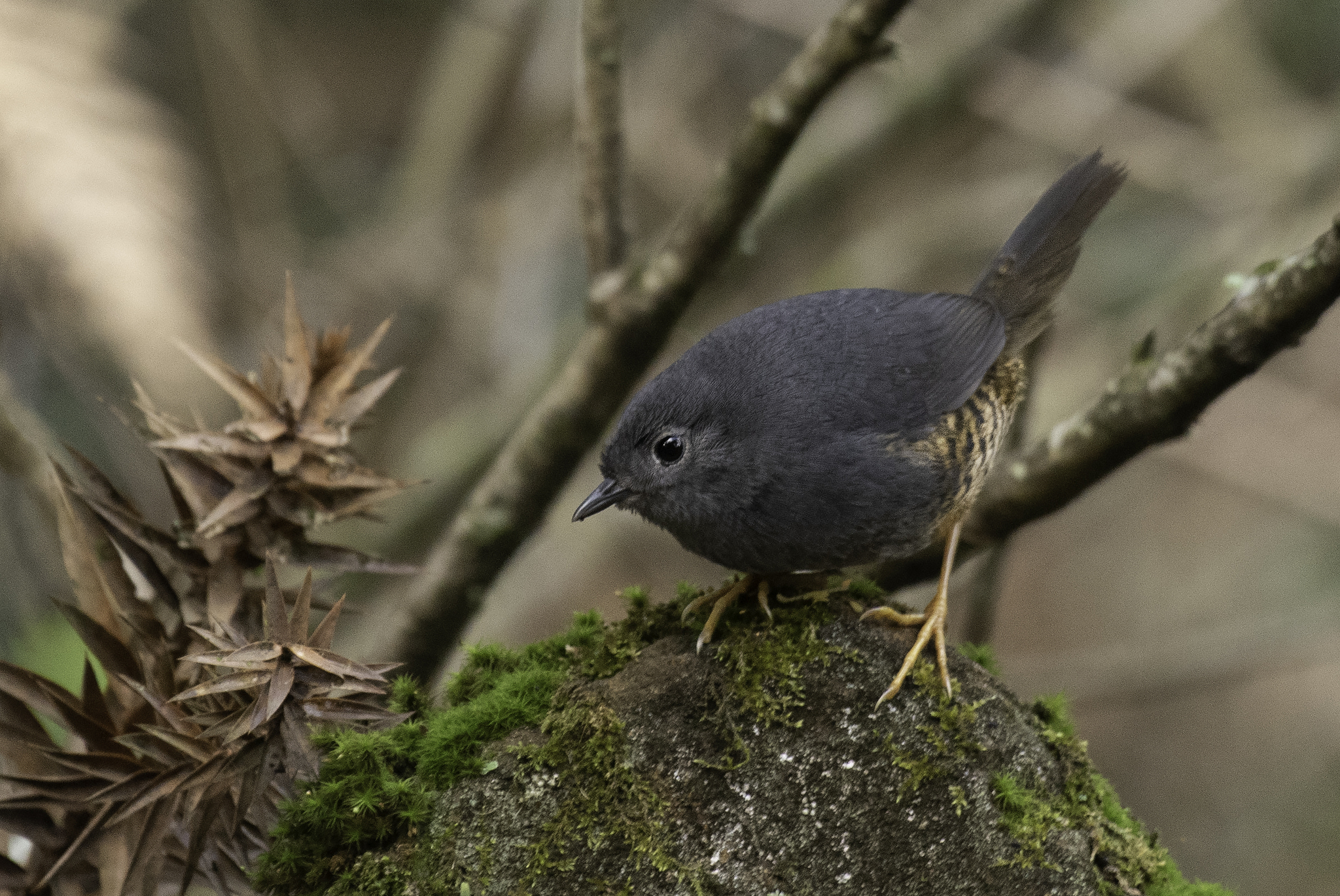
The Planalto Tapaculo is a grey tapaculo of the forests on the highlands of southern Brazil and extreme north-eastern Argentina. It lives in dense undergrowth, often with bamboo and along streams. The species was described in 2005; before that these birds were included in Mouse-colored Tapaculo.
Voice
The song is a long series of notes that starts at two or three notes per second and then accelerates into a trill. It also gives a single-note contact call and a loud alarm call.
Recording: Faustino Hollmann — CC BY-NC-SA 4.0 · xeno-canto
Identification
12 cm, round, with a short tail, short wings, a thin bill and fairly long legs. The male is dark grey above and paler grey below, with ochre-brown, dark-barred flanks and undertail. The female is browner. Juveniles are brown and densely barred dark.
Confusion species
Mouse-colored Tapaculo Scytalopus speluncae, which in the south only occurs at the edges of this species' range, is darker and more uniform grey and sings a monotonous, even series. Marsh Tapaculo Scytalopus iraiensis lives in tall-grass marshes on the plateau of Paraná and Rio Grande do Sul, not in forest. White-breasted Tapaculo Eleoscytalopus indigoticus has a white throat and breast. In tapaculos, song and location are the main features.
Habitat
Forest and forest edges, often near streams and in dense undergrowth with bamboo, in araucaria forest, montane forest and old secondary forest; up to about 1500 m. It occurs at higher densities in secondary forest than in undisturbed forest. It searches on and just above the ground for insects and other small arthropods. Little is known about its breeding.
Where the bird is most at home, classified by the vegetation units of Amazonia and the Guianas.



Range and movements
In Brazil in parts of Rio Grande do Sul and in south-eastern Santa Catarina. Not in Amazonia, Venezuela or the Guianas. Outside the guide area in extreme north-eastern Misiones in Argentina.
- Resident
- dark = core range, pale = thinly spread
How and when to look
Listen on the plateau of Rio Grande do Sul and Santa Catarina, for example around São Francisco de Paula or in the canyons of Aparados da Serra, for the accelerating series of notes from bamboo and dense shrubbery along streams. Wait quietly at a gap in the vegetation.
Conservation status
Least Concern. The species tolerates secondary forest and occurs in protected areas. Its habitat has been fragmented by logging and the creation of pasture and plantations.
Scientific name
Scytalopus pachecoi | Maurício, 2005
Maurício described the species in 2005 and placed it straight away in the genus where it still stands. The genus Scytalopus was introduced in 1837 by Gould. Scytalopus is Greek, from skutalē 'stick, cudgel' and pous 'foot', after the stout legs. pachecoi honours the Brazilian ornithologist José Fernando Pacheco (b. 1961). The specimen the first description was based on came from Cerro das Almas (Capão do Leão), Rio Grande do Sul, Brazil.