All species › Passerines › Cotingas › Purple-throated Cotinga
Purple-throated Cotinga | Porphyrolaema porphyrolaema
Purperkeelcotinga | Cotinga golipúrpura | Cotinga-de-garganta-encarnada
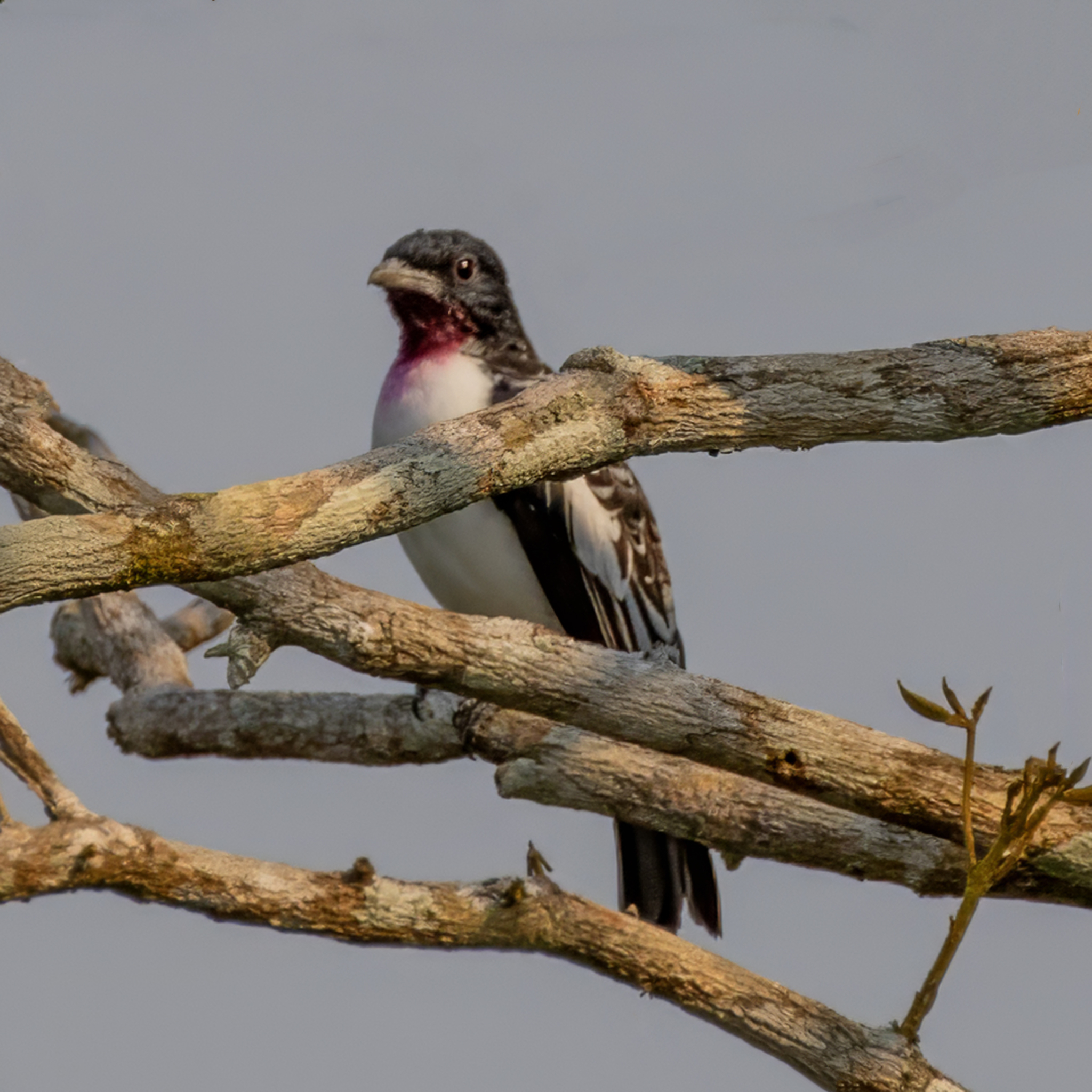
The Purple-throated Cotinga is a small, compact cotinga of the canopy in western Amazonia. The male is scaled black and white above and white below, with a deep purple throat. In the guide area it occurs only in western Brazil, where it is scarce and scattered; it is usually seen perched high in a fruiting tree.
Voice
The male calls infrequently but loudly: a high, plaintive, descending whistle preeeeer lasting one to two seconds, repeated from a high perch. Also a trilled werleeyoo.
Recording: John V. Moore — CC BY-NC-SA 4.0 · xeno-canto
Identification
17–18 cm, with a broad bill with a curved upper mandible and a square tail. The male is black above, with white edges to the feathers of the back and wing-coverts, so that the upperparts look scaled; also a white wing-bar and white edges to the tertials. The throat is deep purple, the rest of the underparts white with some black barring on the rear flanks. The female is dark brown above with pale buff edges, has an unbarred rufous throat and is cinnamon below with black barring. Bill and legs are black, the iris dark brown.
Confusion species
The male Plum-throated Cotinga Cotinga maynana is turquoise-blue with a purple throat and lacks the black-and-white pattern. The male Pompadour Cotinga Xipholena punicea has a wine-red body and white wings. Females of the cotingas of the genus Cotinga are greyish brown and scaled, without the rufous throat and the clear barring on the underparts.
Habitat
The canopy and edges of humid lowland forest, both terra firme and seasonally flooded várzea forest, mostly below 400 m. It feeds mainly on the fruit of forest trees, especially Cecropia, and occasionally on small insects; it sometimes joins groups of other fruit-eaters. Little is known about breeding; the only described nest was high in a tree, in a fork of two horizontal branches.
Where the bird is most at home, classified by the vegetation units of Amazonia and the Guianas.



Range and movements
In the guide area only in Brazil: in western Amazonas and in Acre, mainly south of the Amazon, with scattered records farther east into Rondônia and northern Mato Grosso. Absent from Venezuela, Guyana, Suriname and French Guiana. Outside the guide area in south-eastern Colombia, eastern Ecuador and Peru and northern Bolivia.
- Resident
- dark = core range, pale = thinly spread
How and when to look
Search from a canopy tower or a clearing with a view over the canopy, in western Amazonas or in Acre, for birds sitting high in fruiting Cecropia trees. The male's high, descending whistle often reveals it before its plumage does.
Conservation status
Least Concern. The species is scarce everywhere and rarely reported; deforestation in western Amazonia is the main threat.
Scientific name
Porphyrolaema porphyrolaema | (Deville & Sclater, 1852)
Deville & Sclater described the species in 1852 as Cotinga porphyrolaema; because it was later moved to another genus, the author and year stand in brackets. The genus Porphyrolaema was introduced in 1854 by Bonaparte. Porphyrolaema is Greek, from porphura 'purple' and laimos 'throat', after the male's purple throat. porphyrolaema is Greek, from porphura 'purple' and laimos 'throat', after the male's purple throat. The specimen the first description was based on came from Sarayacu on the Ucayali, Peru.