All species › Parrots › African and New World parrots › Riparian Parrotlet
Riparian Parrotlet | Forpus crassirostris
Oevermuspapegaai | Periquito ribereño | Tuim-ribeirinho
The Riparian Parrotlet is a small parrotlet with a short tail and a heavy, pale bill, of the large rivers of western and central Amazonia. It was long regarded as a subspecies of Cobalt-rumped Parrotlet. Pairs and flocks live on river islands, in young riverine forest and in villages and towns along the rivers.
Voice
A high, sharp tsit and rapid, shrill twittering, often by the whole flock at once, in flight and while feeding.
Recording: John V. Moore — CC BY-NC-SA 4.0 · xeno-canto
Identification
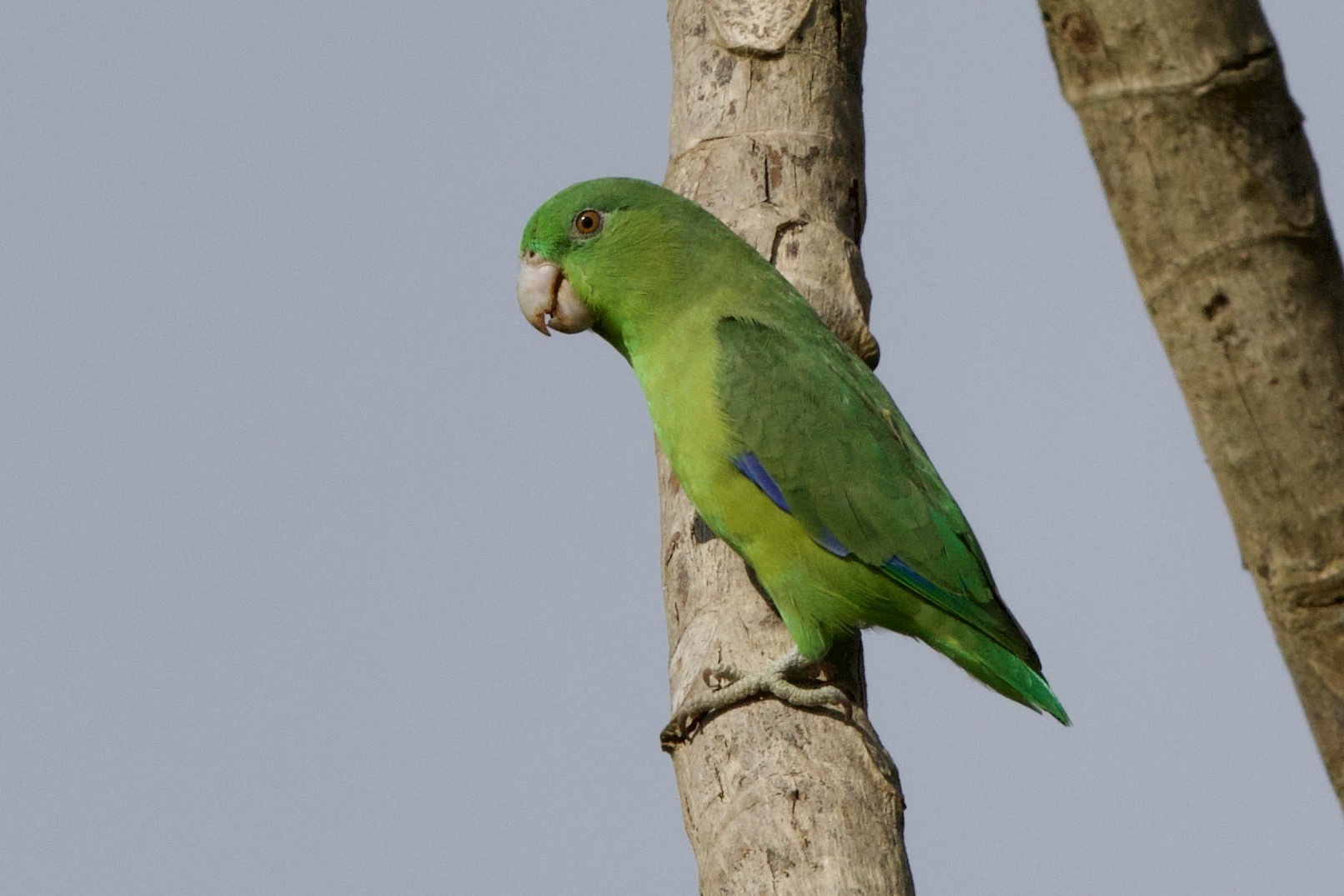
12–13 cm, with a short, wedge-shaped tail and a rather heavy, pale, horn-coloured bill. The plumage is light, bright green, slightly more yellowish on the head. The male has a cobalt-blue lower back and rump and blue wing coverts and secondaries; the underwing is also blue. The female lacks the blue and has a yellower forehead and face. Juveniles resemble the female.
Confusion species
Dusky-billed Parrotlet Forpus modestus is darker green, with a dark upper mandible; the male has darker blue. Cobalt-rumped Parrotlet Forpus xanthopterygius, in eastern and central Brazil, has a slimmer bill. White-winged Parakeet Brotogeris versicolurus and Tui Parakeet Brotogeris sanctithomae are larger, with a longer, pointed tail; the former has white and yellow in the wing, the latter a yellow forehead.
Habitat
River islands with young growth, riverine forest and scrub along whitewater rivers, edges of várzea, young Cecropia trees and gardens and yards in villages and towns along the rivers, in the lowlands. It feeds on seeds, fruit and blossoms. It nests in holes in trees, posts or termite nests.
Where the bird is most at home, classified by the vegetation units of Amazonia and the Guianas.




Range and movements
In Brazil in western and central Amazonia, along the Solimões and the Amazon and the large tributaries, such as the Juruá, the Purus and the Madeira, east to about the Manaus area and the lower Madeira; the exact boundaries with Cobalt-rumped Parrotlet are not yet well known. Absent from Venezuela, Guyana, Suriname and French Guiana. Outside the guide area in the Amazonian lowlands of south-eastern Colombia, eastern Ecuador and eastern Peru.
- Resident
- dark = core range, pale = thinly spread
How and when to look
On river islands and in riverine forest along the Solimões and the Amazon, for example on boat trips from Manaus or Tefé, and in gardens in the riverside villages. Twittering little flocks often sit close together in shrubs and low trees.
Conservation status
Least Concern. The species lives in vegetation that the rivers constantly renew and also occurs in human-modified landscapes; locally trapped for the cage-bird trade.
Scientific name
Forpus crassirostris | (Taczanowski, 1883) (GBIF: Forpus xanthopterygius)
Taczanowski described the species in 1883 as Psittacula crassirostris; because it was later moved to another genus, the author and year stand in brackets. The genus Forpus was introduced in 1858 by Boie. The derivation of Forpus is unknown. crassirostris is Latin, from crassus 'thick' and rostrum 'bill', after the stout bill. The specimen the first description was based on came from Yurimaguas, Peru.