All species › Passerines › Cardinals and allies › Rose-bellied Chat
Rose-bellied Chat | Granatellus paraensis
Roodbuikgranaatzanger | Granatelo paraense | Polícia-do-mato-do-pará
The Rose-bellied Chat is the eastern counterpart of the Rose-breasted Chat and occurs only in eastern Amazonia, east of the Rio Tocantins. Only recently have some taxonomists treated it as a separate species, on the basis of differences in plumage, song and DNA. In the guide area it is endemic to Brazil.
Voice
The song is a variable phrase in which soft, down-slurred whistles alternate with higher, harsher notes; other recordings resemble the series of similar whistled notes of Rose-breasted Chat. The call is a dry, nasal chep.
No recording with a suitable Creative Commons licence is available for this species yet.
Identification
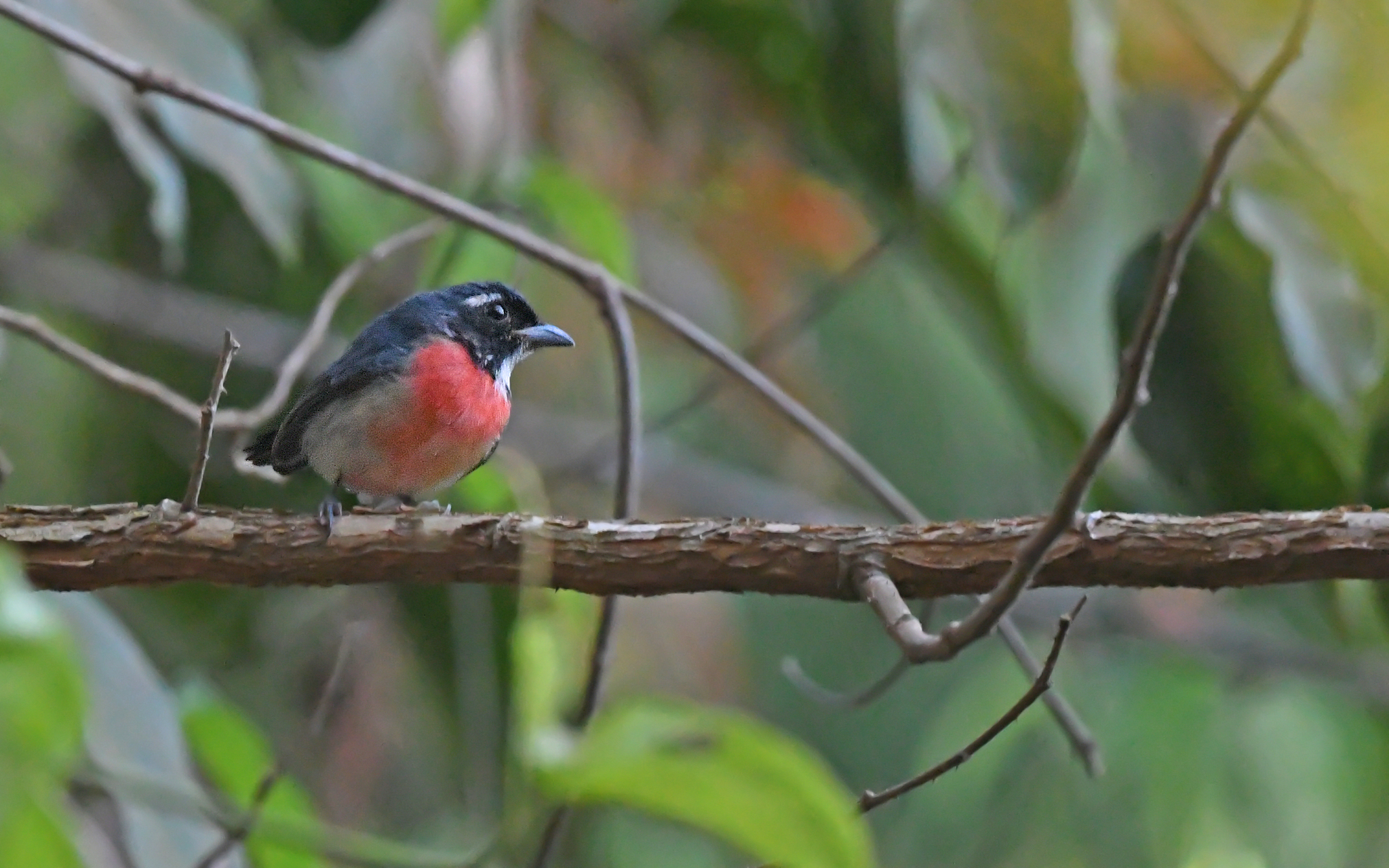
12–13 cm, with a short, fairly thick bill and a long, often cocked tail. The male is slate grey above, with a greyer crown and cheeks than Rose-breasted Chat and less black on the face, a white throat, little white on the flanks and extensive rose-red on the breast, belly and undertail coverts. The female is blue-grey above, with a buff face and underparts and pink undertail coverts. Juveniles resemble the female.
Confusion species
In Rose-breasted Chat Granatellus pelzelni, west of the Rio Tocantins, the male has a black crown and cheeks and more white on the flanks; females can hardly be separated in the field. Range is the best guide; in a possible contact zone in the Tocantins and Araguaia basin, assignment is uncertain.
Habitat
The middle and lower levels of humid terra firme lowland forest, especially in vines and dense growth near openings, also at forest edges and in tall secondary forest. It searches for insects and spiders in the foliage and often joins mixed flocks. Little is known about its nest and breeding biology; presumably as in Rose-breasted Chat.
Where the bird is most at home, classified by the vegetation units of Amazonia and the Guianas.



Range and movements
Only in Brazil: in eastern Pará, east of the Rio Tocantins, and in western Maranhão. Where the boundary with Rose-breasted Chat lies in the south, in Tocantins and northern Goiás, is poorly known. Absent from Venezuela and the Guianas.
- Resident
- dark = core range, pale = thinly spread
How and when to look
In forest remnants of eastern Pará and western Maranhão, search the middle levels of the forest, in vines and near openings, and stay with mixed flocks. A sound recording helps to compare the song later with that of Rose-breasted Chat.
Conservation status
Least Concern according to the current assessment. However, its small range lies in a part of Amazonia where much forest has been cleared and fragmented, so the population is probably declining.
Scientific name
Granatellus paraensis | Rothschild, 1906
Rothschild described the species in 1906 and placed it straight away in the genus where it still stands. The genus Granatellus was introduced in 1850 by Bonaparte. Granatellus is a diminutive of New Latin granatus 'garnet-red', after the red on breast and belly. paraensis means 'from Pará', the Brazilian state where the species was discovered. The specimen the first description was based on came from Santo Antônio do Prata, near Belém, Pará, Brazil.