All species › Parrots › African and New World parrots › Rose-crowned Parakeet
Rose-crowned Parakeet | Pyrrhura rhodocephala
Roodkopparkiet | Cotorra coronirroja | Tiriba-de-coroa-rosa
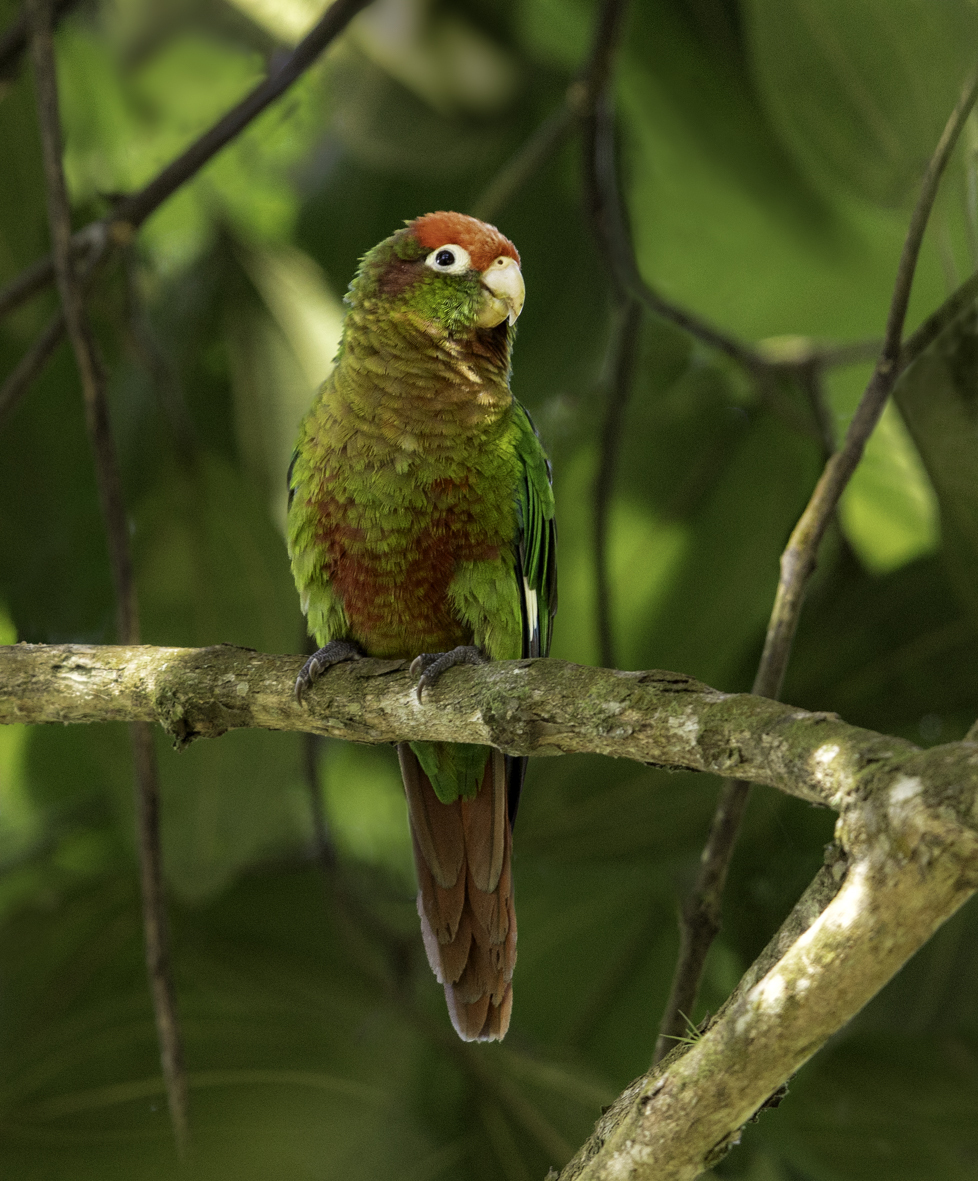
The Rose-crowned Parakeet is a Pyrrhura parakeet of montane forest and cloud forest in the Andes of western Venezuela. It occurs nowhere else. With its red crown, white patch in the wing and red tail it differs from the other Pyrrhura parakeets of the guide area. Flocks fly fast and call as they cross the mountain slopes, sometimes up to near the treeline.
Voice
Shrill, grating calls such as kreek-kreek and cheek, repeated rapidly in flight by the whole flock, and soft chattering from groups in the treetops.
Recording: Joe Klaiber — CC BY-NC-SA 4.0 · xeno-canto
Identification
24 cm, slim, with a long, graduated tail. The plumage is mostly green. The forehead and crown are rose-red, the ear region reddish brown. The throat and breast are green, barely scaled. There is a reddish-brown patch in the centre of the belly. The primary coverts are white and form a white patch in the wing, visible mainly in flight; the primaries are blue. The tail is reddish brown to red. There is a bare, white ring around the eye. The sexes are alike; juveniles have a green or bluish crown with little red and bluish primary coverts.
Confusion species
Scarlet-fronted Parakeet Psittacara wagleri is larger, with red only on the forehead, a green tail and no white in the wing. Barred Parakeet Bolborhynchus lineola is smaller and barred, with a short, pointed tail. Blood-eared Parakeet Pyrrhura hoematotis has a brown crown and no white in the wing, and lives in the coastal range.
Habitat
Humid montane forest and cloud forest, forest edges, older secondary forest and open country with scattered trees, from about 800 to 3000 m, mainly between 1500 and 2500 m; it moves up and down the slopes with the fruit supply. It feeds on fruit, seeds and blossoms. It lives in flocks of ten to thirty birds, sometimes more. The nest is in a tree cavity.
Where the bird is most at home, classified by the vegetation units of Amazonia and the Guianas.

Range and movements
Only in Venezuela, in the Andes of Trujillo, Mérida and Táchira and on the adjacent slopes in Barinas, Apure and southern Lara. Absent from Brazil, Guyana, Suriname and French Guiana. Does not occur outside the guide area.
- Resident
- dark = core range, pale = thinly spread
How and when to look
Search in Sierra Nevada National Park around La Mucuy near Mérida, along the road to La Azulita or in Guaramacal National Park in Trujillo; the white wing patch shows when flocks fly calling over the valley.
Conservation status
Least Concern. Part of the montane forest in the Venezuelan Andes has been converted to fields, coffee plantations and pasture, but large areas of forest lie in national parks; the species also occurs in partly logged forest.
Scientific name
Pyrrhura rhodocephala | (Sclater & Salvin, 1871)
Sclater & Salvin described the species in 1871 as Conurus rhodocephalus; because it was later moved to another genus, the author and year stand in brackets. The genus Pyrrhura was introduced in 1856 by Bonaparte. Pyrrhura is Greek, from purrhos 'red' and oura 'tail', after the maroon tail of many species. rhodocephala is Greek, from rhodon 'rose' and kephalē 'head', after the rose-red head. The specimen the first description was based on came from vicinity of Mérida, Venezuela.