All species › Passerines › Antbirds › Rufous-backed Antvireo
Rufous-backed Antvireo | Dysithamnus xanthopterus
Roodrugmiervireo | Batarito dorsirrufo | Choquinha-de-asa-ferrugem
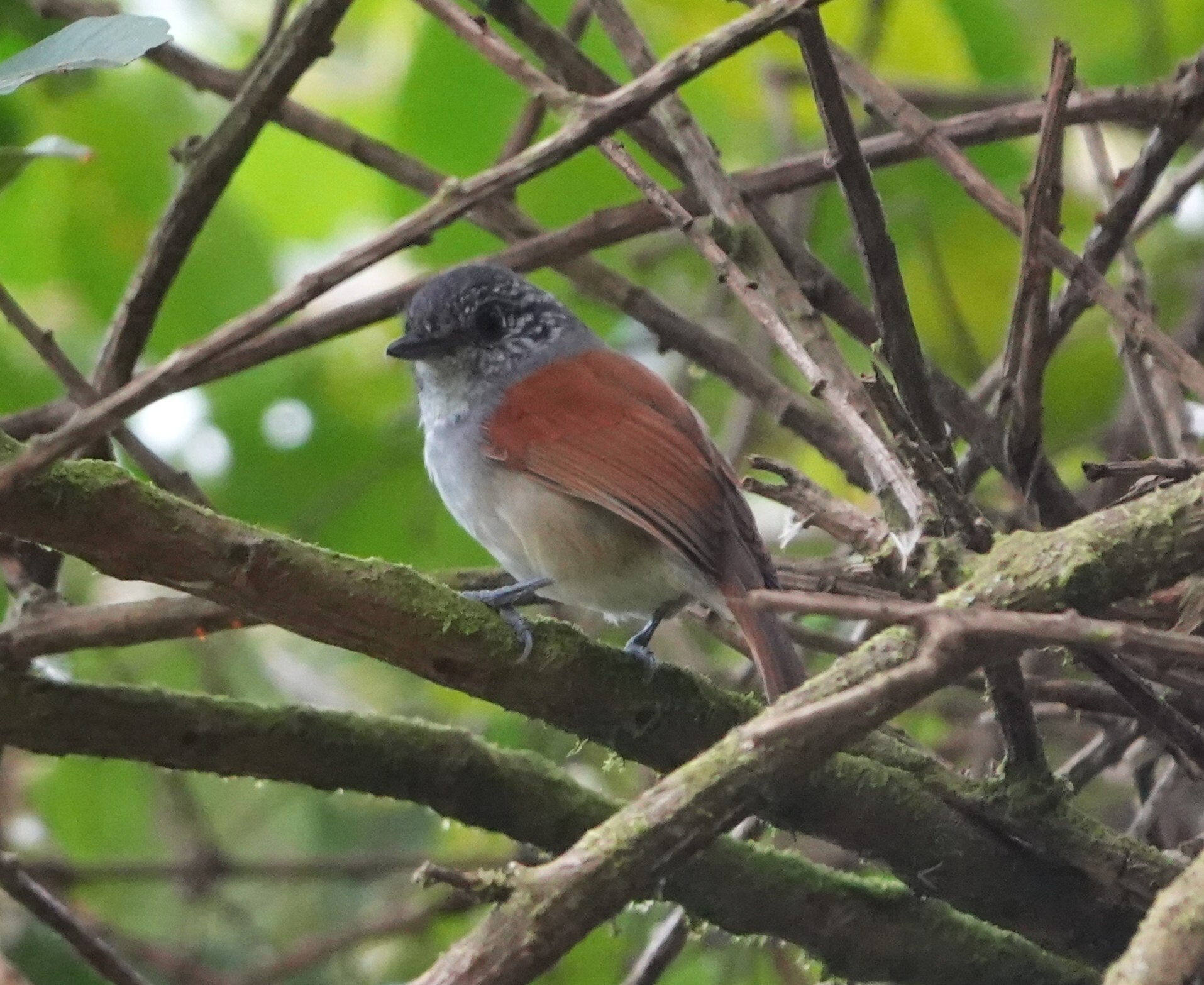
The Rufous-backed Antvireo is an antvireo of the montane forest of the Serra do Mar in south-eastern Brazil. It is the only antvireo in which both sexes have a rufous back, wings and tail. Unlike its relatives, it forages mainly in the middle storey and the lower canopy.
Voice
The song is a very high, fast, descending, shivering rattle of whistles. Calls are a short, low, muffled note and a short, harsh bark.
Recording: Rodrigo Dela Rosa — CC BY-NC-SA 4.0 · converted to mono · xeno-canto
Identification
12 cm, with a large head, a short tail and a stout, slightly hooked bill. The male has the forehead, crown, nape and upper back grey, with small white spots on the forehead, lores and upper face. The rest of the upperparts, the wings and the tail are rufous. The centre of the throat is white, the underparts mostly pale grey, almost white on the belly, with ochre flanks. The female has a rufous crown, pale buff spots on the face and mostly pale buff underparts with olive sides and flanks.
Confusion species
The female Plain Antvireo Dysithamnus mentalis also has a cinnamon-brown crown, but has an olive back and wings, and stays lower in the forest. The female Spot-breasted Antvireo Dysithamnus stictothorax has a chestnut crown, olive upperparts and spotted underparts; that species lives mainly lower on the slopes. No other antvireo of the guide area has the rufous back of this species.
Habitat
The middle storey to lower canopy of evergreen montane forest and older secondary forest, between about 750 and 1700 m. It forages alone or in pairs, often in mixed flocks, mostly 3–12 m above the ground; it takes insects and other arthropods mainly with short sallies to the undersides of leaves and also gleans from a perch; it sometimes eats Rapanea berries. The only known nest was an open cup of plant fibres thickly covered with moss, in a fork 1.8 m up; the breeding season runs from about September to February.
Where the bird is most at home, classified by the vegetation units of Amazonia and the Guianas.

Range and movements
Endemic to Brazil: mainly in montane forest of the Serra do Mar and adjacent ranges, from Rio de Janeiro and southern Minas Gerais through São Paulo to Paraná; since 2013 a few records in Santa Catarina. Not in Amazonia, Venezuela or the Guianas.
- Resident
- dark = core range, pale = thinly spread
How and when to look
Search misty montane forest above about 800 m, for example in Itatiaia National Park and the Serra dos Órgãos. In mixed flocks in the middle storey, look for an antvireo with a grey head and a rufous back.
Conservation status
Least Concern. The range is fairly large; the population size is unknown and probably decreasing. The species is rather scarce and local, and occurs in a number of protected areas.
Scientific name
Dysithamnus xanthopterus | Burmeister, 1856
Burmeister described the species in 1856 and placed it straight away in the genus where it still stands. The genus Dysithamnus was introduced in 1847 by Cabanis. Dysithamnus is Greek, from duō 'to plunge into' and thamnos 'bush', after its life in dense undergrowth. xanthopterus is Greek, from xanthos 'yellow, tawny' and -pteros '-winged', after the rufous wings. The specimen the first description was based on came from Nova Friburgo, Rio de Janeiro, Brazil.