All species › Passerines › Antbirds › Rufous-bellied Antwren
Rufous-bellied Antwren | Isleria guttata
Roodbuikmiersluiper | Hormiguerito ventrirrufo | Choquinha-de-barriga-ruiva
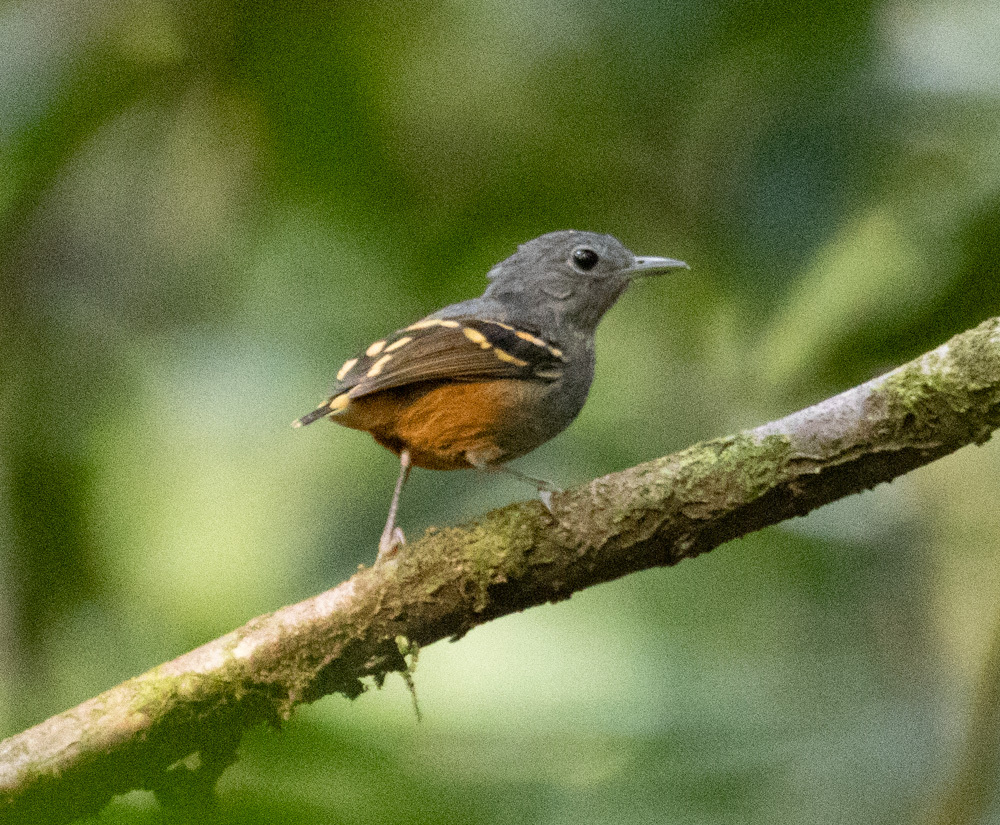
The Rufous-bellied Antwren is a very small, short-tailed antwren of the shady undergrowth of terra firme forest in north-eastern Amazonia and the Guianas. It forages close to the ground, often near slow streams and damp places with deep leaf litter. Together with Plain-throated Antwren it forms the genus Isleria.
Voice
The song is a high, nearly level series of 15–20 sharp, well-spaced notes, the first few somewhat drawn out. In alarm it gives a low, rattling trill.
Recording: GABRIEL LEITE — CC BY-NC-SA 4.0 · xeno-canto
Identification
9 cm, stocky, with a very short tail. The male is mostly grey, with a pale grey throat and a concealed white patch between the shoulders; the lower belly, flanks and undertail coverts are warm tawny. Wings and tail are blackish brown with cinnamon edges, and the wing coverts and uppertail coverts have pale cinnamon spots. The female is olive-grey above with a greyish-olive breast, otherwise like the male.
Confusion species
Plain-throated Antwren Isleria hauxwelli lives south of the Amazon and west of the Rio Negro; the male has white, not cinnamon, wing spots and no tawny belly, and the female is entirely cinnamon below. Pygmy Antwren Myrmotherula brachyura is yellowish below and lives higher in the forest. The female Long-winged Antwren Myrmotherula longipennis has a longer tail and lacks the cinnamon wing spots.
Habitat
Evergreen terra firme forest, especially shady undergrowth with deep leaf litter near slow streams and damp places, from sea level to about 600 m. It gleans insects and spiders from leaves, stems and twigs, alone or in pairs, mostly up to 1 m above the ground, and joins mixed flocks passing through its territory; it sometimes follows army ants. The nest is a small cup suspended 1–1.5 m up.
Where the bird is most at home, classified by the vegetation units of Amazonia and the Guianas.


Range and movements
Venezuela: in the south, in southern Bolívar and Amazonas. Guyana, Suriname and French Guiana: widespread in the interior. Brazil: north of the Amazon and east of the Rio Negro, in Amazonas, Roraima, Pará and Amapá. Outside the guide area locally in eastern Colombia.
- Resident
- dark = core range, pale = thinly spread
How and when to look
Search the interior of the Guianas or the forest north of Manaus along streams in shady terra firme forest, low near the ground. Listen for the long series of high, sharp notes; the bird itself often sits still in the dark understorey.
Conservation status
Least Concern. The species has a very large range with much continuous forest, including large protected areas, and its population is considered stable. It is uncommon to fairly common.
Scientific name
Isleria guttata | (Vieillot, 1824)
Vieillot described the species in 1824 as Myrmothera guttata; because it was later moved to another genus, the author and year stand in brackets. The genus Isleria was introduced in 2012 by Bravo, Chesser & Brumfield. Isleria honours the American ornithologists Morton (Mort) and Phyllis Isler, specialists in antbirds. guttata is Latin for 'spotted, speckled' (gutta 'drop'), after the pale spots on the wing coverts. The specimen the first description was based on came from Cayenne, French Guiana.