All species › Passerines › Antbirds › Rufous-tailed Antbird
Rufous-tailed Antbird | Drymophila genei
Roodstaartmiervogel | Tiluchí colirrufo | Choquinha-da-serra
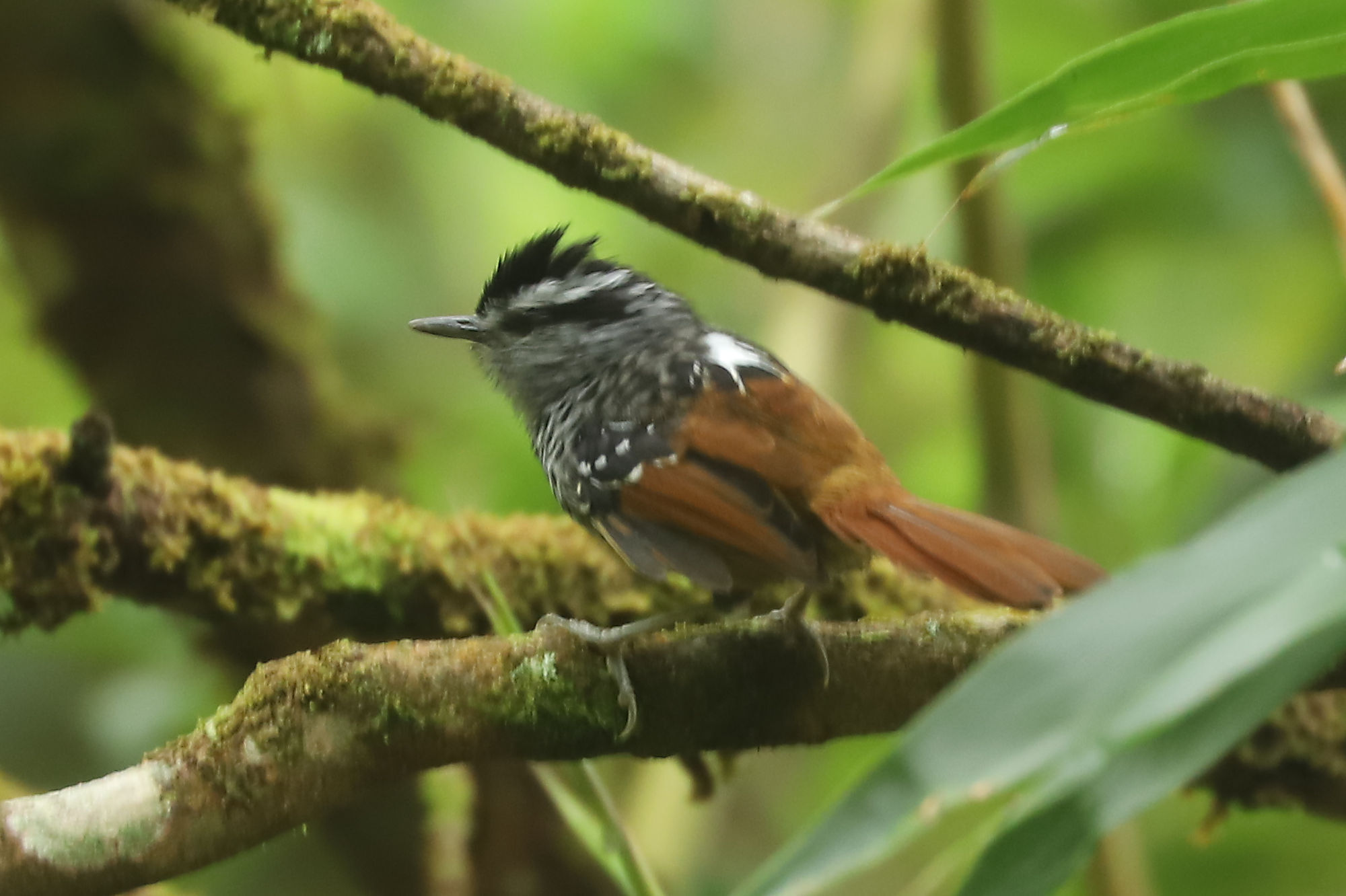
The Rufous-tailed Antbird is a bamboo antbird of the highest montane forests of south-eastern Brazil. Unlike the other antbirds of its genus in the guide area, it has a rufous tail. It lives in separate populations on the mountain ridges and is endemic to Brazil.
Voice
The song is a series of six or seven notes that begins with high, sharp notes and drops to lower, nasal notes. Calls are short, thin notes in groups and longer, raspy churrs.
Recording: Pritam Baruah — CC BY-NC-SA 4.0 · xeno-canto
Identification
13–14 cm, with a long, graduated tail. The male has a black crown, a white supercilium, a black eyeline and white cheeks speckled black. The back is olive-brown with black spots and a white patch between the scapulars; rump, tail and flight feathers are rufous. Throat and breast are white with black spots, which are larger on the breast; the flanks are plain rufous-brown. The female has a rufous-brown crown and nape with blackish streaks, a whitish supercilium, a dark eyeline, buff cheeks and buff underparts with faint dark markings, without the black spots and white back patch of the male.
Confusion species
Ochre-rumped Antbird Drymophila ochropyga has a grey back, a dark tail with white tips and a black-streaked breast; it usually lives lower. Bertoni's Antbird Drymophila rubricollis has a plain rufous throat and underparts and a dark tail with white tips. Dusky-tailed Antbird Drymophila malura is greyer, with a plain greyish-brown tail.
Habitat
Mainly bamboo stands in montane evergreen forest, also adjoining vine tangles and other dense foliage, mostly between 1150 and 2200 m, sometimes from 800 m, up to the transition to mountain grassland. It searches for insects among bamboo leaves, in pairs, low to mid-level. Little is known about the nest.
Where the bird is most at home, classified by the vegetation units of Amazonia and the Guianas.


Range and movements
Brazil: in the mountains of the south-east, in Minas Gerais, Espírito Santo, Rio de Janeiro and São Paulo, mainly in the Serra da Mantiqueira and the Serra do Mar; the range consists of separate patches. Not in Venezuela, Guyana, Suriname or French Guiana. Resident. Endemic to Brazil.
- Resident
- dark = core range, pale = thinly spread
How and when to look
Search bamboo along trails on the ridges above about 1200 m, for example in the upper part of Itatiaia or in the Serra dos Órgãos. The rufous tail shows when the bird moves through the bamboo.
Conservation status
Least Concern; previously assessed as Near Threatened. The population is estimated at 6,000 to 58,000 mature individuals and is probably declining. Threats are conversion of habitat to pasture and farmland, and fire; in protected areas the species is locally common.
Scientific name
Drymophila genei | (de Filippi, 1847)
De Filippi described the species in 1847 as Formicivora Genei; because it was later moved to another genus, the author and year stand in brackets. The genus Drymophila was introduced in 1824 by Swainson. Drymophila is Greek, from drumos 'wood, copse' and philos 'lover': 'woodland-lover'. genei honours the Italian zoologist Carlo Giuseppe Gené (1800–1847), director of the zoological museum in Turin. The specimen the first description was based on came from Brazil (not specified further).