All species › Gamebirds › Guans, curassows and chachalacas › Rusty-margined Guan
Rusty-margined Guan | Penelope superciliaris
Witvoorhoofdsjakohoen | Pava yacupemba | Jacupemba
The Rusty-margined Guan is a medium-sized guan of the forests of Brazil south of the Amazon, from eastern Amazonia to the Atlantic Forest. Its English name refers to the rusty edges of the wing coverts, the clearest feature of the species. It tolerates more disturbance than most of its relatives and also lives in smaller forest fragments and gallery forest.

Voice
Loud, hoarse and honking calls, often at dusk, and a harsh cackling when alarmed. At dawn it makes a rattling sound with its wings in flight.
Recording: Fernando Igor de Godoy — CC BY-NC-SA 4.0 · shortened to the first 60 s, mono · xeno-canto
Identification
60–70 cm, a slender guan with a long tail and a small, untidy crest. The plumage is dark olive-brown, with a greenish gloss on the back and tail. The wing coverts and mantle feathers have broad rusty edges that give a scaled pattern. A pale grey to whitish eyebrow runs back above the eye; the bare skin around the eye is grey. The breast is grey-brown with pale feather edges. The small dewlap is red. The legs are reddish. The sexes are alike.
Confusion species
Dusky-legged Guan Penelope obscura is larger and darker, with dark grey legs and no rusty wing edges, and lives in the south and south-east. White-browed Guan Penelope jacucaca of the caatinga has a broad white eyebrow and no rusty edges. Spix's Guan Penelope jacquacu is larger and darker and lives further west in Amazonia. Chachalacas (Ortalis) are smaller, with a smaller head and no rusty wing edges.
Habitat
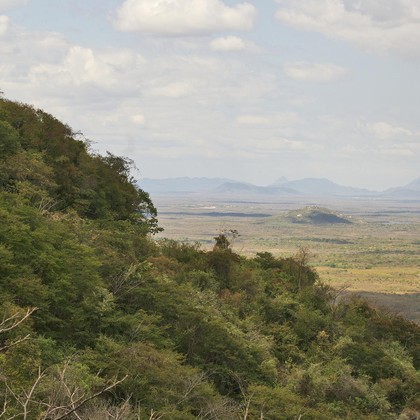
Semi-evergreen and deciduous forest, gallery forest along rivers and forest edges in the cerrado, lowland and seasonal forest of the Atlantic Forest, and forest in eastern Amazonia, from the lowlands to about 1200 m. It eats fruit, berries, leaves and flowers, both in trees and on the ground. The nest is a platform of sticks in a tree or shrub.
Where the bird is most at home, classified by the vegetation units of Amazonia and the Guianas.





Range and movements
Within the guide area only in Brazil: south of the Amazon, roughly east of the Rio Madeira, through Pará into Maranhão and the north-east, and south through the cerrado and the Atlantic Forest into Mato Grosso do Sul, Paraná and Santa Catarina. Absent from Venezuela and the Guianas. Outside the guide area in eastern Paraguay, north-eastern Argentina and the far east of Bolivia.
- Resident
- dark = core range, pale = thinly spread
How and when to look
In the early morning, search gallery forest and forest edges, for example in Chapada dos Guimarães National Park in Mato Grosso, in the Serra da Canastra in Minas Gerais or in forest reserves in the interior of São Paulo; birds then often sit in fruiting trees and call.
Conservation status
Near Threatened (IUCN). The species tolerates some forest disturbance but is declining through logging, the conversion of cerrado and forest into farmland, and hunting.
Scientific name
Penelope superciliaris | Temminck, 1815
Temminck described the species in 1815 and placed it straight away in the genus where it still stands. The genus Penelope was introduced in 1786 by Merrem. Penelope comes from Greek pēnelops, an unidentified duck-like bird; the same name as Penelope, the wife of Odysseus. superciliaris is Latin for 'eyebrowed', from supercilium 'eyebrow', after the pale supercilium. The specimen the first description was based on came from Pará, Brazil.