All species › Passerines › Manakins › Saffron-crested Tyrant-Manakin
Saffron-crested Tyrant-Manakin | Neopelma chrysocephalum
Geelkuiftiranmanakin | Saltarín coronigualdo | Fruxu-do-carrasco
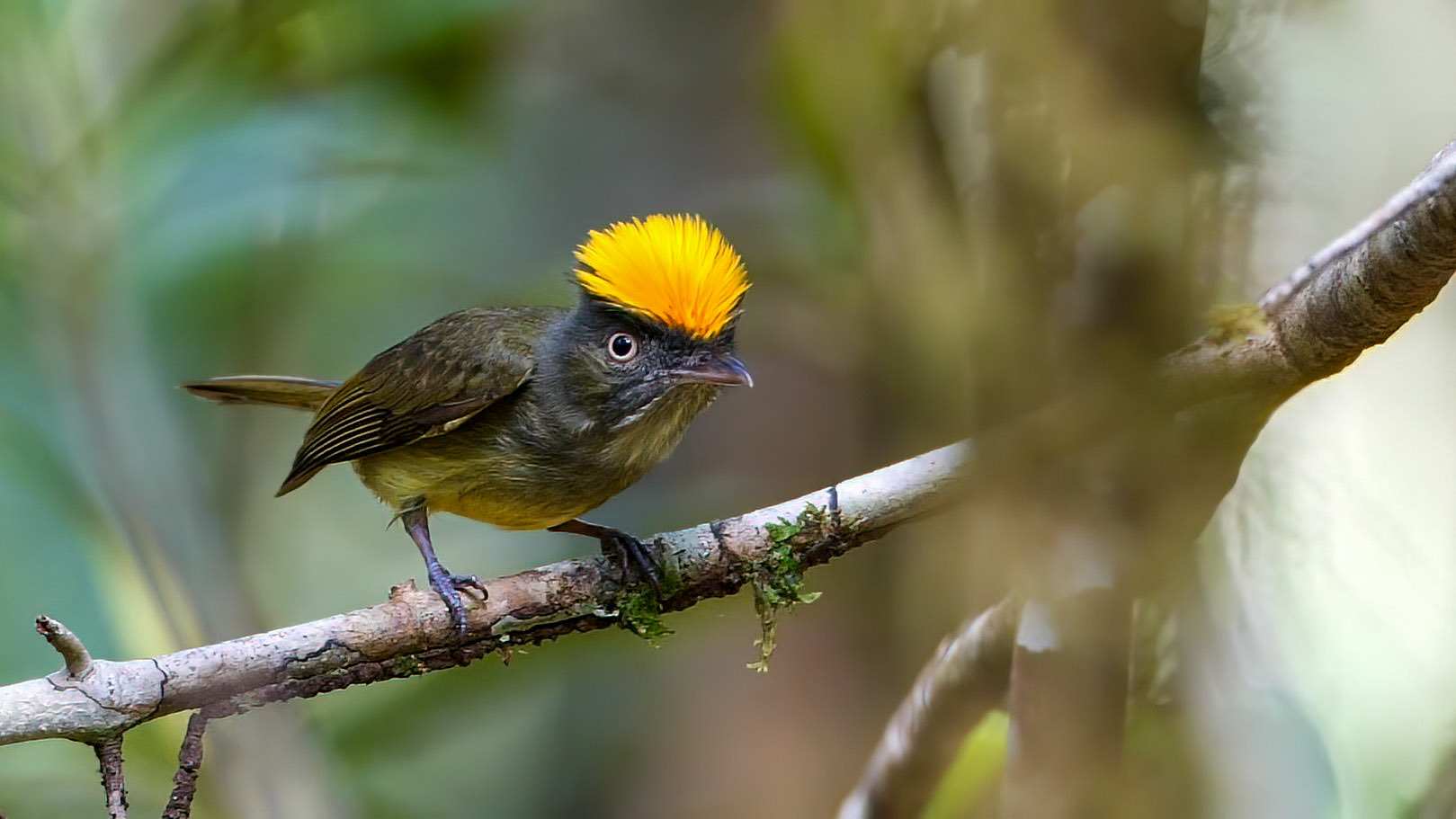
The Saffron-crested Tyrant-Manakin is an olive-green manakin with a saffron-yellow crown stripe. It is closely tied to low, open forest on white sand, such as the campinas and campinaranas of the Rio Negro region and the savanna forest of the Guianas. Outside this forest type it hardly occurs.
Voice
A nasal, buzzy, slightly rising phrase, repeated at long intervals from a song post in the mid-storey, and short dry calls.
Recording: Barry Edmonston — CC BY-NC-SA 4.0 · xeno-canto
Identification
13 cm, with a fairly long tail and a small bill. The upperparts are olive green. A broad orange-yellow to saffron-yellow stripe runs over the crown and is raised as a small crest when excited; the sides of the head are greyish. Throat and breast are grey with an olive wash, the belly is pale yellow. The iris is whitish to pale yellow. The sexes are alike.
Confusion species
Pale-bellied Tyrant-Manakin Neopelma pallescens has a narrower, mostly concealed crown stripe and a whitish belly, and lives in drier forest further south and east. Sulphur-bellied Tyrant-Manakin Neopelma sulphureiventer has a smaller crown stripe and lives in south-western Amazonia. Tiny Tyrant-Manakin Tyranneutes virescens is much smaller, with a very short tail. Yellow-crowned Elaenia Myiopagis flavivertex has a dark iris and pale wing bars.
Habitat
Low, open forest and scrub on white sand (campina, campinarana) and their edges, also savanna forest and forest on sandy soils in the Guianas, in the lowlands and on low plateaus. It lives in the lower and middle storeys and eats mainly small fruit, plus insects.
Where the bird is most at home, classified by the vegetation units of Amazonia and the Guianas.



Range and movements
In Brazil in northern Amazonia: in the Rio Negro basin, in Roraima and around Manaus, locally also further east north of the Amazon. In Venezuela in the south, in Amazonas and Bolívar. In Guyana and Suriname fairly widespread in white-sand forest and savanna forest; in French Guiana very few reports. Outside the guide area in eastern Colombia and north-eastern Peru.
- Resident
- dark = core range, pale = thinly spread
How and when to look
In the campinas north of Manaus, for example along the road to Boa Vista, and in Suriname in the savanna forest around Zanderij. Listen for the buzzy song and search the low forest for the yellow crown stripe.
Conservation status
Least Concern. The species is tied to a forest type that occurs locally; white-sand forest near towns is threatened by logging and sand extraction.
Scientific name
Neopelma chrysocephalum | (Pelzeln, 1868)
Pelzeln described the species in 1868 as Heteropelma chrysocephalum; because it was later moved to another genus, the author and year stand in brackets. The genus Neopelma was introduced in 1861 by Sclater. Neopelma is Greek, from neos 'new, different' and pelma 'sole of the foot', after the foot structure that differs from related manakins. chrysocephalum is Greek, from khrusos 'gold' and kephalē 'head', after the saffron-yellow crown stripe. The specimen the first description was based on came from San Carlos de Río Negro, Venezuela.