All species › Passerines › Antpittas › Scallop-breasted Antpitta
Scallop-breasted Antpitta | Grallaricula loricata
Schubborstdwergmierpitta | Ponchito lorigado | Tovaquinha-de-peito-escamado
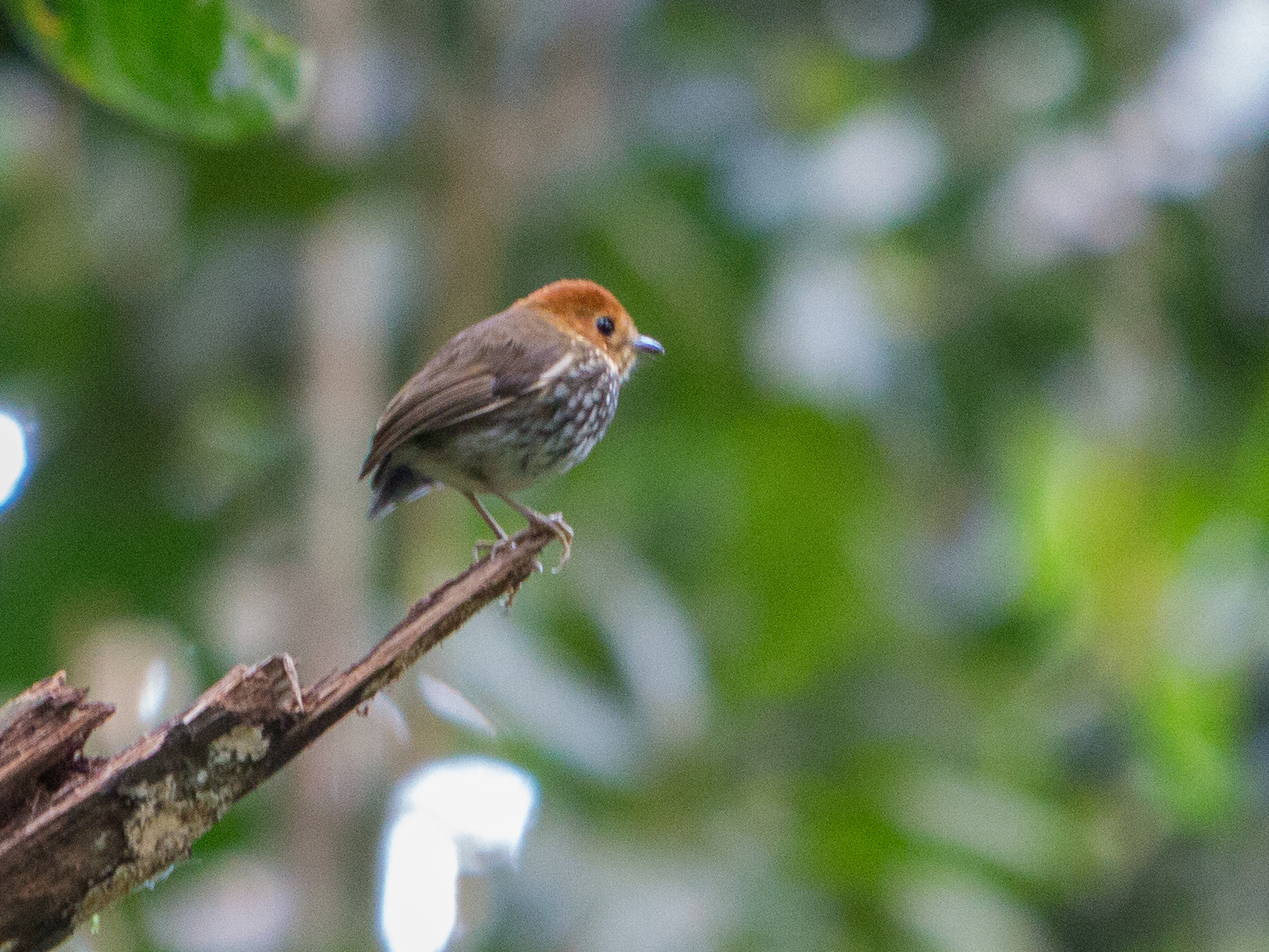
Scallop-breasted Antpitta is a small antpitta with a rufous crown and a yellow breast with black scaling. It occurs only in the Coastal Cordillera of northern Venezuela and is one of the endemic species of the guide area. It lives low in the understorey of cloud forest, usually singly or in pairs.
Voice
The call heard most often is a melancholy-sounding whistle, repeated three to five times; males also give a longer, drawn-out version. Pairs keep in contact while foraging with soft, nasal calls.
Recording: Daniel Lane — CC BY-NC-SA 3.0 · shortened to the first 60 s, mono · xeno-canto
Identification
10–11 cm, round and short-tailed, on long legs. The crown and nape are chestnut-rufous with a few fine black streaks, and a rufous stripe runs over the eye. The upperparts are olive-brown. The throat is yellowish ochre, the breast maize-yellow with an olive base and a black edge to each feather, giving a clear scaled pattern; towards the belly it becomes creamy white. The sexes are alike.
Confusion species
Rusty-breasted Antpitta Grallaricula ferrugineipectus also lives in the Coastal Cordillera, but has a plain rusty breast without scaling, a brown crown and a pale spot in front of the eye. Slaty-crowned Antpitta Grallaricula nana has a slate-grey crown and orange-rufous underparts without scaling, and lives in dense bamboo.
Habitat
The understorey of humid cloud forest and, less often, adjacent old secondary forest, mostly between about 1400 and 2100 m. It forages singly or in pairs low in the vegetation and rarely on the ground, picking insects and other small invertebrates from leaves and twigs. It appears to be able to breed at any time of year; little is known about the nest.
Where the bird is most at home, classified by the vegetation units of Amazonia and the Guianas.

Range and movements
Only in Venezuela, in the Cordillera de la Costa from Carabobo east through Aragua to the Capital District, with a smaller area in the Sierra de Aroa in Yaracuy. Not in the Venezuelan Andes, and not in Brazil or the Guianas. It does not occur outside the guide area.
- Resident
- dark = core range, pale = thinly spread
How and when to look
Search in the national parks of the Coastal Cordillera, such as Henri Pittier, San Esteban and El Ávila, in the understorey of cloud forest along trails. Listen for the repeated whistle; the bird often sits motionless on a low branch and turns slowly.
Conservation status
Near Threatened. The range is small and the population is thought to be declining because of fires and clearing of forest for agriculture and settlements, also inside protected areas. In suitable forest the species can be fairly common, for example in San Esteban, Henri Pittier and El Ávila National Parks.
Scientific name
Grallaricula loricata | (Sclater, 1857)
Sclater described the species in 1857 as Grallaria loricata; because it was later moved to another genus, the author and year stand in brackets. The genus Grallaricula was introduced in 1858 by Sclater. Grallaricula is a diminutive of Grallaria: 'little antpitta'. loricata is Latin for 'wearing a corselet', from lorica 'breastplate', after the scaled breast. The specimen the first description was based on came from near Caracas, Venezuela.