All species › Parrots › African and New World parrots › Scarlet Macaw
Scarlet Macaw | Ara macao
Geelvleugelara | Guacamaya roja | Araracanga
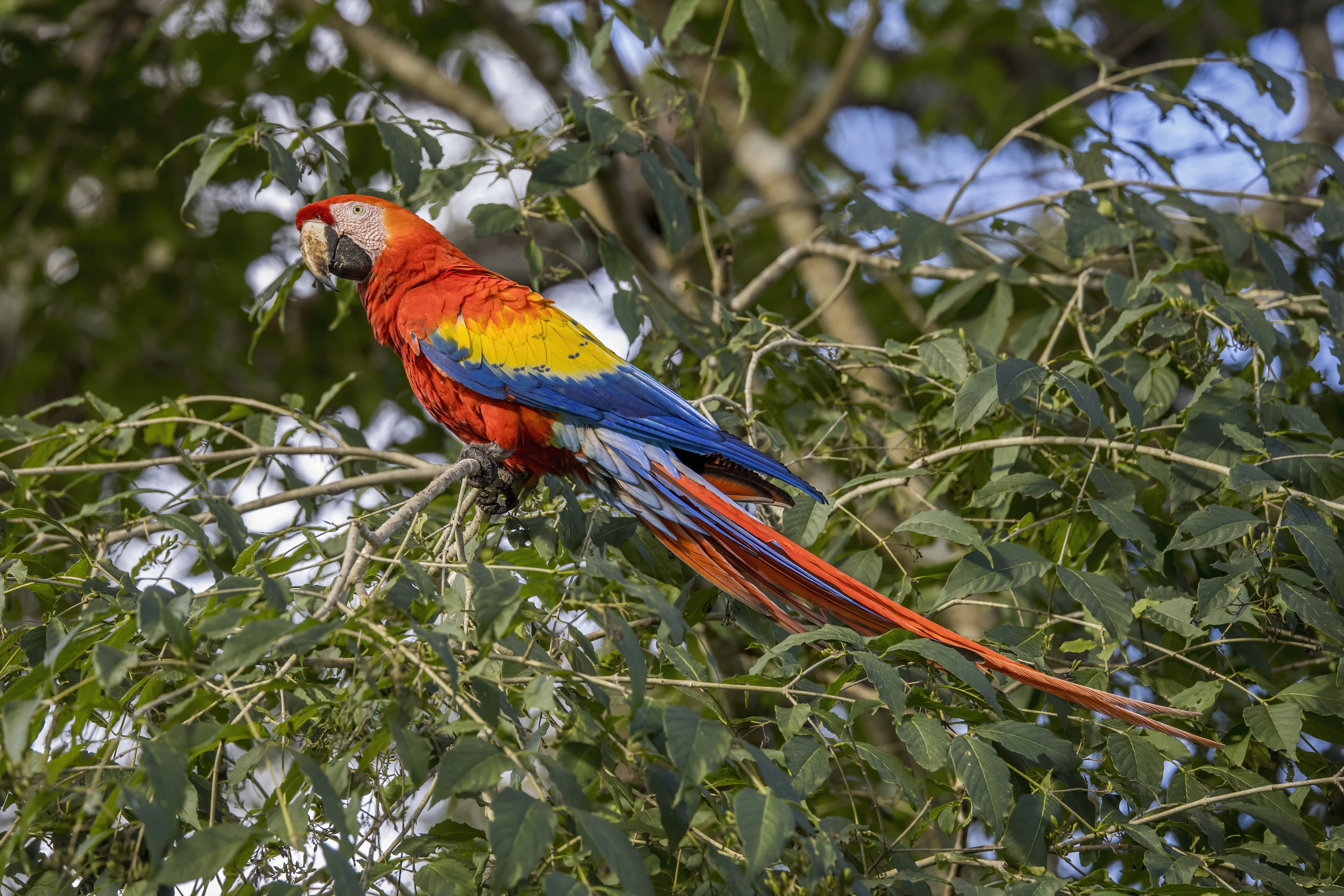
The Scarlet Macaw is one of the largest parrots in the world, scarlet with a broad yellow band and blue in the wings. In the guide area it lives in the lowland forest of the Amazon basin and the Guiana Shield, from Venezuela and the Guianas to central Brazil. Pairs and small flocks fly over the forest with loud screeches, the pairs close side by side.
Voice
Loud, hoarse, raw screeches, mainly in flight, audible over a long distance. Flocks at a clay lick or feeding tree keep up a continuous squabbling.
Recording: Mauricio Cuéllar-Ramírez — CC BY-NC-SA 4.0 · shortened to the first 60 s, mono · xeno-canto
Identification
81–96 cm, more than half of it tail, with a heavy, hooked bill: the upper mandible pale, the lower mandible black. The plumage is mostly scarlet. The upper wing coverts are yellow with green tips and form a broad yellow band on the wing; the flight feathers, rump and tail sides are blue. The cheeks are bare and white, with at most a few tiny feathers. In flight the long, pointed red tail and the yellow-and-blue wings stand out. The sexes are alike; juveniles have a shorter tail and a dark eye.
Confusion species
Red-and-green Macaw Ara chloropterus is slightly larger and darker red, with green instead of yellow wing coverts and distinct lines of small red feathers on the white cheeks; in flight the colour of the wing band is the best feature. Blue-and-yellow Macaw Ara ararauna is yellow below and blue above, without red. Both often occur in the same forests.
Habitat
Tall humid lowland forest on terra firme and along rivers, várzea, palm swamps, gallery forest and woodland patches at the edge of savannas, mostly below 500 m. It feeds on fruit, nuts and seeds, including unripe ones, which it cracks with its heavy bill. Locally it visits clay banks along rivers to eat clay. It nests in a cavity high in a large, often dead tree.
Where the bird is most at home, classified by the vegetation units of Amazonia and the Guianas.





Range and movements
In Brazil across much of the Amazon basin, north and south of the Amazon, south to northern Mato Grosso and east to Pará and western Maranhão; absent from the dry east and the south. In Venezuela mainly south of the Orinoco, in Bolívar and Amazonas, locally also in the Orinoco Delta and the southern llanos. In Guyana, Suriname and French Guiana in the forest of the interior and in the Rupununi savannas. Outside the guide area from southern Mexico through Central America and in the western Amazon basin to Bolivia.
- Resident
- dark = core range, pale = thinly spread
How and when to look
At sunrise and sunset, when pairs and flocks fly between roost and feeding area, for example along the rivers around Alta Floresta in Mato Grosso or in the savannas and forest of the Rupununi and Iwokrama in Guyana. From canopy towers you can watch them feeding in the treetops.
Conservation status
Least Concern, and still fairly common in large, undisturbed forests of the Amazon basin and the Guiana Shield. At the edges of its range, such as along the deforestation frontier in the south and east of the Brazilian Amazon, it has declined through logging and trapping for the cage-bird trade; the species is listed on CITES Appendix I.
Scientific name
Ara macao | (Linnaeus, 1758)
Linnaeus described the species in 1758 as Psittacus Macao; because it was later moved to another genus, the author and year stand in brackets. The genus Ara was introduced in 1799 by De Lacépède. Ara comes from Tupí, where ará is an onomatopoeic name for the macaws. macao comes from Portuguese macau, an old name for macaws; its further origin is unclear (possibly Tupi, or confusion with Macau). The specimen the first description was based on came from South America (not specified).