All species › Passerines › Antbirds › Sclater's Antwren
Sclater's Antwren | Myrmotherula sclateri
Sclaters miersluiper | Hormiguerito de Sclater | Choquinha-de-garganta-amarela
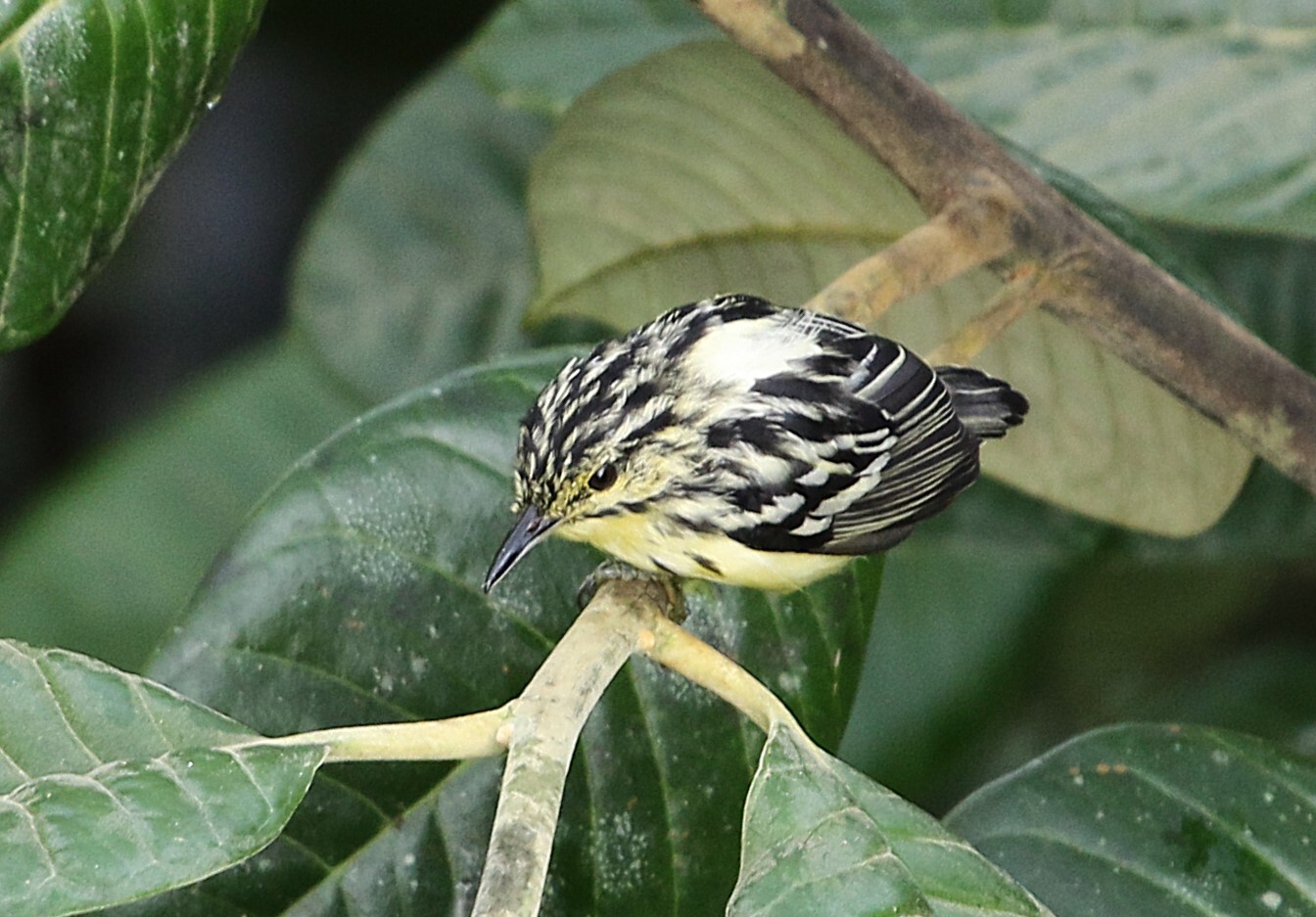
Sclater's Antwren is a small, short-tailed antwren of the canopy of Amazonian lowland forest south of the Amazon. The male is streaked black and white above and has a yellow throat and breast. It lives high in the treetops and usually joins mixed flocks.
Voice
The song is a short, slow series of four to six well-separated, falling notes, roughly peew peew peew peew. It also gives short, high calls from the canopy.
Recording: JAYRSON ARAUJO DE OLIVEIRA — CC BY-NC-SA 4.0 · xeno-canto
Identification
8 cm, compact, with a thin bill and a very short tail. The male has a black crown and back with pale yellow to whitish streaks, a black-and-white streaked face with yellow cheeks and a broad black moustache; there is a pale yellow patch between the shoulders. The wings are black with white tips to the coverts, forming two wing bars. Throat and breast are yellow, the belly paler yellow. The female has ochre rather than pale streaks on the head and upperparts, more streaking below and no yellow back patch.
Confusion species
Pygmy Antwren Myrmotherula brachyura lives in the same forests and is also streaked black and white and short-tailed, but has a white throat; only the breast and belly are yellow. Moustached Antwren Myrmotherula ignota in western Brazilian Amazonia also has a white throat and a black moustache. Yellow-throated Antwren Myrmotherula ambigua is very similar, but lives north of the Amazon, in the Rio Negro basin and southern Venezuela. Amazonian Streaked Antwren Myrmotherula multostriata is white below and lives low down near water.
Habitat
Middle levels and canopy of humid evergreen lowland forest, mainly terra firme but also várzea and transitional forest, usually in the forest interior and up to about 550 m. It searches in pairs or small family groups for insects and spiders among leaves and on thin twigs, often in canopy mixed flocks. Little is known about the nest; related species build a small cup hung in the fork of a twig.
Where the bird is most at home, classified by the vegetation units of Amazonia and the Guianas.



Range and movements
Brazil: south of the Amazon, from the borders with Peru and Bolivia east to the Rio Xingu and south into northern Mato Grosso and Rondônia. Absent from the Guianas and Venezuela; a single report from Guyana is probably an error. Outside the guide area in eastern Peru and northern Bolivia.
- Resident
- dark = core range, pale = thinly spread
How and when to look
Search mixed flocks in the canopy of terra firme forest south of the Amazon, for example from a canopy tower or a clearing with a view of the treetops; the species mostly draws attention through its slow, falling song.
Conservation status
Least Concern. Widespread and locally fairly common in continuous forest, but dependent on tall forest and therefore sensitive to deforestation along the southern edge of Amazonia.
Scientific name
Myrmotherula sclateri | Snethlage, HMMEE, 1912
Snethlage, HMMEE described the species in 1912 and placed it straight away in the genus where it still stands. The genus Myrmotherula was introduced in 1858 by Sclater. Myrmotherula is a diminutive of Myrmothera, Greek for 'ant-hunter' (murmos 'ant', -thēras 'hunter'): 'little ant-hunter'. sclateri honours the British ornithologist Philip Lutley Sclater (1829–1913), a leading authority on Neotropical birds. The specimen the first description was based on came from Boim on the Tapajós, Pará, Brazil.