All species › Passerines › Manakins › Snow-capped Manakin
Snow-capped Manakin | Lepidothrix nattereri
Sneeuwkapmanakin | Saltarín coronialbo | Uirapuru-de-chapéu-branco
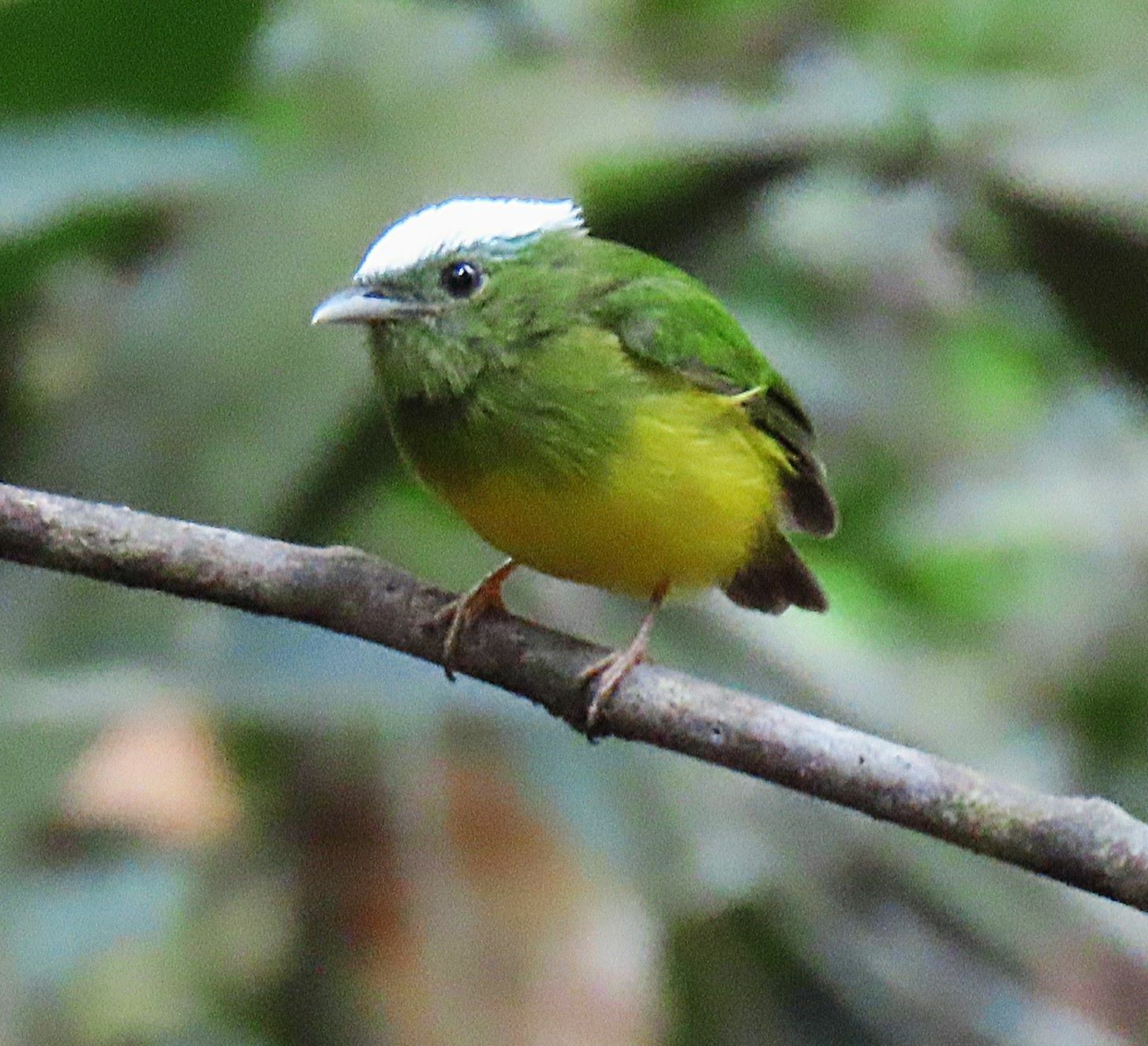
The Snow-capped Manakin is a small manakin of southern Amazonia that lives almost entirely in Brazil south of the Amazon. The male is green, with a white crown and a white rump. As in related manakins, each male displays at its own site in the forest understorey, within earshot of the others.
Voice
From a fixed perch the male gives a short, soft, slightly rising whistle, repeated at intervals. Also dry ticks.
Recording: Jacob Wijpkema — CC BY-NC-SA 4.0 · converted to mono · xeno-canto
Identification
8–9 cm, small and compact, with a short tail and a short, dark bill. The male is green on the upperparts, with a white crown and a white, sometimes bluish-white rump; the underparts are paler yellowish green, yellower on the belly. The female is plain olive green, with a yellower belly, and lacks the white on head and rump. Young males at first resemble the female and acquire the white gradually.
Confusion species
The male Opal-crowned Manakin Lepidothrix iris has an opalescent crown without a white rump and lives further east, east of the Tapajós. The male Blue-capped Manakin Lepidothrix coronata has a blue crown and lives further west; the females of these species are very similar. White-crowned Manakin Pseudopipra pipra is larger; the male is black with a white crown, the female has a greyish head and red eyes.
Habitat
The lower and middle storeys of humid lowland terra firme forest and of transitional forest towards drier forest, also old secondary forest, mainly below 600 m. It eats small fruit, plucked in flight, and insects. As in other manakins the nest is a small open cup slung in a horizontal twig fork.
Where the bird is most at home, classified by the vegetation units of Amazonia and the Guianas.


Range and movements
In Brazil in southern Amazonia south of the Amazon, roughly between the Madeira and the Tapajós (with the Teles Pires), south into Rondônia and northern Mato Grosso. Not known from Venezuela, Guyana, Suriname and French Guiana. Outside the guide area only in north-eastern Bolivia.
- Resident
- dark = core range, pale = thinly spread
How and when to look
Search the forest around Alta Floresta in northern Mato Grosso, for example along the forest trails on the Cristalino. Listen in the understorey for the short whistle of a displaying male and then look for the white crown in the half-light of the forest.
Conservation status
Least Concern. The species depends on closed forest and disappears where it is cleared, which happens on a large scale in southern Amazonia.
Scientific name
Lepidothrix nattereri | (Sclater, 1865)
Sclater described the species in 1865 as Pipra nattereri; because it was later moved to another genus, the author and year stand in brackets. The genus Lepidothrix was introduced in 1854 by Bonaparte. Lepidothrix is Greek, from lepis, lepidos 'scale' and thrix 'hair', after the scale-like, glossy crown feathers. nattereri honours the Austrian naturalist Johann Natterer (1787–1843), who collected in Brazil from 1817 to 1835. The specimen the first description was based on came from Borba, Rio Madeira, Amazonas, Brazil.