All species › Passerines › Antbirds › Streak-backed Antshrike
Streak-backed Antshrike | Thamnophilus insignis
Roraimamierklauwier | Batará insigne | Choca-de-roraima
Streak-backed Antshrike is an antshrike of the montane forest and scrub on the tepuis of the Guiana Shield. The male has a black crest, a black back with a white patch and strongly white-marked wings and tail; the female is similar but has a rufous hindcrown. Its closest relative is Acre Antshrike, far away in western Amazonia.

Voice
The male sings an accelerating series of nasal notes; the female's is similar but higher. Also a variable, slightly falling raspy growl and a soft squeak.
Recording: GABRIEL LEITE — CC BY-NC-SA 4.0 · xeno-canto
Identification
16–17 cm, with a heavy, hooked bill and a crest. Male: crown and nape black with a few white feathers; upperparts black with a white patch between the shoulders; wings and scapulars black with white spots and edges; tail black with white spots and white tips to the outer feathers; underparts grey, slightly paler on the belly. Female: like the male but duller, with faint white spots on the forehead, a dark rufous hindcrown and paler underparts. In the Cerro Sipapo form the female has an entirely black forehead.
Confusion species
Northern Slaty Antshrike Thamnophilus punctatus and Amazonian Antshrike Thamnophilus amazonicus live lower, in the lowlands, lack the crest and the white-spotted back, and have females with olive-brown or orange-rufous tones. Barred Antshrike Thamnophilus doliatus is barred black and white. Roraiman Antbird Myrmelastes saturatus in the same montane forest is dark slaty grey without white markings on back and tail.
Habitat
Understorey to mid-storey of humid evergreen montane forest, favouring low, stunted trees with dense undergrowth of Melastoma and Clusia, bamboo thickets and Brocchinia scrub. From 900 to 2000 m, more frequent above 1200 m. Forages alone or in pairs, mostly 1–5 m above the ground and sometimes up to 10 m, and occasionally joins mixed flocks. Nothing is known about its breeding.
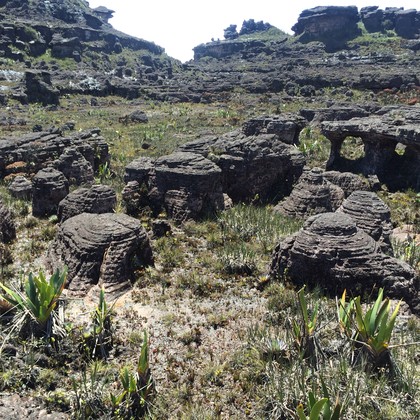
Where the bird is most at home, classified by the vegetation units of Amazonia and the Guianas.

Range and movements
Venezuela: on the tepuis of Bolívar and Amazonas, which hold most of the range, with a separate form on Cerro Sipapo. Guyana: in the far west, in the Pakaraima Mountains. Brazil: in the far north of Roraima, on the border with Venezuela and Guyana. Not in Suriname or French Guiana. Does not occur outside the guide area.
- Resident
- dark = core range, pale = thinly spread
How and when to look
Look in the montane forest of the Sierra de Lema along the road to the Gran Sabana, especially above 1200 m in stunted forest and bamboo thickets. Listen for the accelerating nasal song from the dense undergrowth.
Conservation status
Least Concern. Uncommon to locally common in a fairly small range, part of which lies in protected areas. The population size is unknown and probably decreasing; uncontrolled burning and gold mining are possible threats.
Scientific name
Thamnophilus insignis | Salvin & Godman, 1884
Salvin & Godman described the species in 1884 and placed it straight away in the genus where it still stands. The genus Thamnophilus was introduced in 1816 by Vieillot. Thamnophilus is Greek, from thamnos 'bush' and philos 'loving': 'bush-lover'. insignis is Latin for 'remarkable, distinguished', after this large, handsomely marked antshrike of the tepuis. The specimen the first description was based on came from Mount Roraima, c. 1,500 m.