All species › Passerines › Antbirds › Streak-fronted Antshrike
Streak-fronted Antshrike | Sakesphorus pulchellus
Streepkruinmierklauwier | Batará frentilistado | Choca-de-testa-estriada
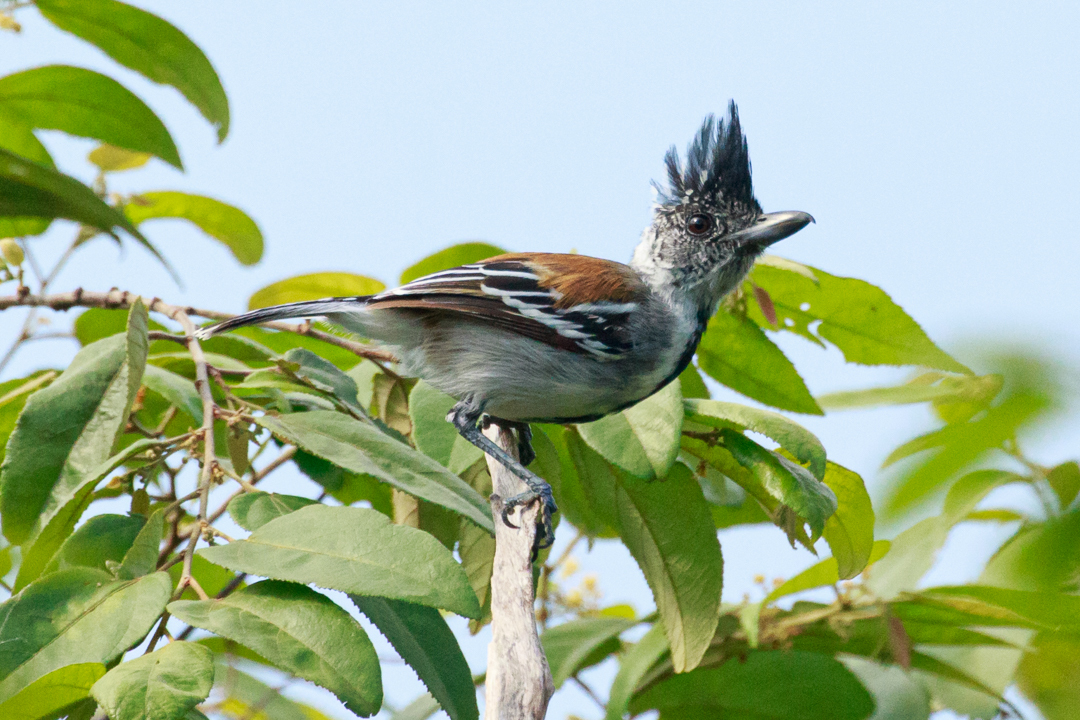
The Streak-fronted Antshrike is a crested antshrike of dry forest and thorn scrub in north-western Venezuela and northern Colombia. It was long included in Black-crested Antshrike Sakesphorus canadensis and is now often treated as a separate species, on the basis of plumage and song. The male has a black hood with white streaks on the forehead.
Voice
The song is a fast series of nasal notes that accelerates slightly, starting lower than in Black-crested Antshrike, with falling final notes and a snarling end. Calls are short, nasal and rasping notes.
No recording with a suitable Creative Commons licence is available for this species yet.
Identification
15–17 cm, with a heavy, hooked bill and a pointed crest. Male: head, crest, throat and centre of the breast black, with white streaks on the forecrown and fine white speckles on the throat, cheeks and supercilium; back pale cinnamon-brown; wings black with white edges; tail black with large white tips and a white outer web to the outermost feather. Rest of the underparts white, flanks greyish. Female: crown and crest rufous-brown, sides of the head streaked black and white, upperparts brown, underparts ochre with faint streaking on the breast.
Confusion species
Black-crested Antshrike Sakesphorus canadensis is very similar; the male lacks the white streaks on the forehead, has a darker, browner back and less white in the tail, and the song differs. The boundary between the two species in Venezuela is poorly known. Barred Antshrike Thamnophilus doliatus has a yellow iris; the male is barred black and white, the female plain rufous-brown without a black-and-white face.
Habitat
Dry and semi-deciduous forest, thorn scrub and cactus scrub, also mangrove edges, dry forest edges and bushes near farmyards; mainly in the lowlands. It forages low to mid-height in dense growth for insects and other invertebrates, usually in pairs. The nest is a deep cup suspended in the fork of a branch.
Where the bird is most at home, classified by the vegetation units of Amazonia and the Guianas.


Range and movements
Venezuela: in the north-west, around Lake Maracaibo in Zulia, in Falcón including the Paraguaná Peninsula, and in Lara. Not in Brazil, Guyana, Suriname or French Guiana. Outside the guide area in arid northern Colombia, including La Guajira. Little is known about the exact range and the transition to Black-crested Antshrike in western Venezuela.
How and when to look
Look for it in thorn scrub and dry forest on Paraguaná and around Coro in Falcón. Listen for the nasal series from dense bushes in the early morning; it is present all year.
Conservation status
Least Concern. Dry forest and scrub in north-western Venezuela are being lost locally to grazing, cutting and the expansion of agriculture, but the species tolerates some disturbance.
Scientific name
Sakesphorus pulchellus | (Cabanis & Heine, 1860) (GBIF: Sakesphorus canadensis)
Cabanis & Heine described the species in 1860 as Hypolophus pulchellus; because it was later moved to another genus, the author and year stand in brackets. The genus Sakesphorus was introduced in 1918 by Chubb. Sakesphorus is Greek, from sakesphoros 'shield-bearing' (sakos 'shield', -phoros 'bearing'). pulchellus is Latin for 'pretty', a diminutive of pulcher 'beautiful'. The specimen the first description was based on came from Cartagena, Colombia.