All species › Passerines › Tapaculos › Stresemann's Bristlefront
Stresemann's Bristlefront | Merulaxis stresemanni
Stresemanns tapaculo | Macuquiño de Stresemann | Entufado-baiano
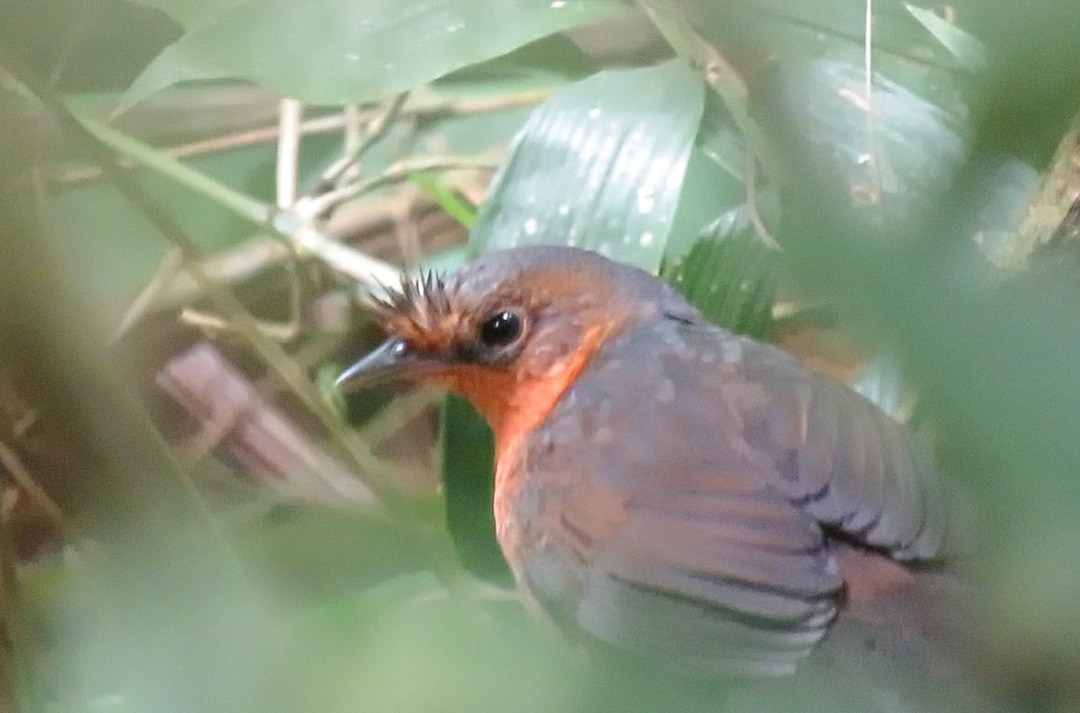
Stresemann's Bristlefront is one of the rarest birds in Brazil. It is known from only three specimens and a handful of sightings, photographs and recordings, and the only confirmed population lives in a small forest reserve on the border of Bahia and Minas Gerais. Like Slaty Bristlefront, it has bristle-like feathers on the forehead.
Voice
The song begins with a few clicks and turns into a trill; it resembles that of Slaty Bristlefront but is lower-pitched. The bird responds strongly to its own song.
Recording: Eduardo Patrial — CC BY-NC-SA 3.0 · xeno-canto
Identification
19–20 cm, medium-sized, with a long tail and long, pointed forehead bristles. The male is uniform slate-grey, with a dark rufous-chestnut rump, uppertail coverts and undertail coverts. The female is cinnamon-brown above with a darker tail and bright cinnamon below.
Confusion species
Slaty Bristlefront Merulaxis ater is very similar, but lives mainly farther south in the montane forests; it is slightly smaller, the male has a brown rather than rufous-chestnut rump, and its song is higher-pitched. Mouse-colored Tapaculo Scytalopus speluncae is much smaller, with a short tail and no forehead bristles.
Habitat
The dense undergrowth of humid lowland and hill forest with a thick layer of leaf litter. It forages on the forest floor, often near fallen trunks, probably for arthropods. The first known nest, found in 2013, was at the end of a tunnel about 1.8 m long.
Where the bird is most at home, classified by the vegetation units of Amazonia and the Guianas.

Range and movements
Endemic to Brazil. The only confirmed site is the Mata do Passarinho Reserve in Bandeira, on the border of northeastern Minas Gerais and southern Bahia. Older records come from the coastal forests of Bahia, including the areas of Salvador and Una. Not in Amazonia, Venezuela or the Guianas.
- Resident
- dark = core range, pale = thinly spread
How and when to look
The species can only be looked for in and around the Mata do Passarinho Reserve, where researchers locate it with recordings. Do not use playback without permission from the reserve managers; disturbance of such a small population must be avoided.
Conservation status
Critically Endangered. The world population is estimated at fewer than 50 mature individuals and may be much smaller. About 90 percent of the original forest in the region has gone; fragmentation, logging and the spread of agriculture remain the main threats. The reserve protects the last known forest where the species lives.
Scientific name
Merulaxis stresemanni | Sick, 1960
Sick described the species in 1960 and placed it straight away in the genus where it still stands. The genus Merulaxis was introduced in 1831 by Lesson. Merulaxis is a blend of the genus names Merula 'blackbird' and Synallaxis (spinetails); contemporaries already called it 'absurdly constructed'. stresemanni honours the German ornithologist Erwin Stresemann (1889–1972), mentor of Helmut Sick, who described the species in 1960. The specimen the first description was based on came from Salvador, Bahia, Brazil.