All species › Passerines › Antpittas › Tepui Antpitta
Tepui Antpitta | Myrmothera simplex
Bruinborstmierpitta | Tororoí flautista | Torom-de-peito-pardo
Tepui Antpitta is an antpitta of montane forest on the slopes of the tepuis of the Guiana Highlands. It occurs only in the guide area, in separate populations on individual table mountains in Venezuela, Guyana and the far north of Brazil. Four subspecies are recognised, which differ little from each other.

Voice
The song is a series of low, hollow notes at a steady pace, first rising slightly in pitch and strength and ending with a few notes on the same pitch. There is also a low, hollow rattling trill.
Recording: Felipe Arantes — CC BY-NC-SA 4.0 · xeno-canto
Identification
16 cm, round and short-tailed, on medium-length grey legs, with a black bill. The upperparts and face are chestnut-brown, with a small white spot behind the eye. The chin and throat are white. The breast and flanks are plain olive-grey to brownish-grey, without streaks or scaling; the centre of the belly is white. The subspecies duidae is browner on the breast, guaiquinimae more olive and pacaraimae paler. The sexes are alike.
Confusion species
Thrush-like Antpitta Myrmothera campanisona lives lower, in lowland forest at the foot of the tepuis, and has a white breast with grey-brown streaks. Scaled Antpitta Grallaria guatimalensis is larger, with scaled upperparts and warm rufous-brown underparts. Variegated Antpitta Grallaria varia is much larger, with white shaft streaks on the back and breast.
Habitat
Dense humid montane forest and cloud forest on the slopes of the tepuis and more open, stunted forest on the summits, from about 600 to 2400 m, mostly above 1200 m. It walks on the forest floor and searches there for insects and other invertebrates. Little is known about the nest.
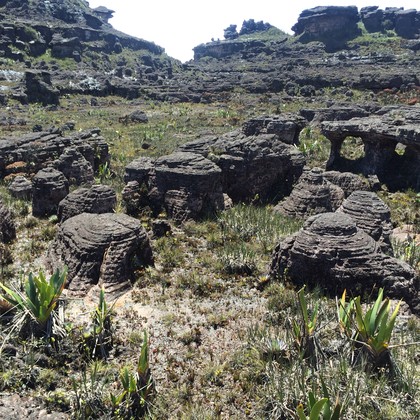
Where the bird is most at home, classified by the vegetation units of Amazonia and the Guianas.

Range and movements
Venezuela: on the tepuis of Bolívar and Amazonas, including the Gran Sabana and Roraima. Guyana: in the Pacaraima Mountains near Roraima. Brazil: only in the far north, in the border mountains of Roraima and northern Amazonas. Not in Suriname or French Guiana. Does not occur outside the guide area.
- Resident
- dark = core range, pale = thinly spread
How and when to look
Listen at dawn along the road from El Dorado to Santa Elena de Uairén, where it climbs through the cloud forest of the Sierra de Lema, for the series of low, hollow notes. Then search low at the forest edge along the road.
Conservation status
Least Concern according to the current assessment. The habitat on the tepuis is largely undisturbed and lies partly within national parks such as Canaima; no direct threats are known.
Scientific name
Myrmothera simplex | (Salvin & Godman, 1884)
Salvin & Godman described the species in 1884 as Grallaria simplex; because it was later moved to another genus, the author and year stand in brackets. The genus Myrmothera was introduced in 1816 by Vieillot. Myrmothera is Greek, from murmēx 'ant' and thēras 'hunter': 'ant-hunter'. simplex is Latin for 'simple, plain', after the plain, sparsely marked plumage. The specimen the first description was based on came from Mount Roraima (c. 1,500 m), Venezuela.