All species › Parrots › African and New World parrots › Tepui Parrotlet
Tepui Parrotlet | Nannopsittaca panychlora
Tepuiparkiet | Cotorrita de tepuí | Periquito-dos-tepuis
The Tepui Parrotlet is a small, short-tailed, almost entirely green parrot of the table mountains and highlands of the Guiana Shield. Flocks fly fast and high over the forest and wander widely, sometimes also into the lowlands at the foot of the tepuis. An isolated population lives on the Paria Peninsula in north-eastern Venezuela.
No photograph of a living wild bird of this species with a suitable Creative Commons licence exists. Do you have one that meets the rules? Send it in.
Voice
High, thin, somewhat buzzy calls such as tchee or tseet, mainly in flight and given by the whole flock at once; perched birds are mostly silent.
Recording: Eduardo D. Schultz — CC BY-NC-SA 3.0 · xeno-canto
Identification
14 cm, compact, with a short, wedge-shaped tail and a small, horn-coloured bill. The plumage is green, slightly darker above and more yellowish green below. There is a faint yellowish wash around the eye and on the lores. The flight feathers are green, with no blue, red or yellow in the wing. The sexes are alike. Juveniles are duller.
Confusion species
Green-rumped Parrotlet Forpus passerinus is smaller, with a paler bill; the male has blue in the wing. Golden-winged Parakeet Brotogeris chrysoptera has a longer, pointed tail, an orange chin spot and orange in the wing. Lilac-tailed Parrotlet Touit batavicus has black wings with yellow and a lilac tail, and Scarlet-shouldered Parrotlet Touit huetii has red under the wing. Manu Parrotlet Nannopsittaca dachilleae, outside this area apart from a few sites in Acre, has a pale blue forehead.
Habitat
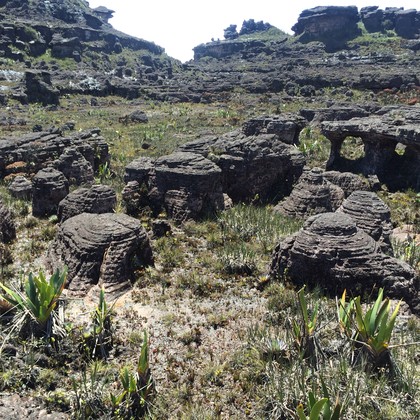
Humid montane and slope forest on the tepuis and highlands of the Guiana Shield, mostly between about 700 and 2000 m, also forest edges and scrub on sandstone; flocks occasionally visit forest in the lower country. It feeds on fruit, seeds and flowers in the canopy. Little is known about its breeding biology.
Where the bird is most at home, classified by the vegetation units of Amazonia and the Guianas.


Range and movements
In Venezuela on the tepuis and highlands of Bolívar and Amazonas, including the Sierra de Lema, the Gran Sabana and the Duida massif, and separately on the Paria Peninsula in Sucre. In Guyana in the Pakaraima Mountains. In Brazil in northern Roraima and Amazonas, including around Mount Roraima and Pico da Neblina. There are a few records from Suriname; absent from French Guiana. Almost entirely confined to the guide area.
- Resident
- dark = core range, pale = thinly spread
How and when to look
Along the road through the Sierra de Lema to the Gran Sabana in Bolívar, where flocks fly fast and high over the forest in the early morning. Listen for the high calls; in fruiting trees perched birds are inconspicuous among the green leaves.
Conservation status
Least Concern. Its habitat on the tepuis is largely intact and hard to reach; the population on the Paria Peninsula is small, and there forest is locally lost to farming.
Scientific name
Nannopsittaca panychlora | (Salvin & Godman, 1883)
Salvin & Godman described the species in 1883 as Brotogerys panychlorus; because it was later moved to another genus, the author and year stand in brackets. The genus Nannopsittaca was introduced in 1912 by Ridgway. Nannopsittaca is Greek, from nannos 'dwarf' and psittakē 'parrot': 'dwarf parrot', after the small size. panychlora is Greek, from pan 'all' and khlōros 'green': 'all green', after the plain green plumage. The specimen the first description was based on came from Mount Roraima, Guyana.