All species › Passerines › Manakins › Tiny Tyrant-Manakin
Tiny Tyrant-Manakin | Tyranneutes virescens
Kleine tiranmanakin | Saltarín diminuto | Uirapuruzinho-do-norte
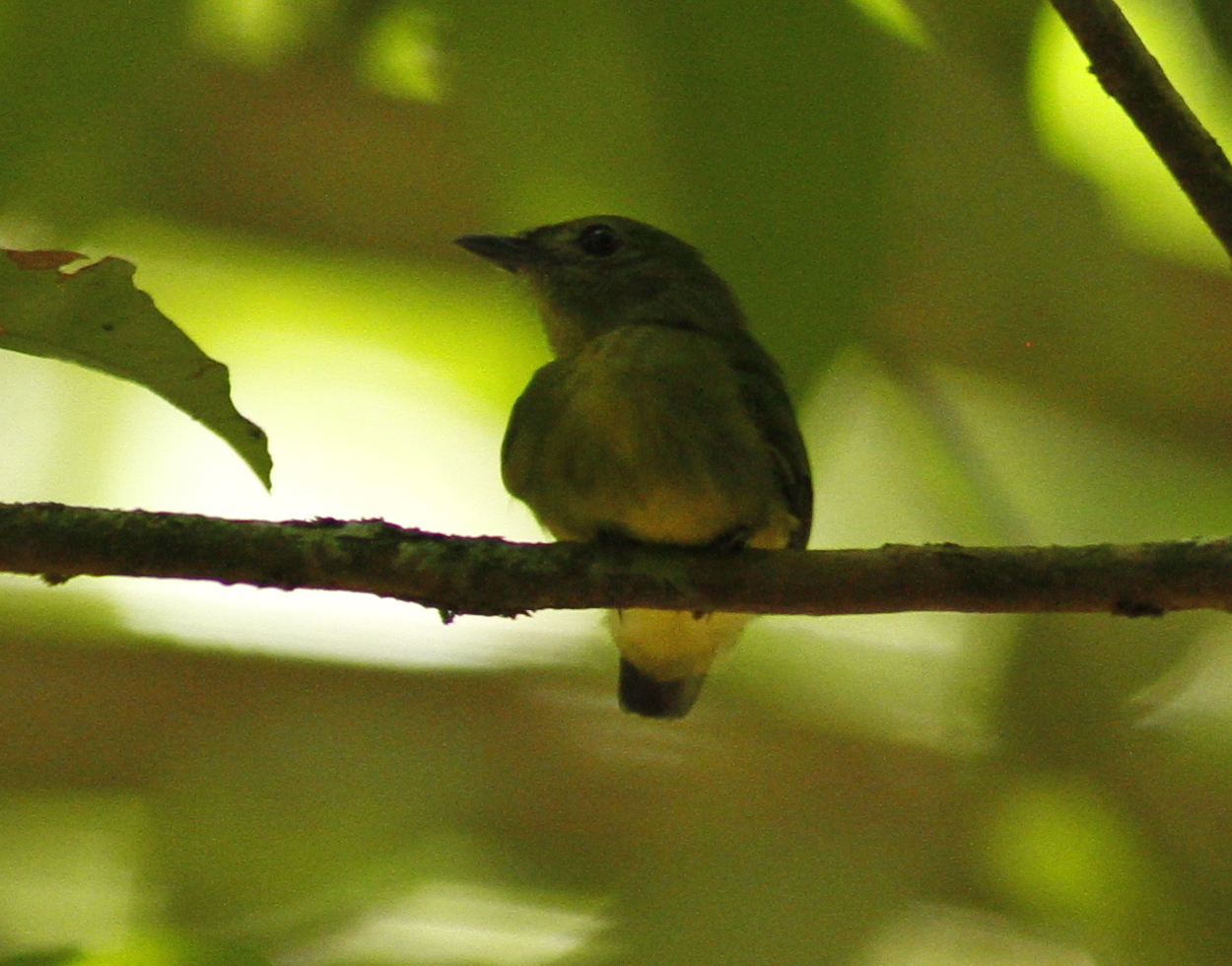
At 8 cm the Tiny Tyrant-Manakin is one of the smallest songbirds of the guide area: a plain olive-green bird with a very short tail. It is the north-eastern counterpart of the Dwarf Tyrant-Manakin and lives in lowland forest of the Guiana Shield and northern Brazilian Amazonia. Males sing for hours from a fixed song post and are noticed mainly in that way.
Voice
A short, quick phrase of a few husky, somewhat buzzy notes, roughly chi-chi-juu, repeated at intervals of a few seconds, often for much of the day from the same branch. Males sing scattered through the forest, within earshot of each other.
Recording: Pritam Baruah — CC BY-NC-SA 4.0 · xeno-canto
Identification
8 cm, with a small, short bill and a very short tail that gives the bird a stubby look. The upperparts are plain olive green. Throat and breast are greyish olive, the belly is pale yellow. The iris is dark. The crown has a yellow stripe that usually stays hidden under the feathers and becomes visible in display. There are no wing bars. The sexes are almost alike; in the female the crown stripe is smaller or absent.
Confusion species
Dwarf Tyrant-Manakin Tyranneutes stolzmanni is very similar but has a pale iris and no yellow crown stripe; it lives south of the Amazon and west of the Rio Negro. Females of White-crowned Manakin Pseudopipra pipra and Golden-headed Manakin Ceratopipra erythrocephala are larger, with a longer tail and no yellow crown stripe. Saffron-crested Tyrant-Manakin Neopelma chrysocephalum is much larger and longer-tailed.
Habitat
Humid lowland terra firme forest, locally also tall secondary forest and white-sand forest, up to about 900 m on the slopes of the Guiana Highlands. It lives in the lower and middle storeys and eats small fruit and insects, which it plucks from leaves in a short flight. The nest is a small open cup in a low twig fork.
Where the bird is most at home, classified by the vegetation units of Amazonia and the Guianas.




Range and movements
In Brazil north of the Amazon and east of the Rio Negro, in Amazonas, Roraima, northern Pará and Amapá. In Venezuela in the east, in Bolívar and Delta Amacuro. In Guyana, Suriname and French Guiana widespread in the interior. Resident; its range largely coincides with the Guiana Shield. The species does not occur outside the guide area.
- Resident
- dark = core range, pale = thinly spread
How and when to look
In the terra firme forest of the Guianas, for example in the interior of Suriname or French Guiana or around Manaus north of the Amazon, listen for the repeated short phrase. Then search the mid-storey for a small bird sitting still; it often stays on the same branch for a long time.
Conservation status
Least Concern. The species is common in a large area with much intact rainforest, especially in the Guianas; locally forest is lost to logging, mining and clearance.
Scientific name
Tyranneutes virescens | (Pelzeln, 1868)
Pelzeln described the species in 1868 as Pipra virescens; because it was later moved to another genus, the author and year stand in brackets. The genus Tyranneutes was introduced in 1881 by Sclater & Salvin. Tyranneutes is Greek, from turanneuō 'to be a tyrant', because these manakins closely resemble tyrant flycatchers (Tyrannidae). virescens is Latin for 'greenish', after the olive-green upperparts. The specimen the first description was based on came from Manaus, Brazil.