All species › Passerines › Antbirds › Variable Antshrike
Variable Antshrike | Thamnophilus caerulescens
Grijskapmierklauwier | Batará variable | Choca-da-mata
The Variable Antshrike is a small antshrike with a heavy bill hooked at the tip, which owes its English and Spanish names to the large differences in colour between its subspecies. In the guide area it lives only in Brazil, where it is one of the commonest antbirds of the Atlantic Forest. Pairs often stay hidden in dense vegetation and give themselves away by their song.

Voice
The song is an accelerating series of short, nasal notes ending in a slightly lower final note, as in many antshrikes. Also growling and plaintive calls. Both sexes sing, often in alternation.
Recording: Robson Silva e Silva — CC BY-NC-SA 4.0 · shortened to the first 60 s, mono · xeno-canto
Identification
14–16 cm, with a short crest raised when excited and a fairly long tail. The male is grey with a blacker crown, white spots and edges on the wing coverts and white tips to the tail feathers; depending on subspecies the belly is pale grey, white or ochre, and birds from the north-east are darker grey. The female is olive-brown above with a more rufous crown, and ochre-yellow to warm buff below; she too has pale wing spots. The iris is dark.
Confusion species
Rufous-capped Antshrike Thamnophilus ruficapillus has a rufous crown and rufous wings in both sexes; the male has a finely barred breast. Planalto Slaty Antshrike Thamnophilus pelzelni and Sooretama Slaty Antshrike Thamnophilus ambiguus have more white in the wing, and their females are rufous-brown with a streaked face rather than olive-brown with ochre-yellow underparts. Plain Antvireo Dysithamnus mentalis is smaller and stockier, with a short tail and a dark mask.
Habitat
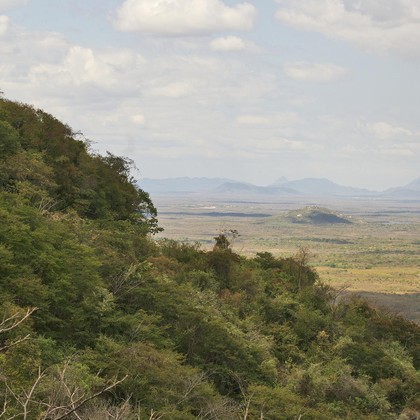
Shrubbery, forest edges, clearings with undergrowth, secondary forest, bamboo and roadside thickets in the Atlantic Forest, the araucaria forest and the gallery forest of the cerrado, from sea level to about 2000 m; in the north-east in humid forest on hills. It searches dense vegetation for insects and other invertebrates, often just above the ground, and sometimes joins mixed flocks. The nest is an open cup in the fork of a shrub.
Where the bird is most at home, classified by the vegetation units of Amazonia and the Guianas.






Range and movements
Brazil: widespread in the Atlantic Forest, from Ceará, Pernambuco and Alagoas south to Rio Grande do Sul, and inland in Minas Gerais, Goiás, the Distrito Federal and Mato Grosso do Sul, mainly in gallery forest. Not in Amazonia, Venezuela or the Guianas. Outside the guide area on the east slope of the Andes in Peru and Bolivia and in Paraguay, northern Argentina and Uruguay.
- Resident
- dark = core range, pale = thinly spread
How and when to look
In almost any tract of Atlantic Forest with dense undergrowth, also in city parks and gardens at the forest edge, as at Itatiaia, the Serra dos Órgãos and the forests around São Paulo. Often first identified by song; patient waiting usually yields a glimpse.
Conservation status
Least Concern. It tolerates forest disturbance well and also occurs in secondary growth. The isolated forms of north-eastern Brazil live in small forest remnants.
Scientific name
Thamnophilus caerulescens | Vieillot, 1816
Vieillot described the species in 1816 and placed it straight away in the genus where it still stands. He introduced the genus Thamnophilus in that same work. Thamnophilus is Greek, from thamnos 'bush' and philos 'loving': 'bush-lover'. caerulescens is Latin for 'bluish', after the male's blue-grey plumage. The specimen the first description was based on came from Paraguay.