All species › Gamebirds › Guans, curassows and chachalacas › Wattled Guan
Wattled Guan | Aburria aburri
Lelgoean | Pava carunculada | Jacu-de-barbela
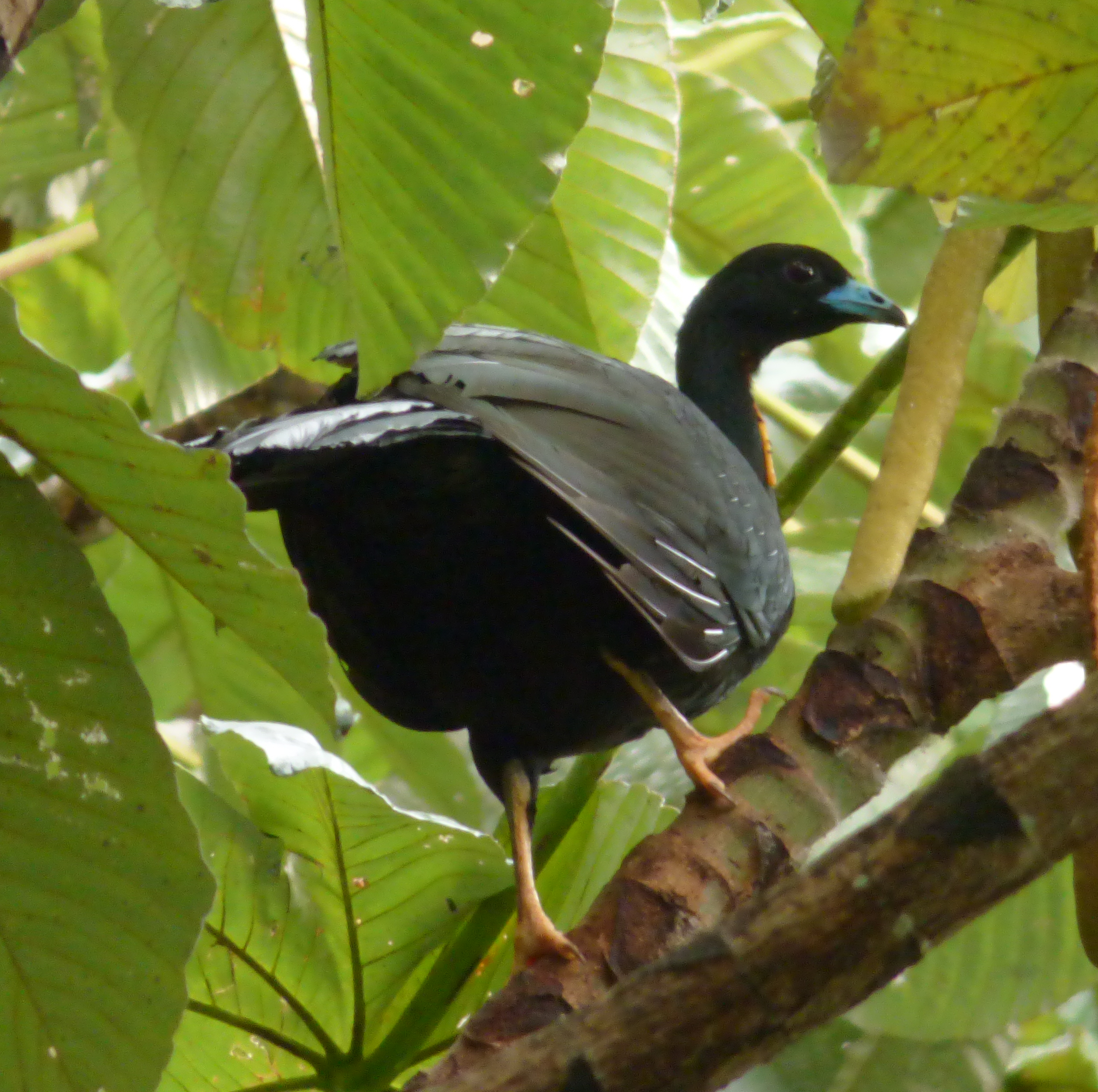
The Wattled Guan is a large, glossy black guan of the montane forests on the slopes of the Andes. In the guide area it lives only in western Venezuela. A long, thin, yellow wattle hangs from the throat, unique among the gamebirds of the guide area. The scientific name aburri derives from the deep, rolling call that is heard mainly at night and before dawn.
Voice
A deep, rolling, slightly rising call, roughly a-boorrr, repeated at intervals; heard mainly at night and in the twilight before dawn and audible from far away. Also low, guttural notes.
Recording: Alain Verneau — CC BY-NC-SA 4.0 · shortened to the first 60 s, mono · xeno-canto
Identification
70–78 cm, large and fairly slender, with a long, broad tail and a small head. The entire plumage is black with a green to bronze gloss, strongest on the wings and tail. The bill is pale blue with a dark tip. A narrow, bright yellow wattle a few centimetres long hangs from the throat. The legs are yellow. The sexes are alike; young birds are duller and have a shorter wattle.
Confusion species
Andean Guan Penelope montagnii and Band-tailed Guan Penelope argyrotis are smaller and brown, with a small red dewlap and pale feather edges on the breast. Crested Guan Penelope purpurascens is olive-brown, with a crest and a red dewlap, and usually lives lower. Helmeted Curassow Pauxi pauxi is heavier, with a grey-blue casque on a red bill, and walks mainly on the forest floor.
Habitat
Humid montane and foothill forest, especially on steep slopes and in ravines, also forest edges and tall secondary growth, mostly between 600 and 2500 m. It lives mainly in the canopy, alone or in pairs, and eats fruit, such as that of palms and laurels. Little is known about the nest; it is placed in a tree.
Where the bird is most at home, classified by the vegetation units of Amazonia and the Guianas.

Range and movements
In Venezuela only in the west: in the Serranía de Perijá and on the slopes of the Andes, mainly in the south-west. Absent from Brazil and the Guianas; the few reports from Brazil are probably errors. Outside the guide area in the Andes of Colombia, Ecuador and Peru.
- Resident
- dark = core range, pale = thinly spread
How and when to look
At dusk and at night, listen along forest trails at middle elevations on the Andean slopes of western Venezuela for the rolling call; by day the bird often sits quietly high in fruiting trees.
Conservation status
Least Concern (IUCN). In Venezuela local and scarce; sensitive to hunting and to clearance of montane and foothill forest, and disappears where forest is opened up.
Scientific name
Aburria aburri | (Lesson, 1828)
Lesson described the species in 1828 as Penelope aburri; because it was later moved to another genus, the author and year stand in brackets. The genus Aburria was introduced in 1853 by Reichenbach. Aburria comes from aburri, the Colombian local name for the Wattled Guan, an imitation of its call. aburri is the Colombian local name for this guan, an imitation of its call, heard at dusk and dawn. The specimen the first description was based on came from the mountains of Colombia (then New Granada).