All species › Passerines › Antpittas › White-browed Antpitta
White-browed Antpitta | Hylopezus ochroleucus
Witbrauwmierpitta | Tororoí teguá | Torom-do-nordeste
White-browed Antpitta is a small, almost tailless antpitta found only in eastern Brazil. It lives in the caatinga and dry forests of the interior of the north-east, an unusually dry habitat for an antpitta. It lives on the ground in dense scrub and is noticed mainly by its song.

Voice
The song is a series of about ten clear, hollow whistles that rise slightly in pitch and grow in strength. It sings from the ground or a low branch, mainly early in the morning and in the rainy season.
Recording: Aran Rodrigues Cardoso — CC BY-NC-SA 4.0 · shortened to the first 60 s, mono · xeno-canto
Identification
13–14 cm, round, with a very short tail and long pinkish-grey legs. The upperparts are olive-brown, the crown slightly greyer. A broad ochre-white supercilium and a pale eye-ring give the head a clear pattern. The underparts are white, with black spots and streaks on the breast and flanks; the flanks are washed with ochre. The sexes are alike.
Confusion species
Speckle-breasted Antpitta Cryptopezus nattereri is very similar, but lacks the white supercilium, has an ochre breast with denser spotting and lives in humid montane forest in south-eastern and southern Brazil. Spotted Antpitta Hylopezus macularius and related species live in the rainforest of Amazonia, far outside the range of this species.
Habitat
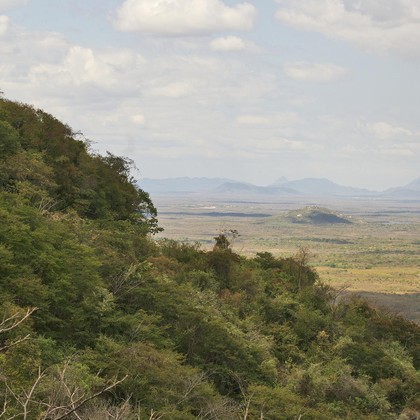
Dense scrub and the understorey of caatinga, dry and semi-deciduous forest and liana forest (mata de cipó) in the interior, from the lowlands to about 1200 m. It walks on the ground and searches the leaf litter for insects and other invertebrates. The nest is an open cup of leaves and twigs low in a shrub.
Where the bird is most at home, classified by the vegetation units of Amazonia and the Guianas.


Range and movements
Only in Brazil: in the interior of the north-east, from Piauí and Ceará south through Pernambuco and Bahia to northern Minas Gerais. Not in Venezuela or the Guianas. Does not occur outside the guide area.
- Resident
- dark = core range, pale = thinly spread
How and when to look
Listen early in the morning in the liana forest around Boa Nova in Bahia or in the dry forests of the Chapada Diamantina for the series of whistles. Then search low in dense scrub.
Conservation status
Least Concern according to the current assessment. The species is sensitive to the clearance of caatinga and dry forest for farming and charcoal, which has left its habitat in the north-east strongly fragmented.
Scientific name
Hylopezus ochroleucus | (Wied-Neuwied, 1831)
Wied-Neuwied described the species in 1831 as Myioturdus ochroleucus; because it was later moved to another genus, the author and year stand in brackets. The genus Hylopezus was introduced in 1909 by Ridgway. Hylopezus is Greek, from hulē 'woodland' and pezos 'walking', after its life on the forest floor. ochroleucus is Greek, from ōkhros 'ochre' and leukos 'white', after the pale, yellowish-white underparts. The specimen the first description was based on came from Arraial da Conquista (now Vitória da Conquista), southern Bahia, Brazil.