All species › Passerines › Antbirds › Yellow-browed Antbird
Yellow-browed Antbird | Hypocnemis hypoxantha
Geelbrauwmierkruiper | Hormiguero cejiamarillo | Cantador-amarelo
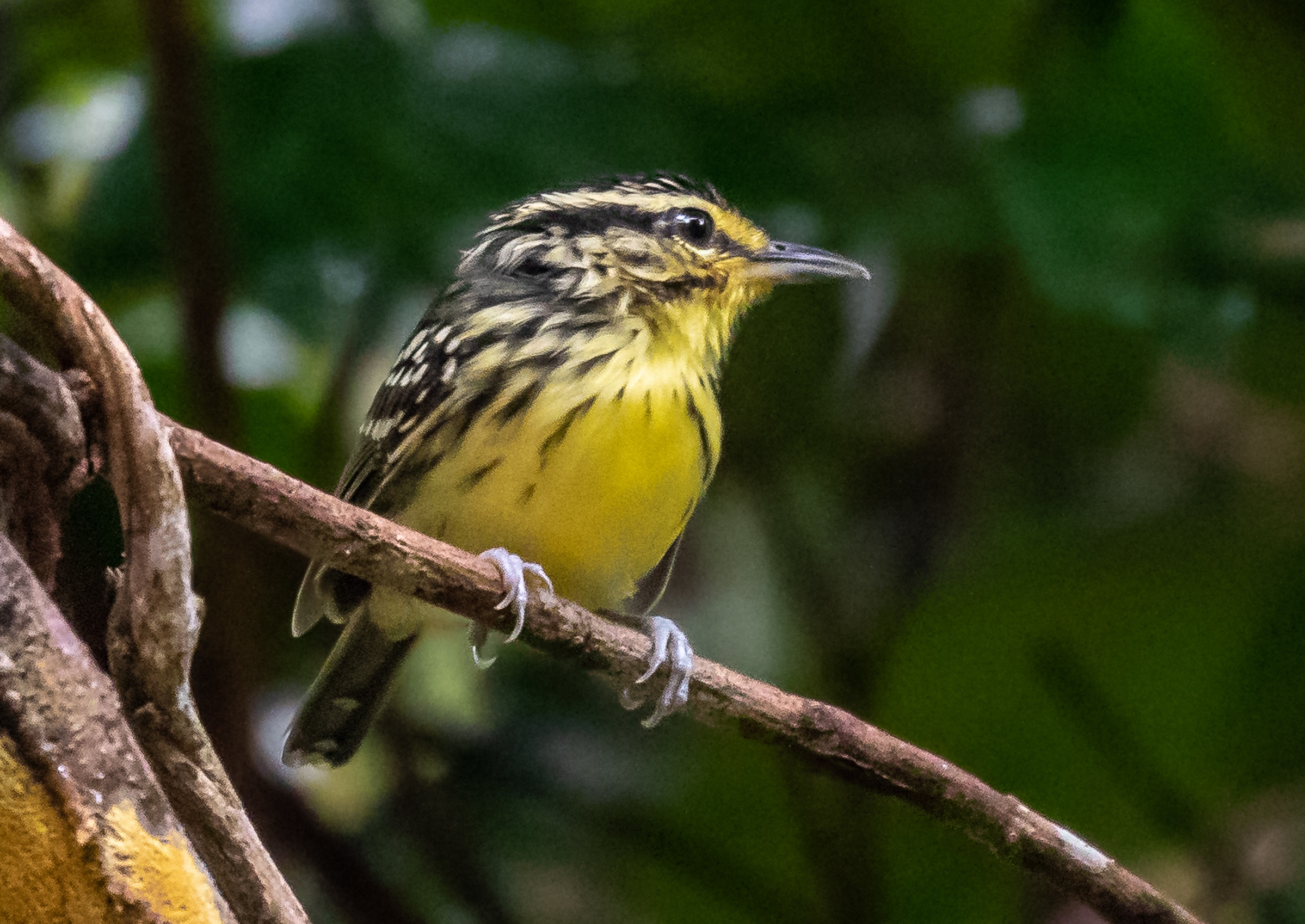
The Yellow-browed Antbird is a small, lemon-yellow relative of the warbling antbirds of Amazonian terra firme forest. Unlike those species it forages mainly in the midstorey and often joins mixed flocks. In the guide area it lives only in Brazil, with one subspecies north and one south of the Amazon.
Voice
The song is an even, slow, descending series of modulated whistles, often answered by the female. Calls are a whistled, plaintive descending series, pwee-pwee-pwee, and a burry grr-grr.
Recording: GABRIEL LEITE — CC BY-NC-SA 4.0 · converted to mono · xeno-canto
Identification
12 cm, compact, with a fairly short tail. The male has a black crown with white spots in the centre, a broad lemon-yellow supercilium and ear coverts, a black eyeline and malar stripe and pale greyish-olive upperparts. The wing coverts are black with white tips. Throat and underparts are lemon-yellow, with a few black streaks on the breast. The female is duller, with pale buff spots on the crown and wing coverts. The subspecies ochraceiventris south of the Amazon is larger and browner, paler yellow and more streaked below, with ochraceous flanks.
Confusion species
The warbling antbirds in the same area, such as Peruvian Warbling Antbird Hypocnemis peruviana and Spix's Warbling Antbird Hypocnemis striata, have a white supercilium, a white or whitish throat and rufous flanks, and live lower in the understorey. Yellow-breasted Warbling Antbird Hypocnemis subflava is also yellow below, but has a white supercilium and lives in bamboo in the south-west. Spot-backed Antbird Hylophylax naevius has a spotted back and white or ochre underparts.
Habitat
Understorey to midstorey of the interior of terra firme forest and mature secondary forest in the lowlands, up to about 400 m. It searches for insects and spiders among leaves and vines, usually a few metres to over 10 m above the ground, often in mixed flocks. Pairs stay in their territory all year. Little is known about the nest.
Where the bird is most at home, classified by the vegetation units of Amazonia and the Guianas.


Range and movements
Brazil: in western Amazonas, north of the Solimões to the Rio Negro and south of it to the Javari and Juruá (nominate form); the subspecies ochraceiventris south of the Amazon, from the Tapajós and Teles Pires east to the Xingu, in Pará and northern Mato Grosso. Not in Venezuela, Guyana, Suriname or French Guiana. Resident. Outside the guide area in south-eastern Colombia, eastern Ecuador and north-eastern Peru.
- Resident
- dark = core range, pale = thinly spread
How and when to look
Follow mixed flocks in tall terra firme forest, for example in western Amazonas or between the Tapajós and the Xingu. Listen for the descending whistled series from the vines above the understorey; the yellow underparts and supercilium can be seen between the leaves.
Conservation status
Least Concern. The species has a large range; the population is probably declining slowly. It depends on tall forest, and deforestation in southern Amazonia, especially between the Tapajós and the Xingu, affects the habitat of the subspecies ochraceiventris.
Scientific name
Hypocnemis hypoxantha | Sclater, 1869
Sclater described the species in 1869 and placed it straight away in the genus where it still stands. The genus Hypocnemis was introduced in 1847 by Cabanis. Hypocnemis is Greek, from hupo 'somewhat' and knēmis 'legging, greave': 'booted', after the look of the legs. hypoxantha is Greek, from hupo 'below' and xanthos 'yellow', after the yellow underparts. The specimen the first description was based on came from upper Amazon (not specified further).