All species › Passerines › Manakins › Yellow-crested Manakin
Yellow-crested Manakin | Heterocercus flavivertex
Geelkruinmanakin | Saltarín crestiamarillo | Dançarino-de-crista-amarela
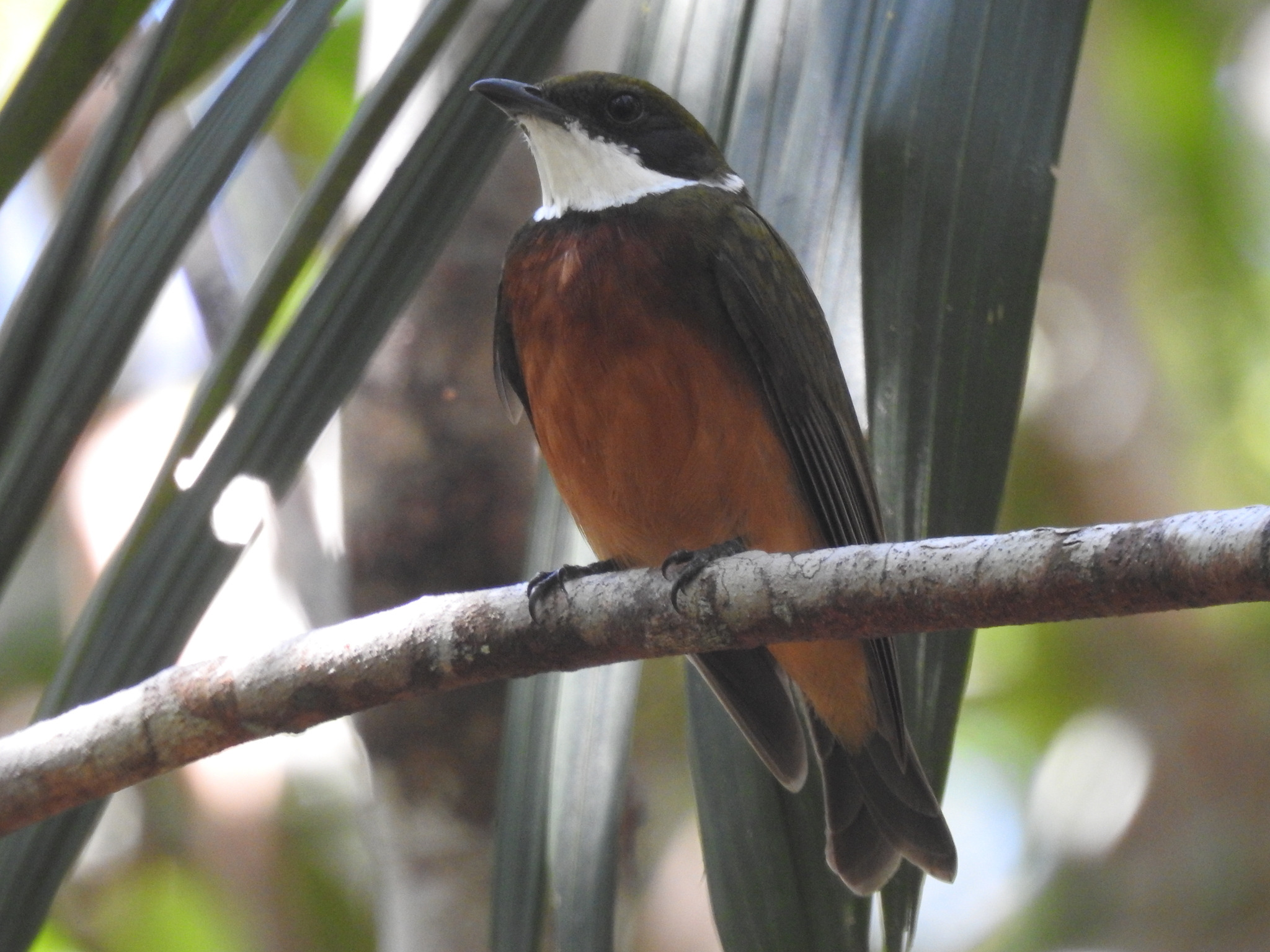
The Yellow-crested Manakin is a large manakin of blackwater rivers and igapó in the Rio Negro and upper Orinoco drainages. It lives north of the Amazon; south of it, it is replaced by Flame-crested Manakin. The male has a yellow crown stripe that is usually concealed.
Voice
A high, thin, slightly descending whistle and sharp, repeated chip notes.
Recording: GABRIEL LEITE — CC BY-NC-SA 4.0 · xeno-canto
Identification
14 cm, with a fairly long tail. The male is olive-green above, with a greyish head, a white throat with silky, slightly elongated feathers at the sides and a warm brown breast that becomes buffy towards the belly. On the crown a yellow, usually concealed stripe. The female has no crown stripe and a duller breast.
Confusion species
Flame-crested Manakin Heterocercus linteatus has a red crown stripe and a blacker head and lives south of the Amazon. Black Manakin Xenopipo atronitens of white-sand forest and campina is smaller; the male is entirely black. Varzea Schiffornis Schiffornis major of flooded forest is plain rusty brown, without a white throat.
Habitat
Igapó, blackwater forest and scrub along the banks of blackwater rivers and lakes, also white-sand forest close to water, below about 300 m. It lives in the lower and middle storeys and eats fruit and insects.
Where the bird is most at home, classified by the vegetation units of Amazonia and the Guianas.



Range and movements
In Brazil north of the Amazon, in the drainage of the Rio Negro and its tributaries, east to western Pará. In Venezuela in the south, in Amazonas, along the upper Orinoco, the Casiquiare and the Río Atabapo, and locally in south-eastern Apure. Absent from Guyana, Suriname and French Guiana. Outside the guide area in eastern Colombia.
- Resident
- dark = core range, pale = thinly spread
How and when to look
Along the forested banks of the Rio Negro, for example in the Anavilhanas archipelago upstream of Manaus, and in Venezuela along the Río Atabapo. Search from a boat along the bank, in the lower and middle storeys.
Conservation status
Least Concern. The blackwater forest in its range is still largely intact.
Scientific name
Heterocercus flavivertex | Pelzeln, 1868
Pelzeln described the species in 1868 and placed it straight away in the genus where it still stands. The genus Heterocercus was introduced in 1862 by Sclater. Heterocercus is Greek, from heteros 'different' and kerkos 'tail', after the unusual tail. flavivertex is Latin, from flavus 'yellow' and vertex 'crown', after the male's yellow crown stripe. The specimen the first description was based on came from Marabitanas, Rio Negro, Amazonas, Brazil.