All species › Waterfowl › Ducks, swans and geese › Andean Teal
Andean Teal | Anas andium
Andestaling | Cerceta andina | Marreca-andina
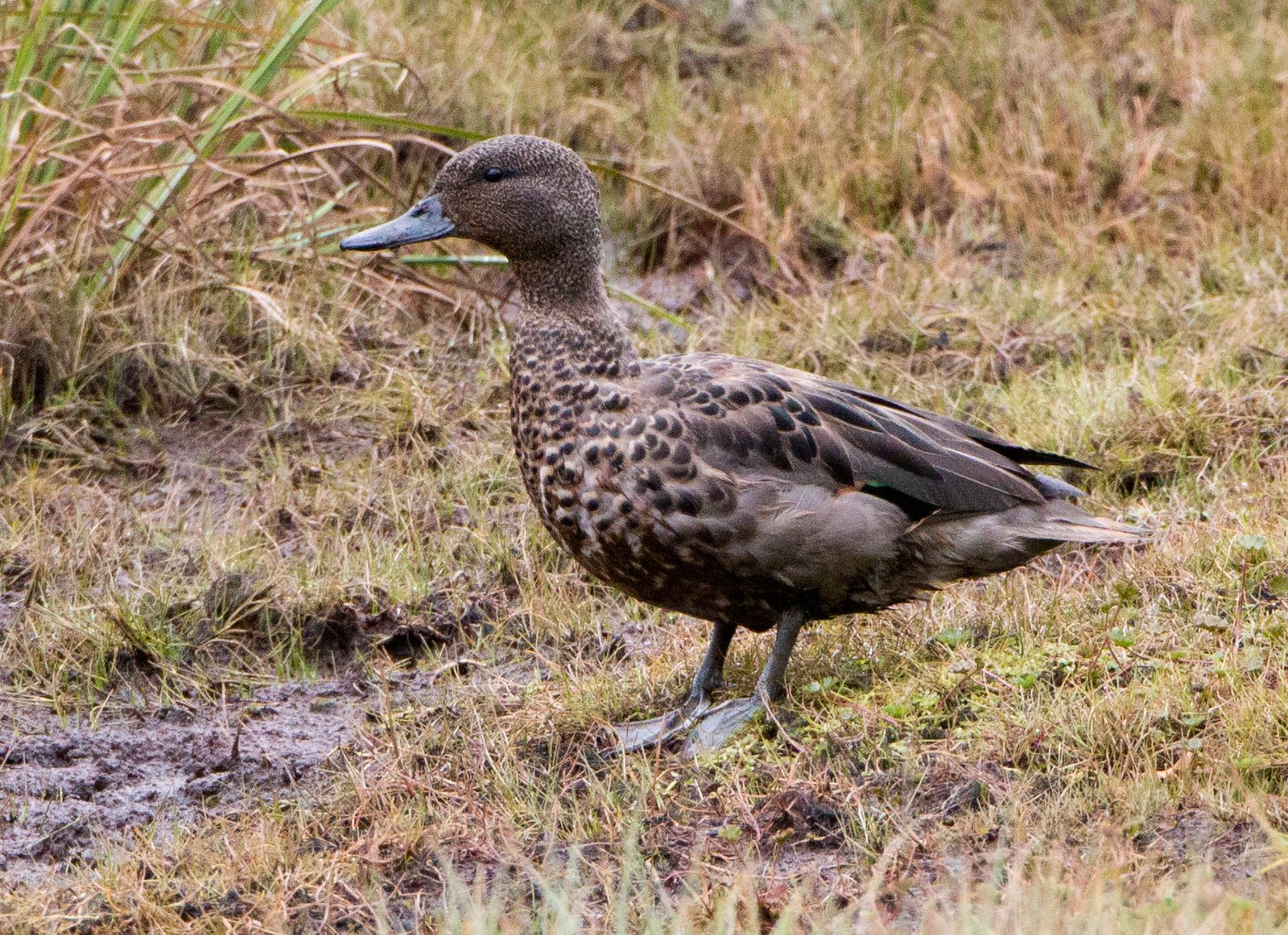
The Andean Teal is a small, dark teal of the lakes and bogs of the páramo in the northern Andes. It was long treated as a subspecies of Yellow-billed Teal, but differs in its dark bill and heavily speckled, grey head. In Colombia and Ecuador it is the common teal of the high mountains.
Voice
The male gives a clear, short, whistled prrip; the female a rasping, descending quack.
Recording: Leonardo Ordóñez-Delgado — CC BY-NC-SA 4.0 · xeno-canto
Identification
38–43 cm, stocky, with a rounded head and a short, pointed tail. The head and neck are grey with dense dark speckles, without an obvious cap or eye-stripe. The body is greyish brown, with dark spots on the breast and flanks. The bill is dark blue-grey, without yellow. The speculum is blackish with a green gloss and buff borders. The sexes are nearly alike.
Confusion species
Yellow-billed Teal Anas flavirostris has a yellow bill and lives further south. Yellow-billed Pintail Anas georgica is larger and slimmer, with a yellow bill and a long, pointed tail. Female Blue-winged Teal Spatula discors has a dark eye-stripe, a pale spot at the base of the bill and pale blue forewings. Crested Duck Lophonetta specularioides is much larger, with a longer tail and a coppery speculum.
Habitat
Lakes, pools, bogs and slow-flowing streams in the páramo and the upper montane zone, roughly between 2500 and 4300 m. It dabbles in shallow water and along shores for seeds, aquatic plants and invertebrates. It nests on the ground among grass tussocks or dense shoreline vegetation.
Where the bird is most at home, classified by the vegetation units of the Andes and the west coast.


Range and movements
In Colombia in the Central and Eastern Andes. In Ecuador in the Andes throughout the country. To the south, in Peru, it is replaced by Yellow-billed Teal. Absent from Bolivia and the Galápagos. Outside the guide area in the Andes of western Venezuela.
- Resident
- dark = core range, pale = thinly spread
How and when to look
Search the lakes of the páramo, for example in Cayambe-Coca National Park and at Papallacta Pass and Laguna de Mica in Ecuador, or in Chingaza National Park and on the lakes of the Sabana de Bogotá in Colombia.
Conservation status
Least Concern. Hunted locally; páramo bogs and lakes are under pressure from water extraction, grazing and burning of the vegetation.
Scientific name
Anas andium | (Sclater & Salvin, 1873)
Sclater & Salvin described the species in 1873 as Querquedula andium; because it was later moved to another genus, the author and year stand in brackets. The genus Anas was introduced in 1758 by Linnaeus. The genus name comes from Latin anas, 'duck'. The species name means 'of the Andes' and refers to the Andes mountains. The specimen the first description was based on came from Between Riobamba and Mocha, Ecuador.