All species › Waterfowl › Ducks, swans and geese › Torrent Duck
Torrent Duck | Merganetta armata
Bergbeekeend | Pato torrentero | Pato-das-torrentes
The Torrent Duck is the only duck that lives permanently in the fast, churning water of Andean rivers. It swims and dives against the current, clambers onto wet boulders and props itself on its long, stiff tail. Each pair defends a fixed stretch of river all year.
Voice
The male gives a high, piercing whistle, wheet, that carries above the roar of the water, often in flight. The female has a lower, harsher call.
Recording: Cristian Pinto — CC BY-NC-SA 4.0 · xeno-canto
Identification
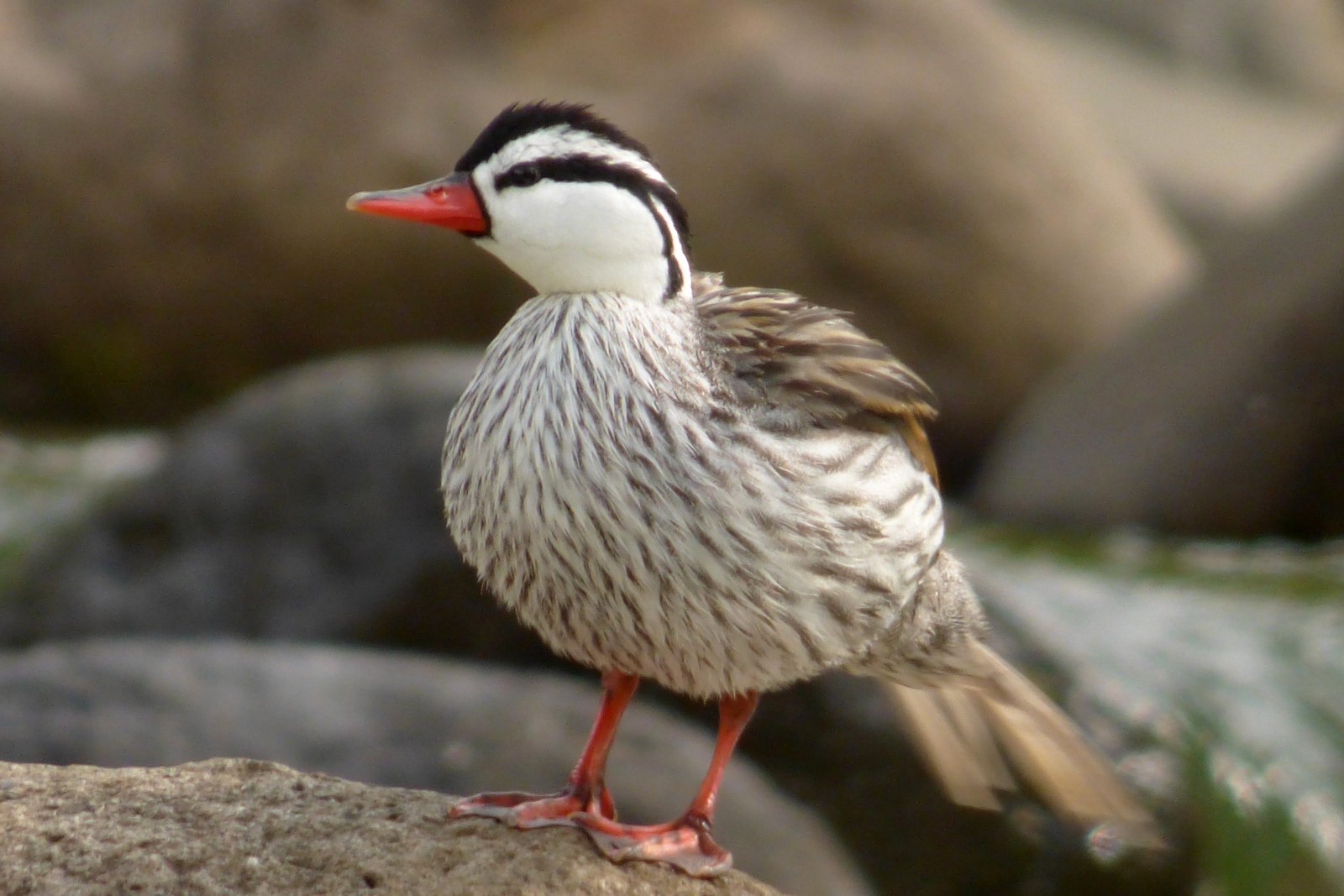
40–46 cm, slim and streamlined, with a long, stiff tail and a narrow, red bill. The male has a white head and neck with a black pattern: a stripe over the crown and hindneck and a stripe through the eye that runs down the neck. The back is streaked black and greyish brown. The underparts vary by form: pale greyish brown with dark streaks in the north, darker further south, with an almost black breast in southern birds. The female has a grey, finely streaked head and upperparts and plain rufous throat and underparts. Juveniles are grey above and white below, with barred flanks.
Confusion species
No duck in the guide area closely resembles it. Andean Teal Anas andium and Yellow-billed Pintail Anas georgica are brown and spotted, without head stripes, and live on lakes and slow water, not in rapids. White-capped Dipper Cinclus leucocephalus shares the same rivers but is much smaller, blackish brown with a white crown, and bobs on the rocks.
Habitat
Fast, rocky rivers and mountain streams with clear water in the Andes, mostly between 1000 and 3500 m, locally lower or up to over 4000 m. It dives in the current and picks insect larvae, especially of stoneflies, caddisflies and mayflies, from the stones. The nest is in a rock crevice, a hole in the bank or among roots, close to the water.
Where the bird is most at home, classified by the vegetation units of the Andes and the west coast.


Range and movements
In Colombia in all three Andean ranges. In Ecuador on both slopes of the Andes. In Peru along the whole length of the Andes, mainly on the eastern slope. In Bolivia along the eastern slope of the Andes. Absent from the Galápagos. Outside the guide area in western Venezuela and in the Andes of Chile and Argentina.
- Resident
- dark = core range, pale = thinly spread
How and when to look
Scan wet boulders in white water from bridges and banks along clear, fast rivers, preferably in the early morning. In Peru for example along the Urubamba near Machu Picchu, in Ecuador along the rivers around Papallacta.
Conservation status
Least Concern. Locally declining because of dams and hydroelectric plants, pollution and siltation, and because of introduced trout, which feed on the same insect larvae.
Scientific name
Merganetta armata | Gould, 1842
Gould described the species in 1842 and placed it straight away in the genus where it still stands. He introduced the genus Merganetta in that same work. The genus name combines Mergus, the merganser genus, with Greek netta, 'duck'. Latin armata means 'armed', after the spurs at the bend of the wing. The specimen the first description was based on came from central Chile.