All species › Cranes, rails and allies › Rails, gallinules and coots › Ash-throated Crake
Ash-throated Crake | Mustelirallus albicollis
Askeelral | Polluela piquiceniza | Sanã-carijó
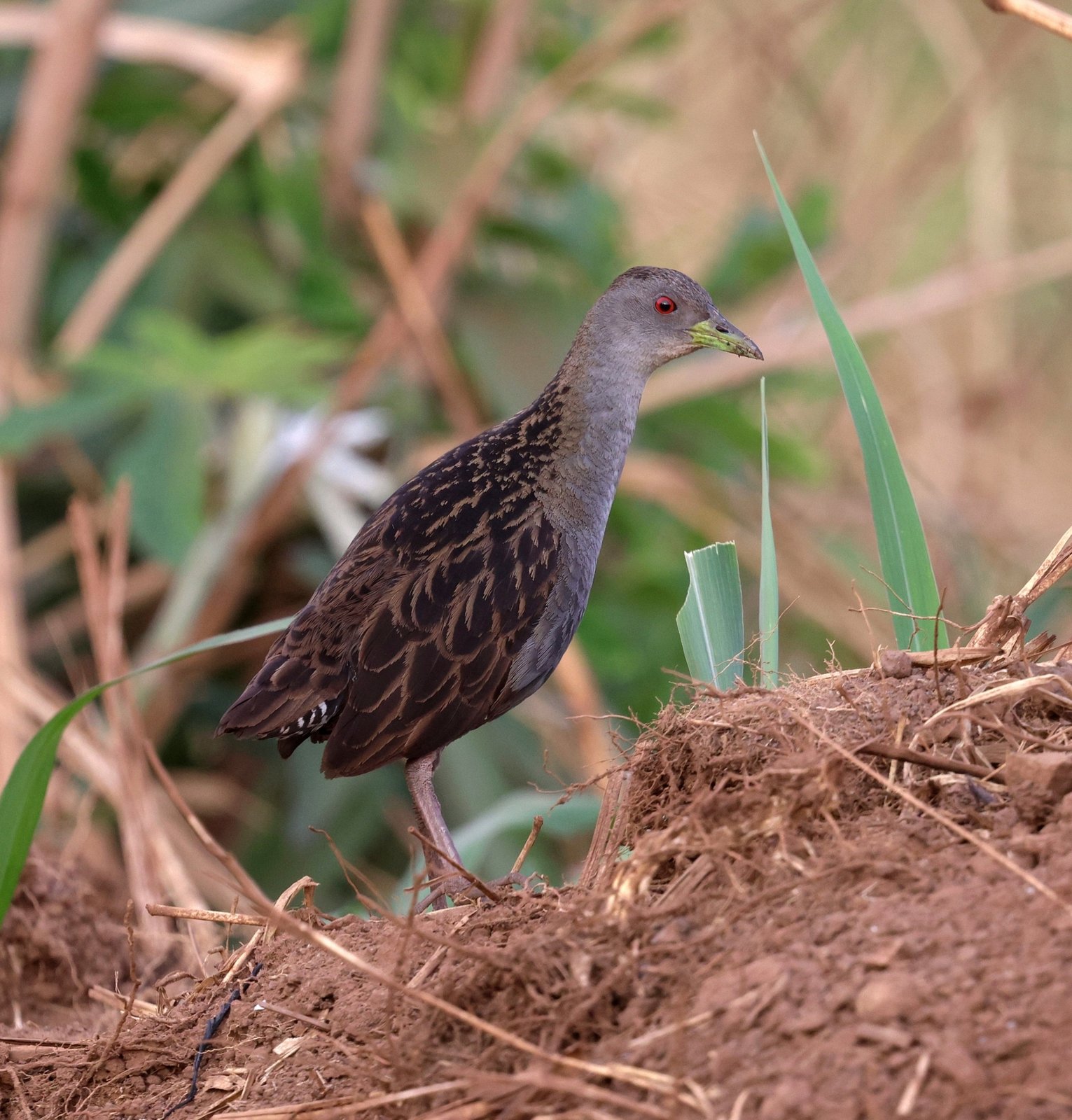
The Ash-throated Crake is a medium-sized rail of wet grassland and savanna in the lowlands. It has streaked upperparts, grey underparts and barred flanks, and lives hidden in tall grass. In the guide area it occurs mainly in northern and eastern Colombia and in the savannas of Bolivia.
Voice
A long, loud, rasping series, often in duet, swelling at the start; mainly at dusk and at night.
Recording: JAYRSON ARAUJO DE OLIVEIRA — CC BY-NC-SA 4.0 · xeno-canto
Identification
21–24 cm. The upperparts are olive-brown with broad black streaks; the face, neck and breast grey, the throat paler, to greyish white. The flanks, rear belly and undertail coverts are barred black and white. The bill is fairly short and greenish, the legs brownish. The sexes are alike; juveniles are duller.
Confusion species
Paint-billed Crake Mustelirallus erythrops is smaller, with plain brown upperparts, red legs and a red base to the bill. Sora Porzana carolina has a short yellow bill and a black face and throat. Grey-breasted Crake Laterallus exilis is much smaller, with a rufous nape.
Habitat
Wet grassland, savanna, marsh edges with tall grass, rice fields and rank pastures in the lowlands, mainly below 1000 m. It searches dense vegetation for insects, spiders and seeds. The nest is in a grass tussock, close to the ground.
Where the bird is most at home, classified by the vegetation units of the Andes and the west coast.


Range and movements
In Colombia in the northern lowlands and in the llanos east of the Andes. In Peru only in the far south-east, in the savannas near the border with Bolivia. In Bolivia in the savannas of the north and east. Absent from Ecuador and the Galápagos. Outside the guide area in Venezuela, the Guianas, Trinidad, Brazil, Paraguay and northern Argentina.
- Resident
- dark = core range, pale = thinly spread
How and when to look
Visit wet grassland and savanna at dusk and listen for the rasping duets; the bird sometimes crosses a track or appears at the edge of a rice field.
Conservation status
Least Concern. The species has a large range and also uses wet grassland shaped by people.
Scientific name
Mustelirallus albicollis | (Vieillot, 1819) (GBIF: Porzana albicollis)
Vieillot described the species in 1819 as Rallus albicollis; because it was later moved to another genus, the author and year stand in brackets. The genus Mustelirallus was introduced in 1858 by Bonaparte. The genus name combines the specific name of Crex mustelina Lichtenstein, 1823 (a synonym of Mustelirallus albicollis), with the genus Rallus, 'rail'. Latin mustelinus means 'weasel-like', from mustela, 'weasel'. The species name comes from Latin albus, 'white', and collum, 'neck', after the pale throat. The specimen the first description was based on came from Curuguaty, Paraguay.