All species › Cranes, rails and allies › Rails, gallinules and coots › Plumbeous Rail
Plumbeous Rail | Pardirallus sanguinolentus
Loodgrijze ral | Rascón plomizo | Saracura-do-banhado
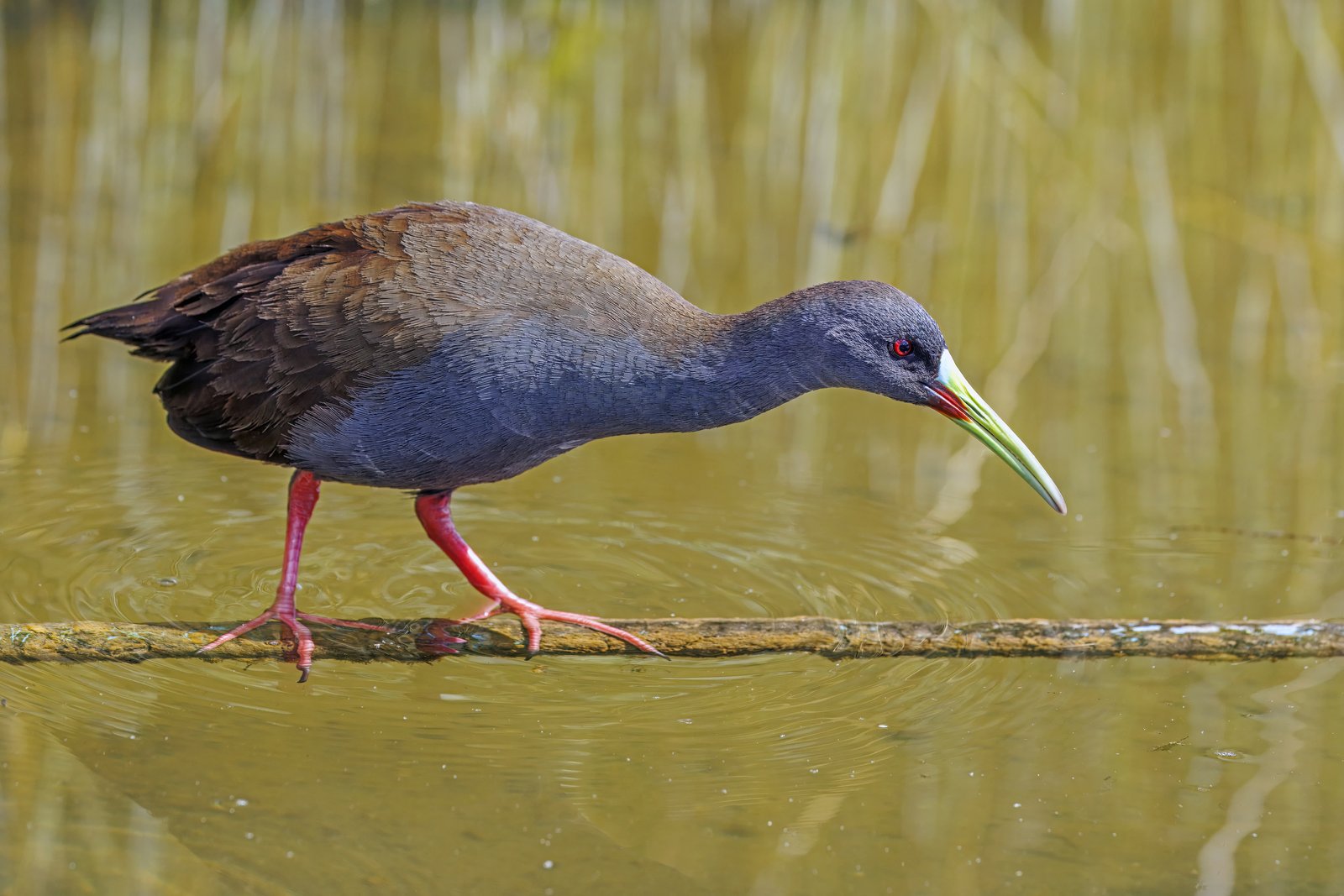
The Plumbeous Rail is the most widespread rail of the highlands and the coast in the south of the guide area. It lives in reedbeds, ditches and wet fields, also close to villages, and comes into the open more often than most other rails. The red and blue spot at the base of the bill is distinctive.
Voice
Loud, screaming and squealing cries, often in duet, which can sound like a shrill chorus; mainly at dusk.
Recording: José Dellacasa Bravo — CC BY-NC-SA 4.0 · xeno-canto
Identification
30–38 cm, with a long, straight bill; birds from the south are larger. The head, neck and underparts are plain leaden grey, the back and wings olive-brown, the tail and undertail coverts blackish. The bill is greenish yellow, with a red spot below and a blue spot above at the base. The iris and legs are red. The sexes are alike; juveniles are duller and browner, with less colour at the base of the bill.
Confusion species
Blackish Rail Pardirallus nigricans is smaller and darker, without the red and blue spot at the base of the bill, and lives on the eastern slope of the Andes and in the lowlands. Spotted Rail Pardirallus maculatus is spotted black and white. Andean Coot Fulica ardesiaca and Common Moorhen Gallinula chloropus swim in open water and have a short bill with a frontal shield.
Habitat
Reedbeds, rush beds, ditches, irrigation channels, wet fields, bofedales and lake shores, from the coast to above 4000 m in the Andes. It searches mud and shallow water for insects, snails, worms and seeds, sometimes also refuse. The nest is a cup of plant material in dense vegetation, just above the water.
Where the bird is most at home, classified by the vegetation units of the Andes and the west coast.


Range and movements
In Ecuador in the Andean highlands. In Peru along the coast and in the Andes over almost the whole country. In Bolivia in the Andes and the dry valleys, locally lower. Absent from Colombia and the Galápagos. Outside the guide area in Chile, Argentina, Uruguay, Paraguay and southern Brazil.
- Resident
- dark = core range, pale = thinly spread
How and when to look
At reed edges, ditches and irrigation channels in the Andean valleys and along the coast of Peru, for example at Pantanos de Villa near Lima and around Lake Titicaca; in the early morning birds often walk over open mud.
Conservation status
Least Concern. The species is widespread and persists in human-modified landscapes as long as wet vegetation remains.
Scientific name
Pardirallus sanguinolentus | (Swainson, 1838)
Swainson described the species in 1838 as Rallus sanguinolentus; because it was later moved to another genus, the author and year stand in brackets. The genus Pardirallus was introduced in 1856 by Bonaparte. The genus name combines Greek pardos, 'leopard', with the genus Rallus. The species name is Latin sanguinolentus, 'blood-stained', probably referring to the red spot at the base of the bill. The specimen the first description was based on came from Brazil and Chile.