All species › Cranes, rails and allies › Rails, gallinules and coots › Blackish Rail
Blackish Rail | Pardirallus nigricans
Rouwral | Rascón negruzco | Saracura-sanã
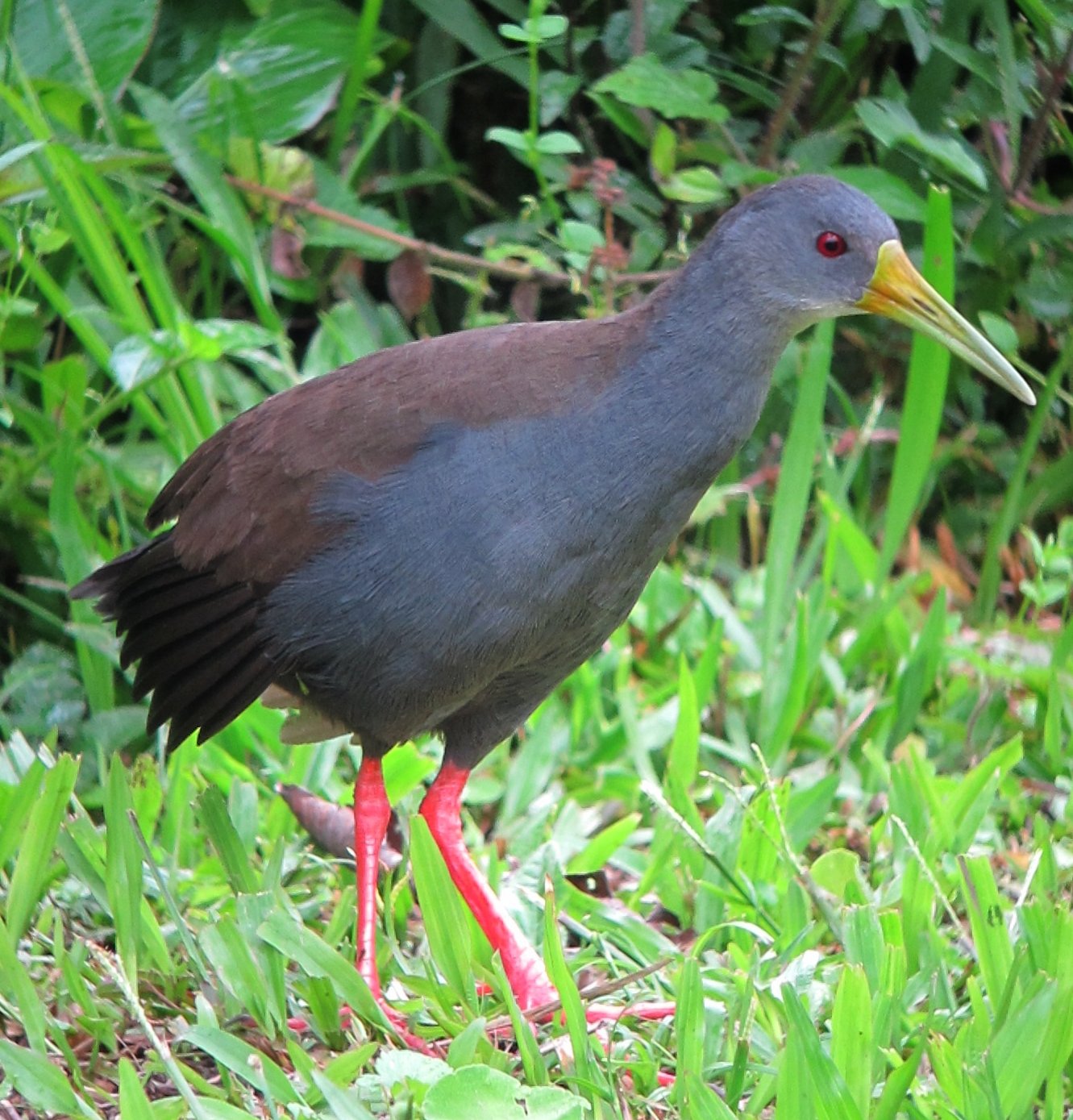
The Blackish Rail is a dark, slender rail of marshes and stream banks on the slopes of the Andes and in the adjacent lowlands. It is slate-grey and olive-brown, without spots, with a long greenish-yellow bill. Its loud, shrill duets usually reveal it before it shows itself.
Voice
A loud, shrill series of high, squealing notes, often in duet, swelling and then fading; also short, sharp calls.
Recording: Marcelo J Feliti — CC BY-NC-SA 4.0 · xeno-canto
Identification
28–32 cm, with a long, straight bill. The head, neck and underparts are dark slate-grey, the throat slightly paler; the back and wings olive-brown. The tail, undertail coverts and rear flanks are blackish. The bill is greenish yellow without coloured spots at the base, and the iris and legs are red. The sexes are alike; juveniles are duller, with a browner tinge to the underparts.
Confusion species
Plumbeous Rail Pardirallus sanguinolentus is very similar, but has a red and a blue spot at the base of the bill and lives mainly in the Andean highlands and along the coast. Spotted Rail Pardirallus maculatus is spotted and barred black and white. Grey-cowled Wood Rail Aramides cajaneus is larger, with a rufous breast and a black rear belly.
Habitat
Marshes, wet pastures, overgrown stream banks, ditches and swampy forest edges, from the lowlands up to about 2000 m on the slopes of the Andes. It searches muddy ground and shallow water for insects, snails and other invertebrates. The nest is a cup of plant material in dense vegetation.
Where the bird is most at home, classified by the vegetation units of the Andes and the west coast.


Range and movements
In Colombia locally on the Andean slopes and in the valleys. In Ecuador on the eastern slope and in the adjacent lowlands. In Peru along the eastern slope of the Andes and locally in the Amazonian lowlands. In Bolivia in the Yungas and the adjacent lowlands. Absent from the Galápagos. Outside the guide area in eastern and southern Brazil, Paraguay and north-eastern Argentina.
- Resident
- dark = core range, pale = thinly spread
How and when to look
Listen in the early morning along overgrown stream banks, wet pastures and small marshes in the foothills of the eastern slope; the bird sometimes steps briefly onto the open edge, especially after rain.
Conservation status
Least Concern. The species persists in human-modified landscapes as long as wet, overgrown patches remain.
Scientific name
Pardirallus nigricans | (Vieillot, 1819)
Vieillot described the species in 1819 as Rallus nigricans; because it was later moved to another genus, the author and year stand in brackets. The genus Pardirallus was introduced in 1856 by Bonaparte. The genus name combines Greek pardos, 'leopard', with the genus Rallus. The species name is Latin nigricans, 'blackish'. The specimen the first description was based on came from Paraguay.