All species › Passerines › Tyrant flycatchers and allies › Black-capped Pygmy Tyrant
Black-capped Pygmy Tyrant | Myiornis atricapillus
Zwartkapdwergtiran | Mosqueta capirotada | Caçula-de-boné-preto
The Black-capped Pygmy Tyrant, at about 6.5 cm and under 6 g, is one of the smallest passerines in the world. In the guide area it lives only in the humid lowlands of the Chocó, from western Colombia to north-western Ecuador.
Voice
A high, insect-like 'cree-eek' or 'tseek' and short, dry trills, often kept up for long periods.
Recording: Juan Freile — CC BY-NC-SA 4.0 · xeno-canto
Identification
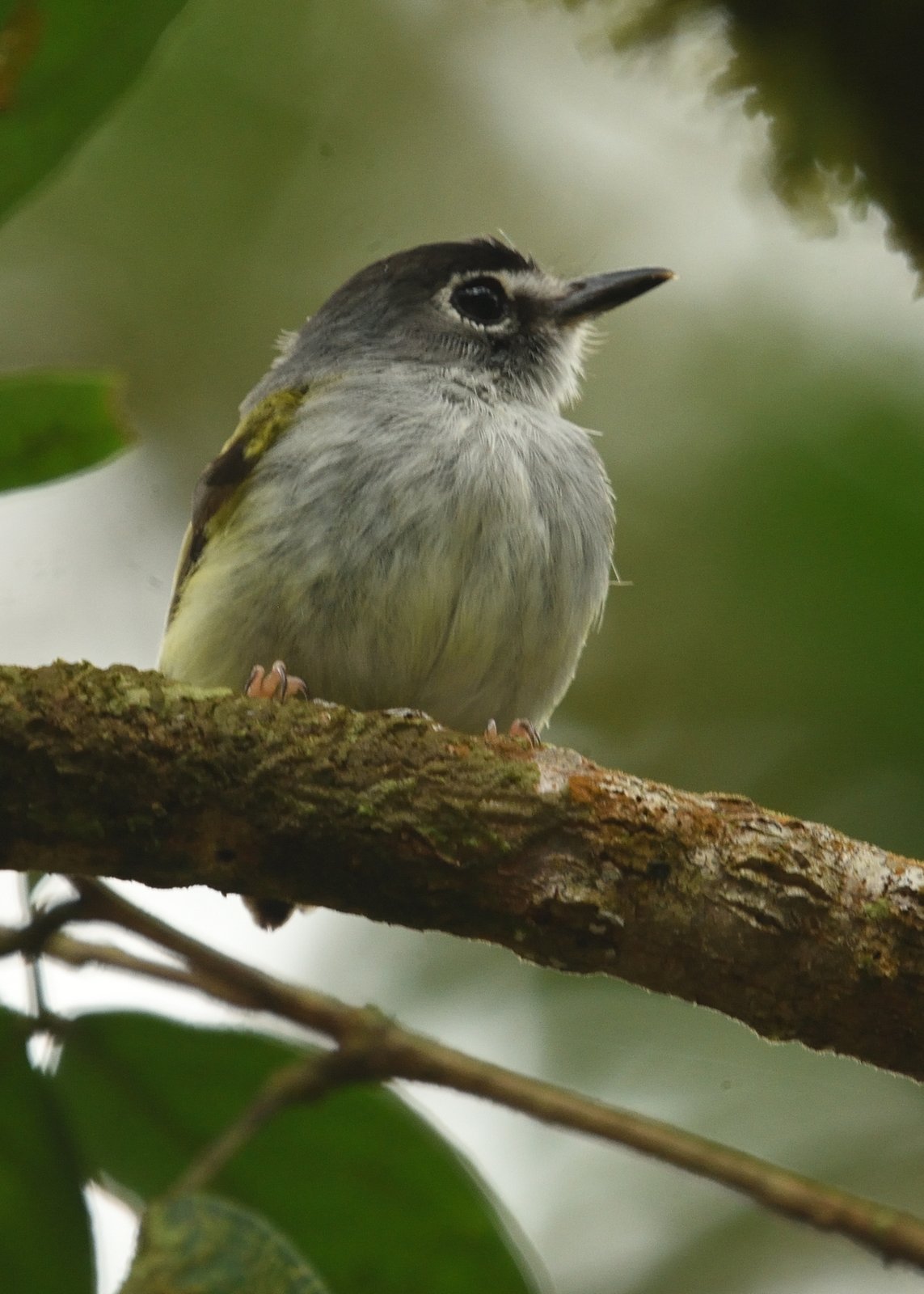
6.5 cm, with a short, flat bill and a very short tail, which makes it look almost round. Males have a black crown, females a dark grey one. The lores and eye-ring are white, the rest of the upperparts bright olive-green. The wings are dusky with yellow edges. The underparts are white, with yellow flanks and undertail coverts. Juveniles are duller.
Confusion species
Southern Bentbill Oncostoma olivaceum is larger, all olive-green with yellowish underparts and a thick, bent bill. Common Tody-Flycatcher Todirostrum cinereum is larger, with a long tail, entirely yellow underparts and a pale eye. Scale-crested Pygmy Tyrant Lophotriccus pileatus is larger, with a crest and a streaked breast, and lives higher.
Habitat
Humid lowland and hill forest, especially forest edges, clearings, tall secondary forest and wooded gardens, up to about 900 m. It keeps high in the middle level and the canopy and catches small insects with quick sallies. The nest is a hanging globular nest with a side entrance.
Where the bird is most at home, classified by the vegetation units of the Andes and the west coast.


Range and movements
Colombia: in the Pacific lowlands and the western foothills of the Chocó, and in the north into the Magdalena Valley. Ecuador: in the north-west, mainly in Esmeraldas and northern Pichincha. Absent from Peru, Bolivia and the Galápagos. Outside the guide area from Costa Rica to Panama.
- Resident
- dark = core range, pale = thinly spread
How and when to look
Listen in the lowlands of Esmeraldas or the Colombian Chocó for the high, insect-like call along forest edges and clearings; the bird often sits high and moves quickly among the leaves.
Conservation status
Least Concern. The species tolerates secondary forest and forest edges, but depends on forest in a region with ongoing deforestation.
Scientific name
Myiornis atricapillus | (Lawrence, 1875)
Lawrence described the species in 1875 as Orchilus atricapillus; because it was later moved to another genus, the author and year stand in brackets. The genus Myiornis was introduced in 1901 by Bertoni. The genus name comes from Greek muia, 'fly', and ornis, 'bird'. The species name comes from Latin ater, 'black', and capillus, 'hair of the head', so 'black-capped'. The specimen the first description was based on came from Talamanca, Costa Rica.