All species › Tinamous › Tinamous › Black-capped Tinamou
Black-capped Tinamou | Crypturellus atrocapillus
Zwartkoptinamoe | Tinamú capirotado | Inhambu-de-coroa-preta
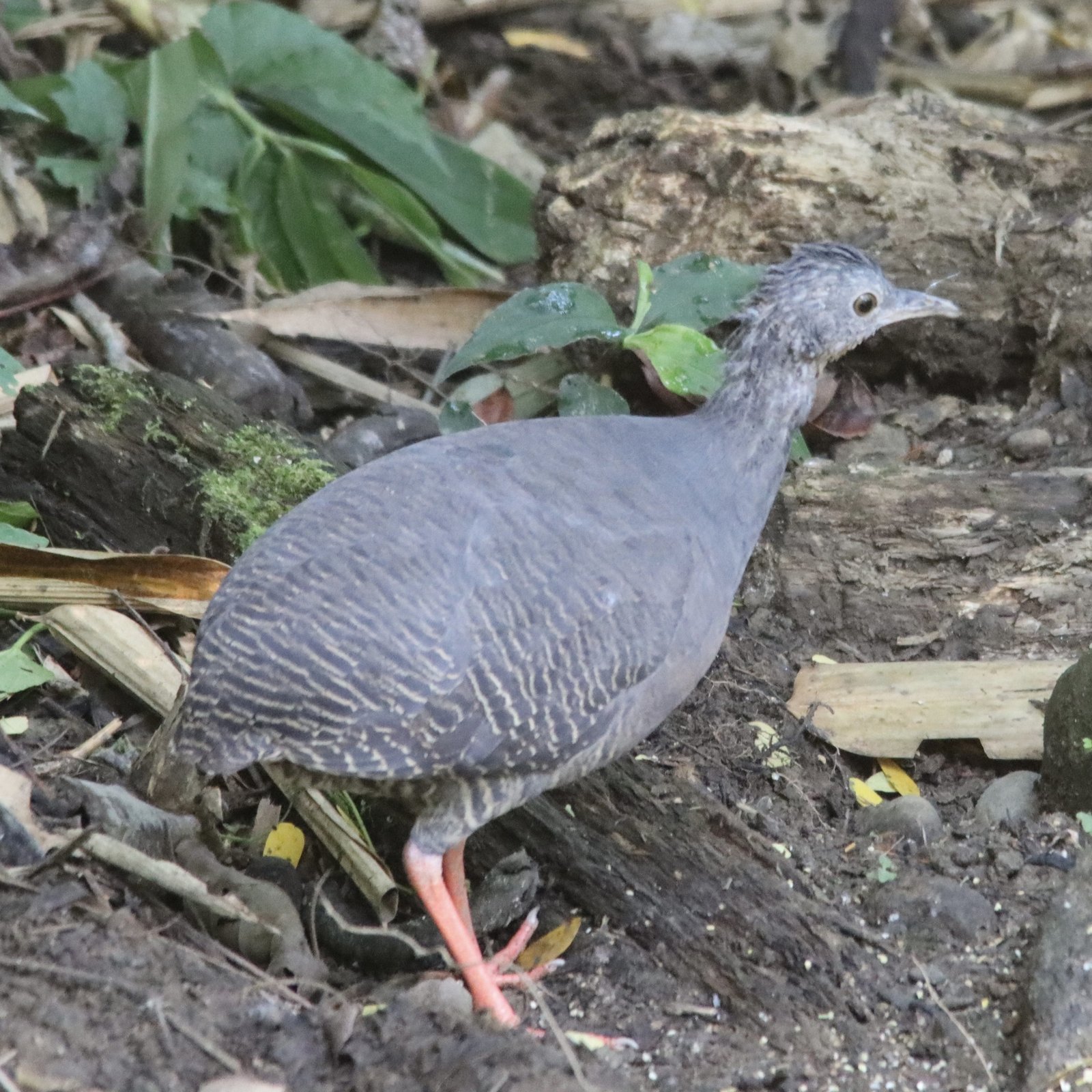
The Black-capped Tinamou is a medium-sized tinamou of south-western Amazonia, with a black cap and red legs. In the guide area it lives in south-eastern Peru and northern Bolivia, often in dense undergrowth and bamboo.
Voice
A long, tremulous, slightly falling whistle, repeated at intervals, mainly in the early morning and at dusk.
Recording: GABRIEL LEITE — CC BY-NC-SA 4.0 · xeno-canto
Identification
28–31 cm, with a small head, a thin neck and almost no tail. The crown and hindhead are black, the throat white, the neck and breast rufous to cinnamon, the belly paler. The upperparts are dark brown; the female has black-and-buff barring on the wings and lower back, the male is plainer there. The legs are red.
Confusion species
Variegated Tinamou Crypturellus variegatus also has a black cap, but a strongly barred back in both sexes and no red legs. Brazilian Tinamou Crypturellus strigulosus lacks the black cap. Little Tinamou Crypturellus soui is smaller and plain. Undulated Tinamou Crypturellus undulatus is larger and greyer, with fine wavy lines.
Habitat
Dense undergrowth in humid lowland and foothill forest, bamboo, forest edges and older secondary forest, also along rivers, up to about 1500 m. It walks on the ground searching for seeds, fruit and invertebrates. The nest is on the ground; the male incubates the eggs.
Where the bird is most at home, classified by the vegetation units of the Andes and the west coast.


Range and movements
In Peru in the south-east, including Madre de Dios, Cusco and Puno. In Bolivia in the northern lowlands and the foothills of the eastern slope. Absent from Colombia, Ecuador and the Galápagos. Outside the guide area in adjacent western Brazil.
- Resident
- dark = core range, pale = thinly spread
How and when to look
Listen in the early morning along forest trails with bamboo or dense undergrowth in Madre de Dios, for example around Manu and Tambopata. The bird usually stays under cover.
Conservation status
Least Concern (LC). Locally reduced by deforestation and hunting, but the range is large and includes large protected areas.
Scientific name
Crypturellus atrocapillus | (Tschudi, 1844)
Tschudi described the species in 1844 as Crypturus atro-capillus; because it was later moved to another genus, the author and year stand in brackets. The genus Crypturellus was introduced in 1914 by Brabourne, WWK-H & Chubb. The genus name comes from Greek kruptos, 'hidden', and oura, 'tail', with the Latin diminutive -ellus: 'little hidden tail'. The species name comes from Latin ater, 'black', and capillus, 'hair of the head', for the black crown. The specimen the first description was based on came from Peru.