All species › Passerines › Antthrushes › Black-headed Antthrush
Black-headed Antthrush | Formicarius nigricapillus
Zwartkopmierlijster | Formicario cabecinegro | Pinto-do-mato-de-cabeça-preta
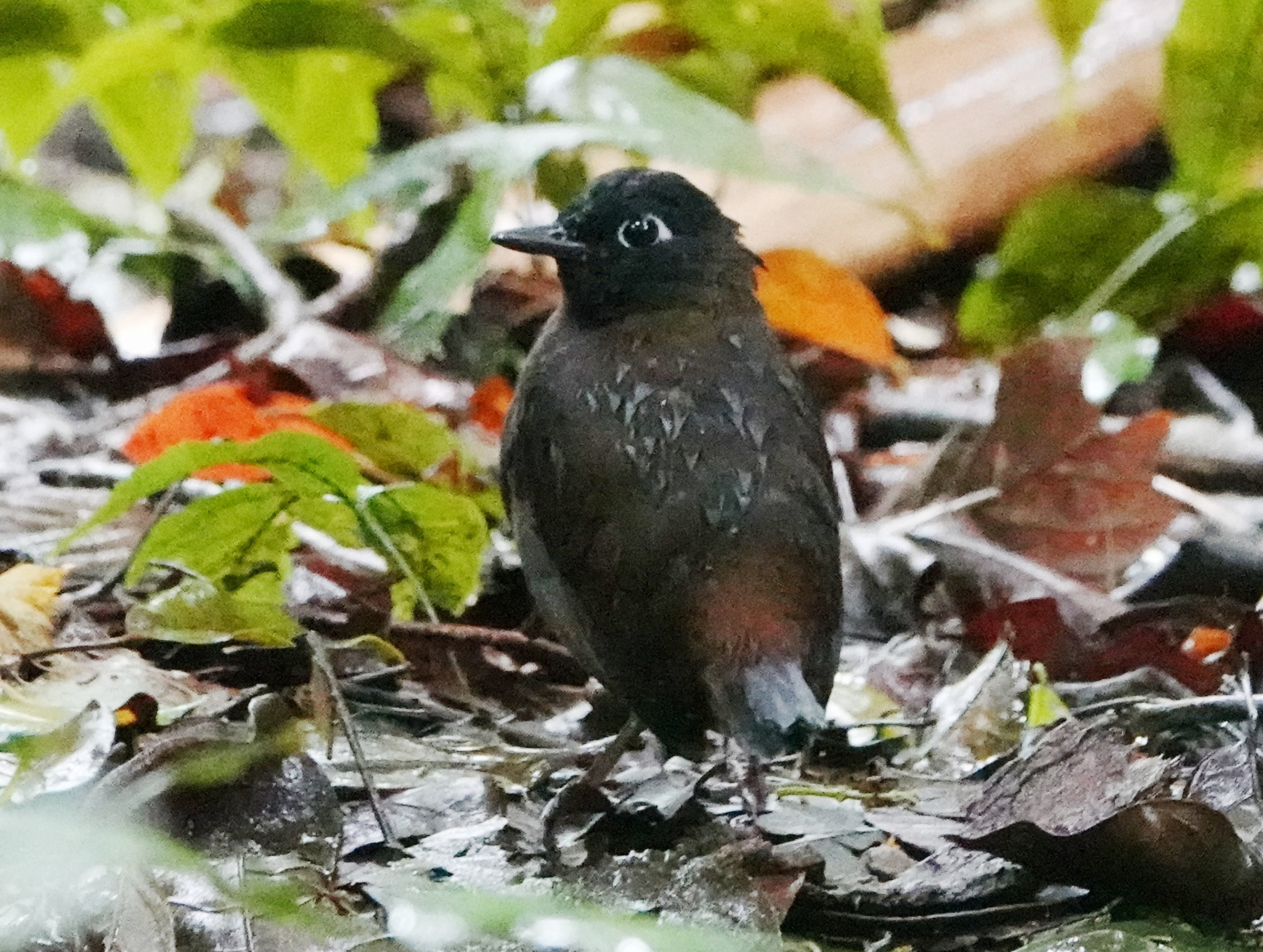
The Black-headed Antthrush is the antthrush of the humid foothills west of the Andes, from Costa Rica to Ecuador. It is darker than the other antthrushes, with a wholly black head and breast. Like all antthrushes it walks over the forest floor with its tail cocked.
Voice
A series of about ten to twenty hollow whistles that gradually increase a little in pitch and volume and end abruptly. The call is a short chuk.
Recording: Juan Freile — CC BY-NC-SA 4.0 · xeno-canto
Identification
18 cm, dumpy, with a short, cocked tail and long legs. Head, neck and breast black; back and wings dark reddish brown. Belly and flanks dark olive-grey to brownish, the undertail coverts rufous. The sexes are nearly alike; the female is slightly duller. Juveniles are duller brownish black.
Confusion species
Rufous-breasted Antthrush Formicarius rufipectus has a rufous breast and usually lives higher in the mountains. Black-faced Antthrush Formicarius analis, in the lowlands of northern Colombia, has only the face and throat black, a rufous neck patch and a grey breast. Short-tailed Antthrush Chamaeza campanisona has pale, streaked underparts.
Habitat
The floor of humid foothill and lower montane forest with dense undergrowth, often in ravines and on steep slopes, roughly between 400 and 1500 m. It walks on the ground, searching for insects and other arthropods in the leaf litter. The nest is in a cavity in a stump or tree.
Where the bird is most at home, classified by the vegetation units of the Andes and the west coast.


Range and movements
Colombia: along the Pacific side of the Andes and in the Chocó. Ecuador: on the western slope, mainly in the northwest, scarcer further south. Absent from Peru, Bolivia and the Galápagos. Outside the guide area in Costa Rica and Panama.
- Resident
- dark = core range, pale = thinly spread
How and when to look
Listen in the early morning in foothill forest on the Pacific side for the series of hollow notes. A bird sometimes crosses a quiet trail; wait by an open patch of forest floor.
Conservation status
Least Concern. The species lives in a narrow elevational belt; clearance of foothill forest on the Pacific side is a local threat.
Scientific name
Formicarius nigricapillus | Ridgway, 1893
Ridgway described the species in 1893 and placed it straight away in the genus where it still stands. The genus Formicarius was introduced in 1783 by Boddaert. The genus name comes from Latin formicarius, 'of the ants', from formica, 'ant'. The species name comes from Latin niger, 'black', and capillus, 'hair of the head': 'black-headed'. The specimen the first description was based on came from Buena Vista, Costa Rica.