All species › Seriemas › Seriemas › Black-legged Seriema
Black-legged Seriema | Chunga burmeisteri
Burmeisters seriema | Chuña patinegra | Seriema-de-pernas-pretas
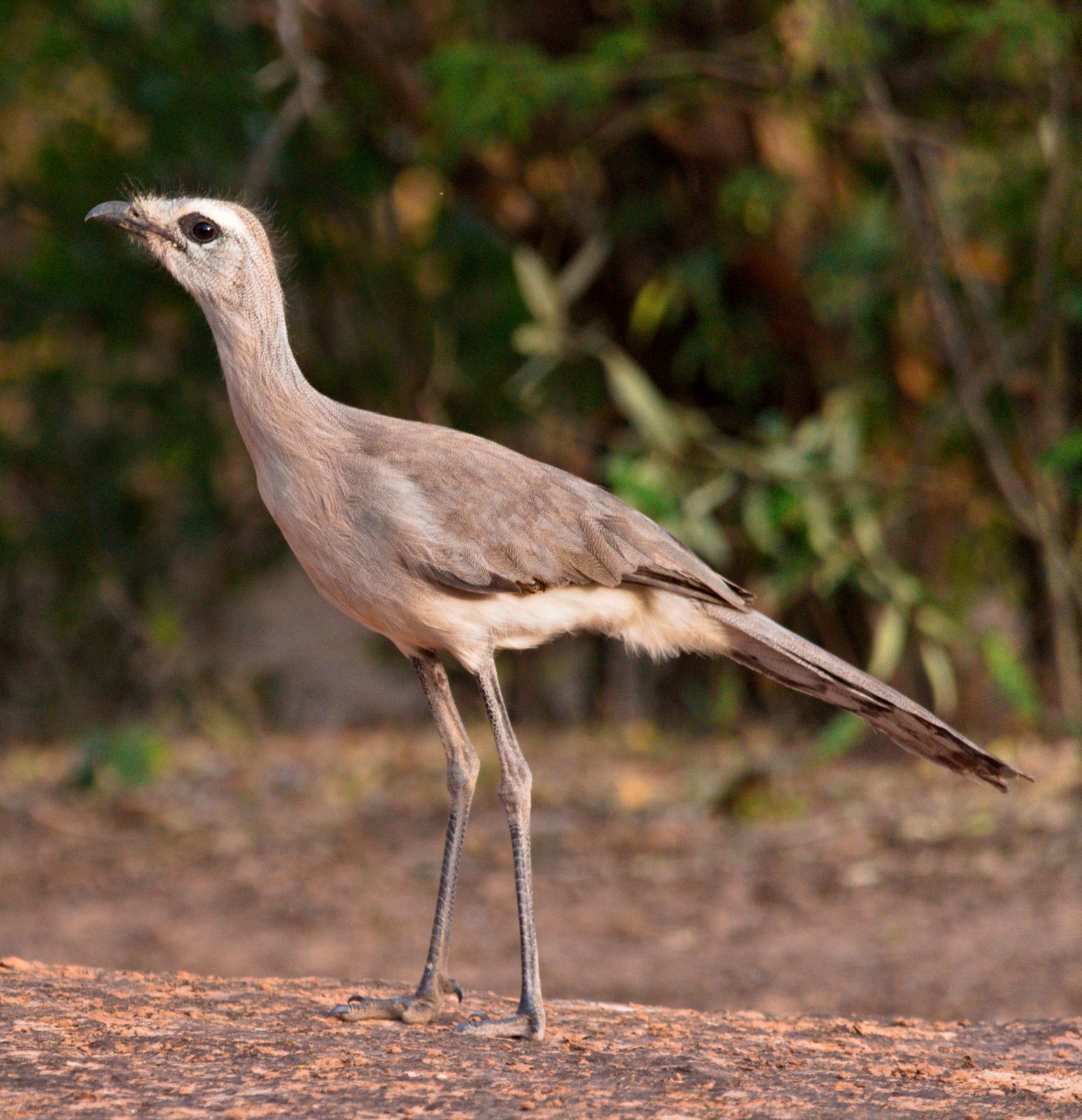
The Black-legged Seriema is a slim, grey, long-legged ground bird of dry Chaco woodland. It is more tied to woodland than Red-legged Seriema and walks through the thorny scrub hunting insects and small vertebrates. At night and when alarmed it takes to a high branch.
Voice
A loud, far-carrying series of high yelping and barking notes, sharper and higher than in Red-legged Seriema, often given as a duet and usually from a tree or bush at dawn.
Recording: Jacob Wijpkema — CC BY-NC-SA 4.0 · xeno-canto
Identification
70–85 cm, with a long neck, long legs and a long, graduated tail. The plumage is rather plain grey, with fine vermiculation on the upperparts and a paler, whitish belly; the tail is barred dark with white tips. Only a few short, bristly feathers stand above the base of the bill, with no obvious crest. The bill and legs are black and the eye is dark. The sexes are alike. Juveniles are browner and more heavily barred.
Confusion species
Red-legged Seriema Cariama cristata is browner and heavier, with a red bill, red legs, a pale eye and an obvious crest, and lives mainly in open savanna and grassland. In the Chaco the two species locally occur side by side; check the colour of the bill and legs.
Habitat
Dry Chaco woodland and thorn scrub, also clearings, grazed woodland and the edges of roads and cleared land in the Chaco, in Bolivia in the lowlands and low foothills. It forages on foot for insects, lizards, snakes and small rodents. It roosts in trees. The nest is a platform of sticks in a tree or bush, usually 2–4 m up.
Where the bird is most at home, classified by the vegetation units of the Andes and the west coast.


Range and movements
In the guide area only in south-eastern Bolivia, in the Chaco of Santa Cruz, Chuquisaca and Tarija. Absent from Colombia, Ecuador, Peru and the Galápagos. Outside the guide area in western Paraguay and northern Argentina.
- Resident
- dark = core range, pale = thinly spread
How and when to look
At dawn in the Chaco south of Santa Cruz, for example around Boyuibe and Villamontes, listen for the yelping duets. Birds often cross dirt roads and then run quickly into the scrub.
Conservation status
Least Concern. Chaco woodland is being cleared rapidly for farming and ranching, which reduces numbers locally; the species is also hunted and trapped.
Scientific name
Chunga burmeisteri | (Hartlaub, 1860)
Hartlaub described the species in 1860 as Dicholophus burmeisteri; because it was later moved to another genus, the author and year stand in brackets. The genus Chunga was introduced in 1860 by Hartlaub. The genus name is the name that Spanish-speaking residents of Argentina gave this bird. The species name honours the German zoologist Hermann Burmeister (1807–1892), who worked in Argentina and gave Hartlaub information about the bird. The specimen the first description was based on came from Tucumán and Catamarca, Argentina.