All species › Seriemas › Seriemas › Red-legged Seriema
Red-legged Seriema | Cariama cristata
Kuifseriema | Chuña patirroja | Seriema
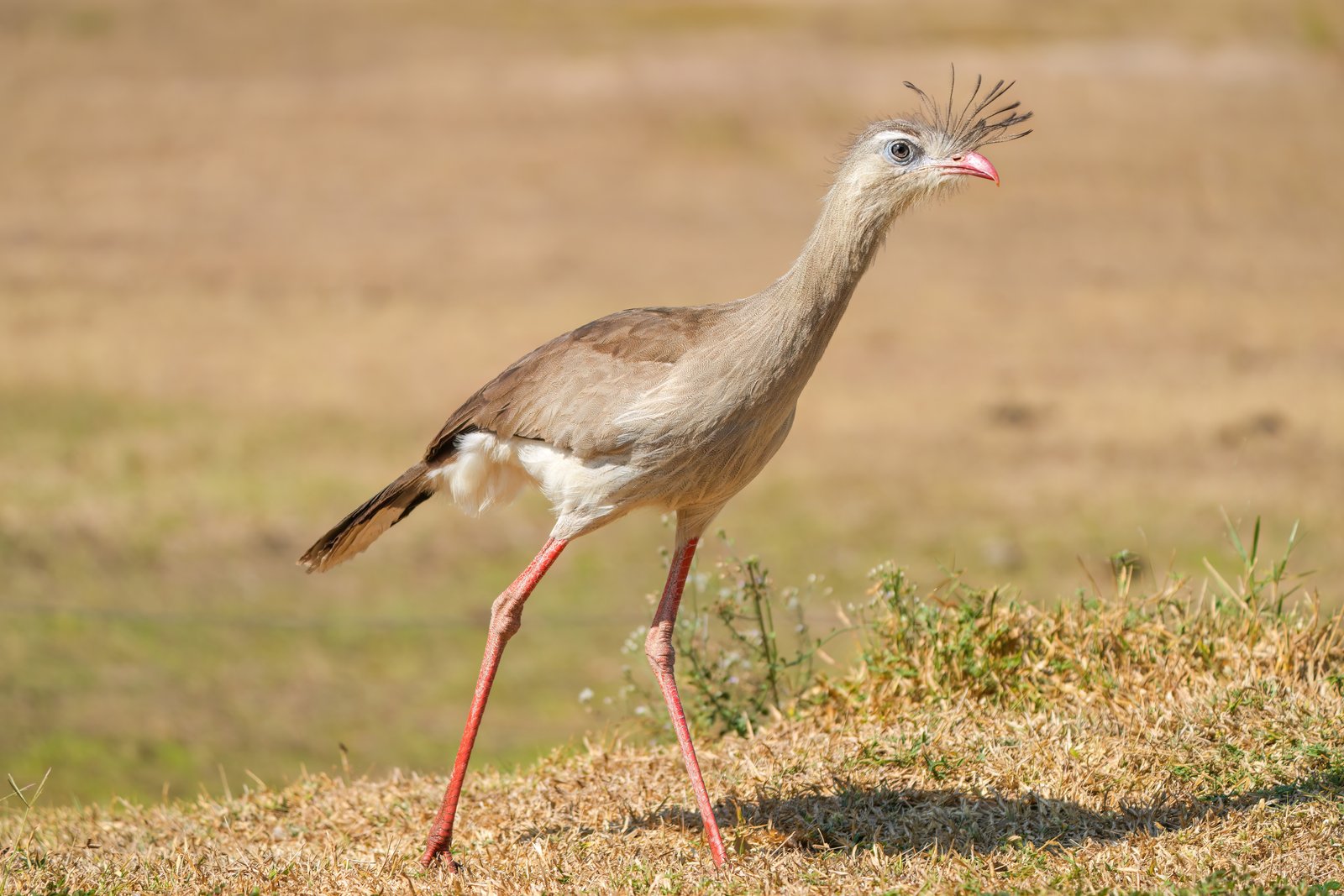
The Red-legged Seriema is a large, long-legged ground bird of open savanna and grassland in central South America. It strides through the grass, rarely flies, and hunts insects, lizards, snakes and small rodents. Its loud, yelping call, often given as a duet, carries for kilometres across the savanna.
Voice
A loud, far-carrying series of yelping and barking notes that rises and then fades, kya-kya-kya-kyaa…; partners and neighbours often call together or in turn, usually from a raised perch such as a termite mound, a post or a treetop.
Recording: JAYRSON ARAUJO DE OLIVEIRA — CC BY-NC-SA 4.0 · xeno-canto
Identification
75–90 cm, with a long neck, long legs and a long tail. An erect crest of loose feathers stands above the base of the bill. The plumage is greyish brown with fine dark vermiculation, and the belly is whitish. The bill and legs are red, the eye is pale and surrounded by bare, bluish skin. The tail has a dark band before a white tip. The sexes are alike. Juveniles are more heavily barred, with a shorter crest and a darker bill.
Confusion species
Black-legged Seriema Chunga burmeisteri is greyer and slimmer, with a black bill, black legs, a dark eye and almost no crest, and lives in dry Chaco woodland. Greater Rhea Rhea americana is much larger and lacks a long tail. Herons such as Cocoi Heron Ardea cocoi walk in water and have a long, pointed bill.
Habitat
Open grassland, savanna and cerrado with scattered trees and shrubs, the edges of dry woodland and extensive pasture, in Bolivia mainly in the lowlands and foothills up to about 1500 m. It forages on foot for insects, snakes, lizards, small rodents and some plant matter; larger prey is beaten on the ground. The nest is a platform of sticks low in a tree or bush, usually 1–3 m up.
Where the bird is most at home, classified by the vegetation units of the Andes and the west coast.


Range and movements
In the guide area only in Bolivia: in the eastern lowlands of Santa Cruz and the savannas of the Beni, south into the Chaco region of Chuquisaca and Tarija. Absent from Colombia, Ecuador, Peru and the Galápagos. Outside the guide area in central and eastern Brazil, Paraguay, Uruguay and northern Argentina.
- Resident
- dark = core range, pale = thinly spread
How and when to look
Drive along open savanna and cerrado in Santa Cruz in the early morning and listen for the yelping duets. Birds often walk along road verges or stand on termite mounds, and run off before taking flight.
Conservation status
Least Concern. The species tolerates extensive pasture and scattered fields, but disappears where savanna is fully converted to intensive agriculture. Birds are trapped or hunted locally.
Scientific name
Cariama cristata | (Linnaeus, 1766)
Linnaeus described the species in 1766 as Palamedea cristata; because it was later moved to another genus, the author and year stand in brackets. The genus Cariama was introduced in 1760 by Brisson. The genus name comes from the Tupi name of the bird (siriema, sariama, çariama), said to mean 'crested'. The species name comes from Latin cristatus, 'crested', after the erect feathers above the bill. The specimen the first description was based on came from northeastern Brazil.