All species › Falcons › Falcons and caracaras › American Kestrel
American Kestrel | Falco sparverius
Amerikaanse torenvalk | Cernícalo americano | Quiriquiri
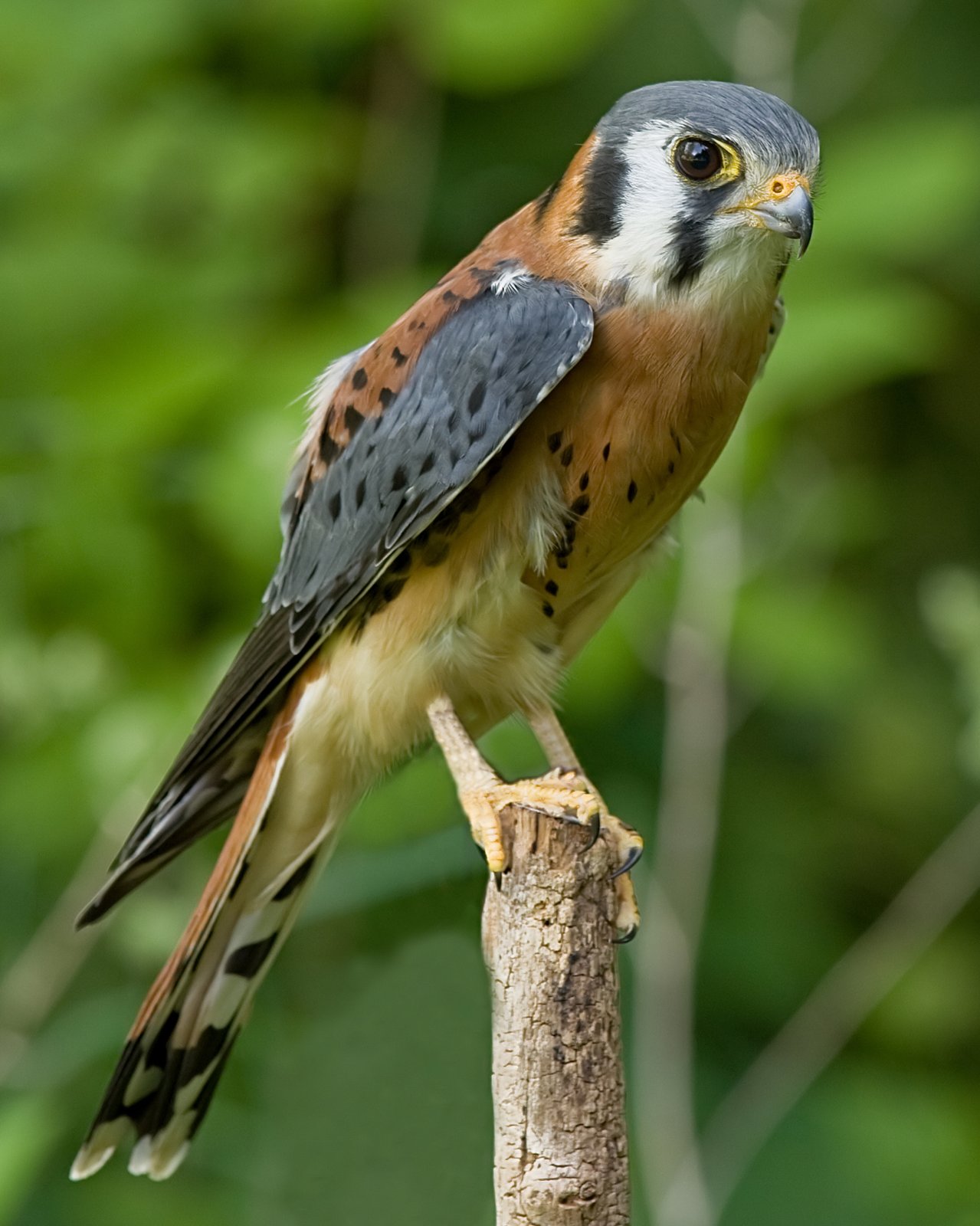
The American Kestrel is the smallest falcon in the guide area and the most widespread falcon of open country in the Andes. It often perches on wires, posts and dead branches and hovers over grassland and fields. It occurs in North and South America from Alaska to Tierra del Fuego, with several subspecies in the guide area.
Voice
A rapid, high series klee-klee-klee-klee, mainly when excited and near the nest.
Recording: JAYRSON ARAUJO DE OLIVEIRA — CC BY-NC-SA 4.0 · xeno-canto
Identification
23–27 cm, with pointed wings and a fairly long tail. The head shows two black vertical stripes, one below and one behind the eye, and a blue-grey crown, often with a rufous patch. The male has blue-grey wings and a rufous back and tail, the tail with a broad black terminal band. The female is larger and rufous with dark barring on the back, wings and tail and brown streaks on the underparts. Across subspecies the underparts vary from almost unspotted to heavily spotted. Juveniles resemble the adults of their sex.
Confusion species
Merlin Falco columbarius is somewhat heavier, darker and plainer above, with only a faint moustache and no rufous back; it does not hover. Aplomado Falcon Falco femoralis is much larger, with a white supercilium, a dark band across the belly and rufous thighs. Bat Falcon Falco rufigularis is darker, with a black vest, and lives mainly near forest.
Habitat
Open and semi-open country: Andean fields and terraces, pasture, dry valleys with scrub, savanna, coastal desert with farmland, villages and cities; from sea level to above 4000 m, most numerous in the highlands. It takes mainly large insects, lizards, small rodents and small birds, from a perch or by hovering. It nests in tree cavities, crevices in cliffs and holes in buildings.
Where the bird is most at home, classified by the vegetation units of the Andes and the west coast.


Range and movements
In Colombia in the Andes, the Caribbean lowlands and the Llanos; in Amazonia locally in open terrain. In Ecuador in the highlands and in the dry west and south-west. In Peru along the coast and in the Andes, scarce in the eastern lowlands. In Bolivia in the Andes and in the savannas of the east. Not on the Galápagos. Outside the guide area from Alaska and Canada to Tierra del Fuego.
- Resident
- dark = core range, pale = thinly spread
How and when to look
Along roads through Andean farmland it often sits on power lines and posts. Look for a small falcon hanging in one spot over a field on rapidly beating wings.
Conservation status
Least Concern. The species benefits from deforestation and agriculture and also occurs in cities.
Scientific name
Falco sparverius | Linnaeus, 1758
Linnaeus described the species in 1758 and placed it straight away in the genus where it still stands. He introduced the genus Falco in that same work. The genus name is Late Latin falco, 'falcon', possibly from falx, 'sickle', after the talons or wing shape. The species name is Medieval Latin sparverius, 'sparrowhawk'. The specimen the first description was based on came from South Carolina, United States.