All species › Falcons › Falcons and caracaras › Merlin
Merlin | Falco columbarius
Smelleken | Esmerejón | Esmerilhão
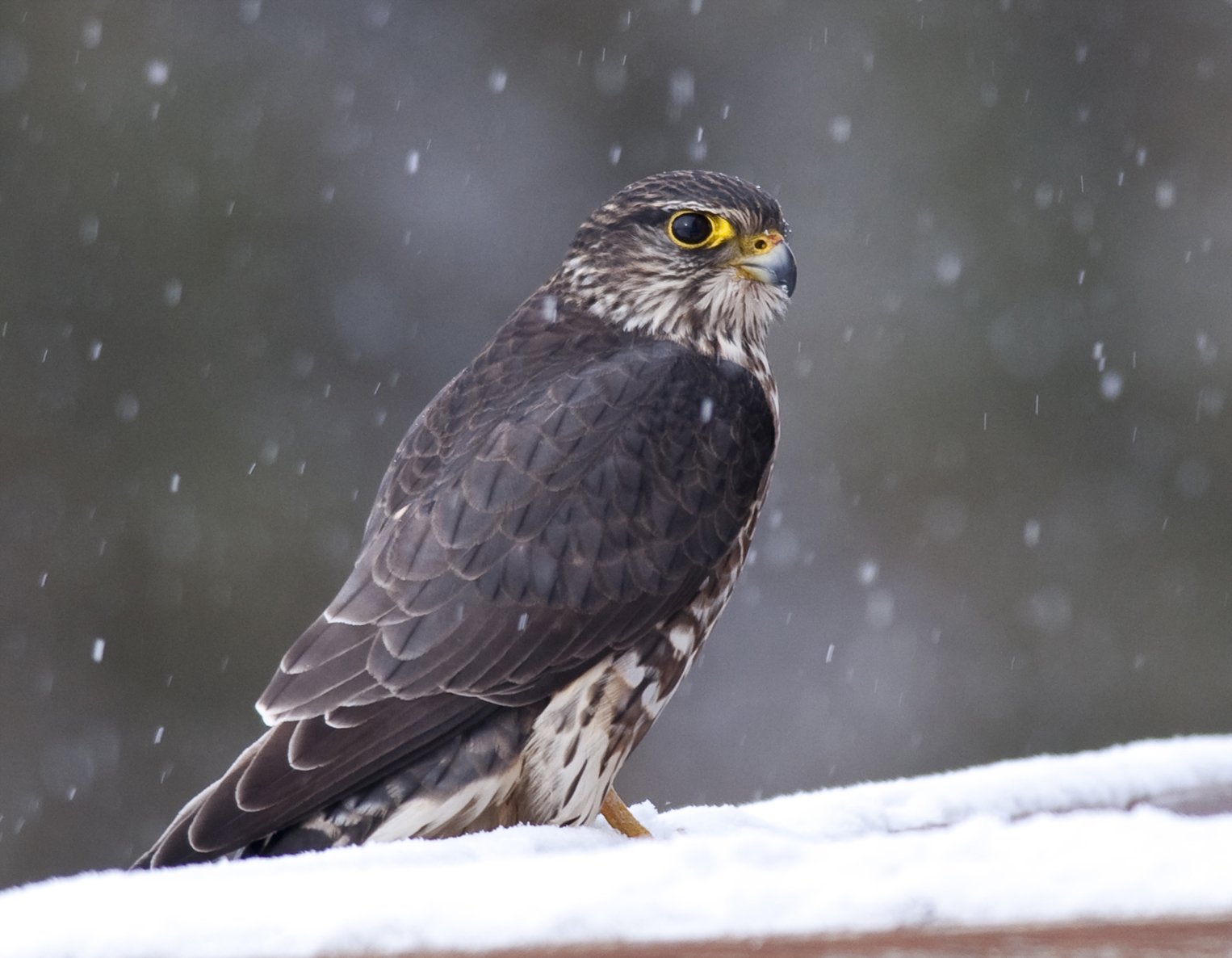
The Merlin is a small, compact falcon that breeds in North America and Eurasia. In the guide area it is a scarce winter visitor from North America, mainly in the north. It hunts small birds in fast, low flight and often surprises its prey by approaching close to the ground.
Voice
Usually silent in the guide area. Sometimes a rapid, shrill series kee-kee-kee.
Recording: Jimmy Utterström — CC BY-NC-SA 4.0 · xeno-canto
Identification
25–30 cm, compact, with fairly short, pointed wings and a medium-length tail. The male is blue-grey above, the female and juvenile dark greyish brown. The underparts are buff to cream with broad brown streaks. The head shows a pale supercilium and only a faint moustache. The tail has broad dark and narrow pale bands. Birds from eastern and western North America differ in colour; western birds are darker.
Confusion species
American Kestrel Falco sparverius is slimmer, with two black stripes on the head and a rufous back and tail, and often hovers. Peregrine Falcon Falco peregrinus is much larger, with a broad, distinct moustache. Sharp-shinned Hawk Accipiter striatus has short, rounded wings and a long tail.
Habitat
Open country with scattered trees: coastal plains, lagoons, salt marshes and tidal areas with shorebirds, pasture, rice fields and farmland, dry forest and town edges; from sea level to high in the Andes. It hunts mainly small birds, which it pursues in fast, direct flight, and also large insects. It often perches on a bare branch or post.
Where the bird is most at home, classified by the vegetation units of the Andes and the west coast.


Range and movements
In Colombia a scarce winter visitor, mainly in the Caribbean lowlands and in the Andes. In Ecuador scarce along the coast and in the highlands. In Peru rare, mainly in the north and along the coast. In Bolivia very rare. Breeds in Canada, Alaska and the northern United States, and also in Eurasia; winters south to northern South America.
- Winter visitor (c. Oct–Mar)
- dark = core range, pale = thinly spread
How and when to look
Between October and April search the Caribbean coast, lagoons and rice fields where flocks of small birds or shorebirds gather. A small, dark falcon flying low and fast over the ground is worth checking.
Conservation status
Least Concern. The North American population recovered after the ban on DDT.
Scientific name
Falco columbarius | Linnaeus, 1758
Linnaeus described the species in 1758 and placed it straight away in the genus where it still stands. He introduced the genus Falco in that same work. The genus name is Late Latin falco, 'falcon', possibly from falx, 'sickle', after the talons or wing shape. The species name is Latin columbarius, 'of doves', after the old name pigeon hawk. The specimen the first description was based on came from South Carolina, United States.